
📊 Full opportunity report: Pesticide-residue Compliance Monitor For Food Importers on IdeaNavigator AI — validation score, market gap, and execution plan.

Get privacy and security gear delivered free with Prime
- Fast, free delivery on millions of items
- Prime Video, Amazon Music and more included
- Member-only deals all year
TL;DR
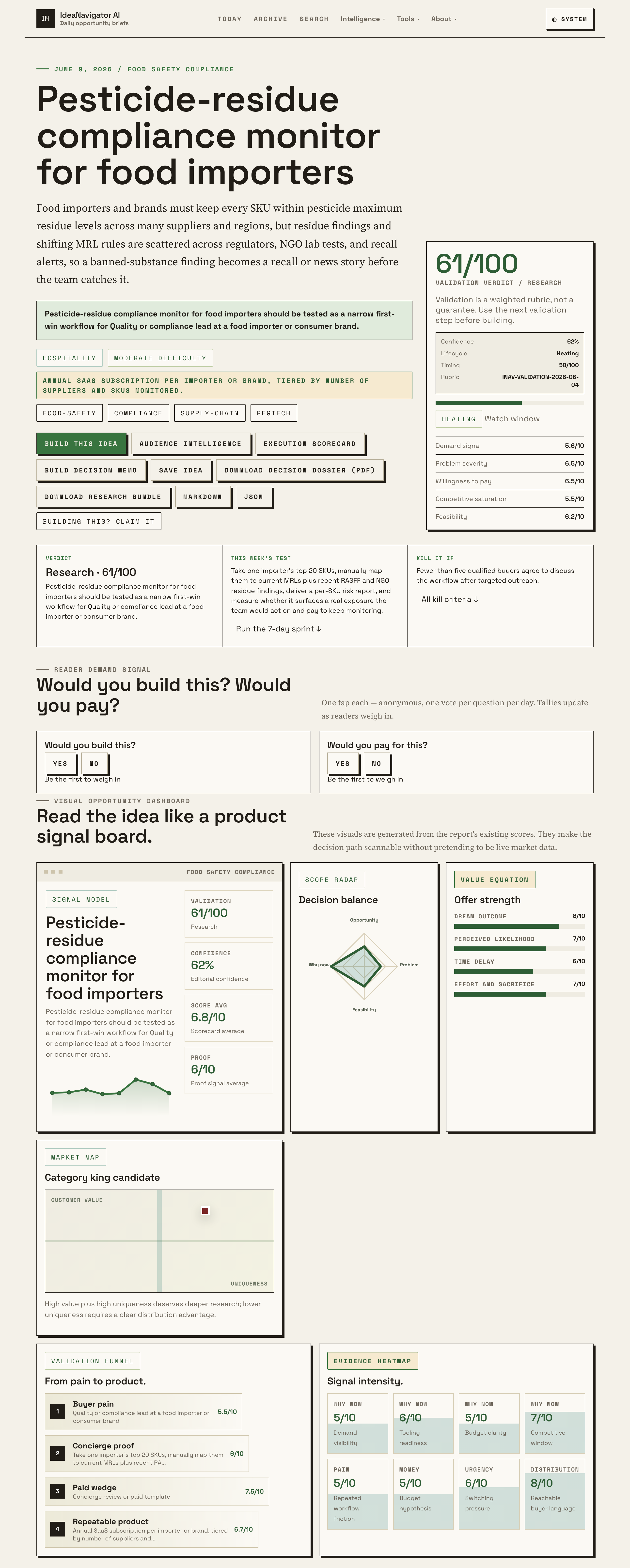
A proposed pesticide-residue compliance monitor for food importers could streamline tracking of residue levels across suppliers and regions. It aims to reduce recall risks and meet tightening regulations. The tool is in development and testing phases.
A new compliance monitoring tool for food importers and brands is in development to automatically track pesticide residue levels across multiple suppliers and regions. This initiative aims to address the challenge of managing increasing regulatory and NGO scrutiny on pesticide residues, which can lead to recalls and reputational damage if not properly monitored.
The proposed pesticide-residue compliance monitor will map a brand’s SKUs to current EU and regional maximum residue levels (MRLs) and cross-reference these with public residue findings, including RASFF alerts and NGO tests. The goal is to flag products at risk of exceeding legal or safety thresholds before they reach consumers.
This tool is designed as a SaaS subscription service, with pricing tiers based on the number of suppliers and SKUs monitored. The initial validation involves analyzing a sample of an importer’s top 20 SKUs, manually mapping them to current MRLs, and comparing these with recent residue findings to assess its effectiveness in surfacing real risks.
Developers aim to create an audit-ready compliance brief for each SKU, simplifying the process of demonstrating regulatory adherence and reducing the likelihood of costly recalls or regulatory penalties.
Implications for Food Importers and Supply Chain Management
This development could significantly improve food safety compliance efforts for importers and brands by providing real-time, actionable insights into pesticide residue risks. It addresses the growing demand from retailers and regulators for documented residue compliance, especially as MRL rules tighten globally.
By proactively identifying at-risk products, companies can avoid costly recalls, protect their brand reputation, and ensure consumer safety. The monitor also offers a streamlined way to demonstrate compliance during audits and regulatory inspections, potentially reducing legal liabilities and operational disruptions.
As an affiliate, we earn on qualifying purchases.
Rising Regulatory and NGO Scrutiny on Pesticide Residues
Over recent years, NGO testing and regulatory agencies have increasingly identified EU-banned pesticides in staple foods such as rice, tea, and spices. These findings have triggered recalls and media coverage, highlighting the need for better residue management within supply chains.
Regulators are tightening MRLs across markets, and retailers now demand documented residue compliance to meet consumer expectations and avoid reputational risks. Currently, monitoring involves manual cross-referencing of lab results, regulatory alerts, and supplier data, which is time-consuming and prone to oversight.
The proposed tool aims to automate this process, providing a comprehensive view of residue risks across multiple sources and facilitating quicker, more informed decision-making.
“The integration of public residue findings with supplier data could revolutionize how importers manage compliance and reduce recall risks.”
— an anonymous researcher
As an affiliate, we earn on qualifying purchases.
Uncertainties Around Implementation and Effectiveness
It is not yet clear how accurately the monitor will identify actual residue violations before they occur, or how well it will integrate with existing supply chain management systems. The validation process is ongoing, and real-world testing results are still pending.
Additionally, questions remain about the frequency of updates needed for MRL data and residue findings, and whether the tool can keep pace with rapidly changing regulations and new residue discoveries.
As an affiliate, we earn on qualifying purchases.
Next Steps for Development and Validation
Developers plan to test the monitor with several importers’ top SKUs, analyzing its ability to surface genuine risks and reduce manual workload. Feedback from these pilots will inform further refinement before broader rollout.
Further validation will involve assessing the tool’s accuracy in predicting residue violations, its ease of integration into existing compliance workflows, and its cost-effectiveness. The goal is to launch a commercially available version within the next 12 months.
food import residue analysis tools
As an affiliate, we earn on qualifying purchases.
As an affiliate, we earn on qualifying purchases.
Key Questions
How will this monitor improve compliance for food importers?
The monitor will automatically cross-reference supplier data with current MRLs and residue findings, flagging at-risk products early to prevent violations and recalls.
What data sources will the monitor use?
It will incorporate EU and regional MRL databases, public residue alerts such as RASFF, NGO testing results, and supplier information.
Will this tool be easy to use for small importers?
The initial design targets scalability with tiered subscription pricing, aiming to be accessible for both small and large importers with varying levels of complexity.
When is the expected launch date?
The developers aim to have a pilot version ready within the next 6 months, with a broader commercial launch targeted within 12 months.
How will this impact regulatory inspections?
The tool is intended to generate audit-ready reports, simplifying compliance documentation and potentially reducing inspection-related disruptions.
Source: IdeaNavigator AI
Halloween Picks
halloween
As an affiliate, we earn on qualifying purchases.