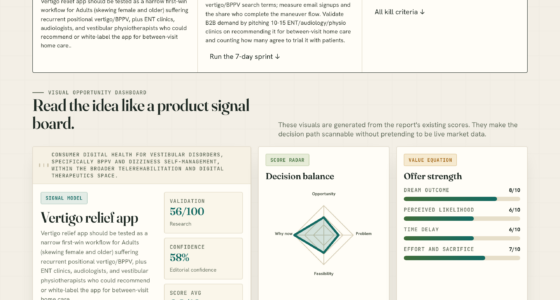
📊 Full opportunity report: Pairing Lab Results With Symptom Tracking During TRT on IdeaNavigator AI — validation score, market gap, and execution plan.

Get privacy and security gear delivered free — and shop member deals
- Fast, free delivery on millions of items
- Access to Prime Big Deal Days deals on October 6–7
- Prime Video, Amazon Music and more included
TL;DR

IdeaNavigator AI has outlined a proposed tracker for men on testosterone replacement therapy, connecting lab results and dose changes with daily symptom check-ins. The concept has not been presented as a launched product or validated service; its proposed test would recruit 300 users and track use for eight weeks.
IdeaNavigator AI’s proposal describes a patient tracker that would link lab results, testosterone dose changes and daily symptom reports for men receiving testosterone replacement therapy (TRT). The concept is framed as an unvalidated first product to test, not a service already available to patients; the proposal says its trial would recruit 300 TRT users and measure app use over eight weeks.
According to the IdeaNavigator AI concept, the proposed app would let users import lab-report PDFs, chart hormone panel results over time and record dose changes alongside daily symptoms. The proposal also describes trend summaries for clinic visits and flags for results that move outside target ranges. It does not specify target ranges, supported lab formats or a clinical review process.
The proposal frames the problem as patients managing periodic tests, prescription adjustments and changing symptoms across clinic portals, PDFs and personal memory. It argues that disconnected records can make it difficult for patients and clinicians to review how reported symptoms relate in time to lab results and treatment changes. This is the proposal’s account of a care gap, not evidence that all TRT patients experience it or that the app would improve outcomes.
The concept outlines a possible business model combining a consumer subscription with a clinic-partnership tier offering patient-monitoring dashboards. Its validation plan calls for recruiting 300 TRT users through hormone-therapy communities, then measuring lab-import rates and weekly check-in retention for eight weeks. The source does not report recruitment, study results, pricing or clinic commitments.
A Test of Connected TRT Records
If developed and adopted, a tracker could give patients a single timeline for test results, dose changes and symptoms to bring into appointments. That could make it easier to discuss when a symptom began or changed relative to a treatment adjustment, instead of relying only on recollection. The proposal does not establish that such a timeline would change prescribing decisions or improve health.
The eight-week test described by IdeaNavigator AI focuses on whether people will use the core features: importing labs and checking in weekly. Those measures could indicate whether the workflow is practical enough for regular use. They would not, by themselves, show that the app is clinically accurate, that its alerts are safe or that it benefits patients.
Fragmented Records Drive the Proposal
The IdeaNavigator AI proposal targets men already receiving TRT who manage treatment and lab monitoring across healthcare providers and digital systems. It identifies fragmented records as the reason to connect data in one view. The proposal cites increased TRT prescribing and telehealth clinics as reasons the need may be timely, but provides no figures or underlying analysis to quantify that trend.
The proposal limits its scope to a patient-facing workflow: importing existing reports, recording doses and symptoms, and preparing summaries. It does not describe a diagnostic tool, a prescribing service or a replacement for clinician oversight. It also does not specify how a clinic dashboard would receive information or who would review alerts.
Clinical Safeguards Remain Unspecified
The IdeaNavigator AI concept provides no evidence from a completed user test, clinical study or product release. It remains unclear how the app would extract values reliably from different lab PDFs, handle missing or inconsistent results, or distinguish a meaningful change from ordinary variation. The proposal also gives no details on how target ranges would be selected and personalized.
Other open questions include how symptom check-ins would be interpreted, who would receive alerts, and what action a patient should take when a value is flagged. The proposal does not describe privacy protections for sensitive health data, integration with clinic systems, subscription prices or criteria for judging the eight-week test. It reports no patient outcomes or clinician endorsements.
User Retention Is the First Milestone
The next step stated in the IdeaNavigator AI proposal is to recruit 300 TRT users from hormone-therapy communities for an eight-week validation effort. The planned measures are lab-import rates and weekly check-in retention. The source provides no launch date, recruitment announcement or results, so it is not clear when or whether the test will proceed.
If the test takes place, those measures would show whether participants use the proposed workflow during the study period. Further evidence would be needed to assess data accuracy, clinical usefulness, privacy practices and whether clinics would adopt a monitoring dashboard. Until those details are reported, the tracker remains a product proposal rather than a tested patient-care tool.
Source: IdeaNavigator AI
Key Questions
Has the TRT tracker been launched?
No launch is reported. The tracker is described as a proposed product concept with an outlined validation plan.
What would the app track?
The proposed app would combine lab results, dose changes and daily symptom check-ins, and create summaries for clinic visits.
How would the concept be tested?
The plan proposes recruiting 300 TRT users for eight weeks and measuring lab-import rates and weekly check-in retention. No results are available in the proposal.
Would the app recommend treatment changes?
The proposal mentions charting results and flagging values outside target ranges, but does not describe treatment recommendations or specify how clinicians would review alerts.
Source: IdeaNavigator AI
Fall Picks
fall essentials
As an affiliate, we earn on qualifying purchases.