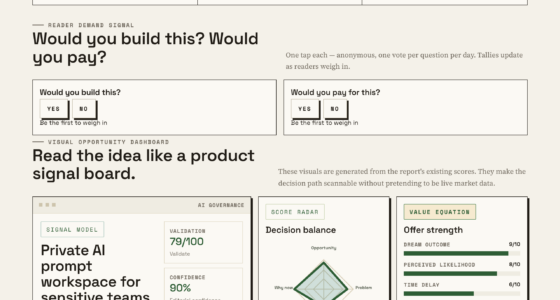

📊 Full opportunity report: Claude Users Are Concerned About Watermarks Limiting Their AI Assistance At Work And School on ThorstenMeyerAI.com — validation score, market gap, and execution plan.

Get privacy and security gear delivered free — and shop member deals
- Fast, free delivery on millions of items
- Access to Prime Big Deal Days deals on October 6–7
- Prime Video, Amazon Music and more included
TL;DR
Anthropic has introduced watermarks in Claude AI outputs to comply with EU transparency rules. Users and institutions express concern over potential detection and privacy implications. Support for older models is still in development.
Anthropic has begun embedding machine-readable watermarks in outputs from supported Claude models, including text and image files, to comply with EU transparency regulations. This change has prompted concern among users who fear that their AI-assisted work could be detected by employers or schools, potentially affecting privacy and policy enforcement.
According to Anthropic, models launched in the EU on or after August 2, 2026, now support embedded watermarks in text, which can persist after copying or editing. These watermarks are designed to be imperceptible and do not alter the content’s meaning or readability. Additionally, supported image files, such as SVG, PNG, and JPG, can carry signed provenance metadata based on the C2PA open standard, indicating whether a file was processed or altered by Claude.
The policy aims to enhance transparency by allowing detection of AI-generated content, but Anthropic clarifies that a detected watermark does not prove misconduct or original authorship. The company is working to add support for older models and plans to provide detection tools for users and third parties, though details remain forthcoming. The initiative aligns with the EU AI Act’s transparency requirements, but its implications extend globally, as supported models will feature watermarks worldwide.
Impact of Watermarks on AI Use in Work and Education
The introduction of watermarks in Claude outputs raises important questions about privacy, transparency, and policy enforcement in workplaces and schools. While intended to identify AI-assisted content, the marks could lead to overreach or misinterpretation, especially since they do not confirm misconduct or original authorship. This development could influence how AI tools are used and monitored, potentially affecting user trust and organizational policies.
As an affiliate, we earn on qualifying purchases.
EU Regulations and the Rise of AI Content Marking
Anthropic’s move follows its signing of the EU AI Act Article 50(2) Code of Practice on transparency. The regulation requires AI providers to embed identifiable marks in generated content to promote accountability. Although driven by European policy, the watermarking system will be implemented globally across supported Claude models, reflecting a broader trend toward transparency in AI deployment.
Prior to this, AI detection relied on probabilistic assessments, which could be unreliable. The new watermarking approach aims to provide a more definitive signal, but technical details and detection accuracy are still under development, leaving some uncertainty about its effectiveness in various scenarios.
“The watermark is embedded within the text and can persist through copying and editing, supporting transparency without affecting content quality.”
— Anthropic spokesperson
laptop privacy screens for students
As an affiliate, we earn on qualifying purchases.
As an affiliate, we earn on qualifying purchases.
Technical Limitations and Detection Reliability
It remains unclear how reliably watermarks can be detected after heavy editing, translation, or reformatting. Technical details about detection accuracy, false-positive rates, and support for older models have not been fully disclosed. Additionally, the impact of watermark removal or obfuscation techniques is still unknown, raising questions about the system’s robustness.
discreet webcam covers for privacy
As an affiliate, we earn on qualifying purchases.
As an affiliate, we earn on qualifying purchases.
Future Developments in Watermark Support and Detection Tools
Anthropic plans to publish technical guidance and detection tools, enabling users, employers, and educational institutions to verify AI-generated content more effectively. The company is also expected to extend support to older Claude models and refine detection mechanisms to improve reliability across various editing scenarios. Monitoring how institutions adopt and interpret watermark detection will be critical in the coming months.
As an affiliate, we earn on qualifying purchases.
Key Questions
Will all Claude outputs automatically contain watermarks?
No. Watermarks are supported in models launched on or after August 2, 2026. Support for older models is still being added.
Can a watermark prove that Claude wrote an assignment?
No. Detection indicates that content may have been processed by Claude, but it does not confirm authorship or policy violation.
Does copying Claude text remove the watermark?
Not automatically. Because the mark is embedded within the text, it travels with copied content, but heavy editing or short excerpts may reduce detection reliability.
Are employers and schools currently able to detect watermarks?
Anthropic says it will support detection tools, but detailed mechanisms are not yet publicly available. Effectiveness in real-world scenarios remains to be seen.
Will the watermarking system be used to monitor policy violations?
While the system can indicate AI assistance, it cannot determine whether use violates policies. Human review and context remain essential.
Source: ThorstenMeyerAI.com
Evergreen bestsellers Picks
bestsellers
As an affiliate, we earn on qualifying purchases.