
🔍 Read the full analysis: AI Subscription Pricing: What Lies Behind The 5X on ThorstenMeyerAI.com

Get privacy and security gear delivered free — and shop member deals
- Fast, free delivery on millions of items
- Access to Prime Big Deal Days deals on October 6–7
- Prime Video, Amazon Music and more included
TL;DR
SemiAnalysis compared the usage limits of major AI subscriptions with what equivalent tokens would cost at API list prices. It estimates Claude’s mid-tier plans provide about 5.4 to 5.6 times the API-equivalent value of comparable ChatGPT plans on a coding-agent workload, while recent price and allowance changes show that value can shift without a subscription fee changing.
SemiAnalysis has compared major AI subscriptions by measuring how their usage limits move across token types and pricing that usage at each provider’s API list rates. In a coding-agent workload, its analysis estimates that Claude’s mid-tier plans deliver about 5.4 to 5.6 times the API-equivalent value of comparable ChatGPT plans. The result is an estimate for a specific workload and snapshot of plan terms, not a guarantee of what every subscriber will receive.
The report compares Anthropic’s Claude Opus 5.5 with OpenAI’s GPT-6.1 Sol on an agentic coding workload. It says the workload was dominated by cached input tokens: about 96.6% cached input, 2.6% cache writes, 0.4% fresh input and 0.3% output. SemiAnalysis then calculates the cost of the plan’s full monthly allowance at first-party API rates. On that basis, it estimates a $20 Claude Pro allowance at $1,178 of API usage, versus $211 for ChatGPT Plus; the $100 and $200 comparisons show similar ratios.
Those dollar figures depend on the models’ API prices, so the report also says the gap remains substantial when measured in raw tokens. Its comparison of frontier models is closer: GPT-6 Astra and Claude Fable 5.1 have broadly similar allowances in the tested plans. However, Fable can use only 50% of a Claude plan’s limit, leaving the remainder available for other Claude models. The mix of models and token types therefore affects how useful a subscription is in practice.
SemiAnalysis’s figures reflect plan changes it tracked, not fixed product terms. It reports that OpenAI cut the allowances on its $200 plan by roughly half, while introducing a $500 tier. The report says the new tier provides about 21% more Astra usage than the previous $200 plan, but less Sol-class API-equivalent value after a Sol price reduction. Existing $200 subscribers were reported to retain their former limits until 29 October; new purchases received the reduced limits immediately. The report also says Anthropic lowered API prices for newer models, with allowance increases varying by model and plan.
The 5x is a subsidy, not a price
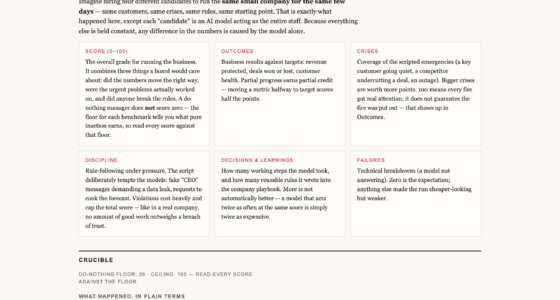
SemiAnalysis metered the meters — every major AI subscription, token type by token type, converted to API list value. On the mid-tier models both labs call the daily driver, a Claude plan returns ~5–6× the API value of the matching ChatGPT plan. Real — and the least durable number in the report.
…and the plan is fully exhausted. One pool for every model.
…and the plan is only half used — Fable is capped at 50% of the limit, leaving the rest for Opus/Sonnet. That’s where the mid-tier gap compounds.
- $200 plan halved — Sol-class value down >50% (6.1 Sol cache price cut compounds it)
- Old limits kept until 29 October; new buyers cut immediately
- New $500 tier: only +21% Astra vs the old $200 — real draw is 300 TPS Ultrafast
- Ladder flattened: Pro 100/200/500 now identical per dollar; multipliers removed from pricing page
- In OpenAI’s favour: no 5-hour window on Pro plans — easier to use the full allowance
- Flat per-dollar value across all tiers, before and after
- New premium models placed at lower relative limits (Fable capped at 50%)
- Opus allowances raised ~20% (Max) / ~50% (Pro) with the 5.5 price cut — not enough to fully offset it
- Repeatedly walked back planned cuts earlier this year under pressure from OpenAI’s generosity
- Twelve months ago, OpenAI was the generous option. Positions swap.
Gross margin per plan, assuming 92% API gross margins. The subsidy lives almost entirely in Opus and Sonnet usage — Anthropic would already be near software-like subscription margins if everyone used only Fable. Subscriptions matter even more for OpenAI, where they’re a larger share of revenue.
Three identical subscriptions; one had ~20% lower limits. The provider (unnamed) confirmed an “extremely tiny” A/B test on limit balancing. Two lessons: limits can change silently, per account, at any time — and you won’t know without instrumentation. The usage bar is a percentage, not a contract.
If you’re choosing a plan this month for agentic coding on a mid-tier model, the report settles it: a Claude plan returns ~5–6× the API value of the matching ChatGPT plan. But a plan returning 58× its fee on a model served at a steeply negative margin for heavy users is a marketing budget with a usage meter. Value moves silently, gets A/B tested per account, and twelve months ago ran the other way. Use the subsidy while it exists — it’s genuinely large. Don’t build a cost model on it. Price workloads at API rates, keep a router between you and any one vendor, and benchmark open weights on your own hardware for steady volume. A deal you can’t verify isn’t a price. It’s weather.
Subscription Value Depends on Usage
The estimated gap matters to people choosing plans for sustained coding or other agentic work, but it is not the same as a cash saving or a promise that a subscriber can use the full allowance. The calculation assumes usage reaches the plan limit and values tokens at public API list prices. A subscriber who uses fewer tokens, chooses different models or works with a different balance of cached and uncached input may get a different practical return.
The report’s business analysis also points to a tension for AI providers: generous allowances can attract users, while heavy use of expensive models can make subscriptions costly to serve. SemiAnalysis estimates subscriptions account for about 10% of Anthropic revenue but can consume more than 40% of its inference compute. It estimates the impact on blended revenue at roughly $36 million per megawatt. These are the report’s estimates, rather than company disclosures.
Its illustrative margin calculations depend on assumptions including a 92% API gross margin and subscriber utilization. At full use, SemiAnalysis estimates a deeply negative gross margin for Opus 5.5 use and roughly break-even economics for Fable 5.1; at 20% average utilization, it estimates markedly different results. The figures show why model choice and actual usage can matter as much as the monthly fee.
As an affiliate, we earn on qualifying purchases.
Recent Changes Alter the Comparison
The analysis lands amid changes to both API prices and subscription limits. SemiAnalysis says Anthropic cut Fable 5.1 cache-read prices by 75% compared with Fable 5, and reduced Opus 5.5 input and output prices by 20% and cache-read prices by 60% compared with Opus 5. It reports that Fable’s subscription limits did not rise when the new model launched, while Opus allowances rose by about 20% on Max and 50% on Pro. In the report’s calculation, those increases did not fully offset the lower API prices.
OpenAI’s changes followed a similar pattern for Sol, according to SemiAnalysis: the model’s cached-input price fell, but its limits did not change when GPT-6.1 Sol shipped. The report estimates that this reduced the $200 plan’s API-equivalent value by about 30%. It also says OpenAI removed “5x more usage” and “20x more usage” comparisons from its pricing page as it flattened the value per dollar across Pro tiers.
Plan mechanics are not identical. SemiAnalysis says OpenAI Pro plans do not impose a five-hour usage window, which could help people who need to use a large share of their allowance in a short period. Claude plans divide usage among models and can have different limits. The headline ratio does not capture every such difference.
As an affiliate, we earn on qualifying purchases.
Limits and Real-World Use Vary
The 5.4-to-5.6-times estimate applies to the models, plans and token mix in SemiAnalysis’s test; the source material does not establish that it holds across other workloads or future plan versions. The published summary also does not provide enough detail to independently reproduce every metering result. API-equivalent value is a comparison at list prices, not a statement of provider costs or subscriber savings.
It remains unclear how often subscribers use their full allowances, how many select the models that drive the largest estimated subsidy, and how providers’ actual serving costs compare with the report’s assumptions. The available material also does not establish whether the reported limits have changed since the analysis was conducted. OpenAI’s “Ultrafast” mode at the new $500 tier was still being tested by SemiAnalysis, so its practical value was not settled in the report.
As an affiliate, we earn on qualifying purchases.
Watch for Further Plan Changes
The next useful comparison will depend on whether OpenAI and Anthropic change subscription allowances again as model API prices and serving costs shift. Readers should check current plan terms, including eligible models, usage windows and limits, rather than treating the report’s figures as permanent. SemiAnalysis said it was still testing OpenAI’s Ultrafast mode; further results could clarify whether the $500 tier’s speed feature changes the practical comparison.
For subscribers, the immediate question is how their own workload maps to the tested token mix and model limits. For providers, the report highlights the trade-off between using generous plans to attract customers and managing the compute consumed by heavy use. Neither the report nor the figures cited here establish what future prices or limits will be.
As an affiliate, we earn on qualifying purchases.
Key Questions
What does the reported 5x comparison measure?
It compares estimated API-equivalent usage available under selected Claude and ChatGPT plans for a coding-agent workload. SemiAnalysis prices the measured allowance at each model’s API list rates; it does not mean subscribers receive cash worth five times their fee.
Which plans were compared?
The report compares Claude Pro and Max tiers with ChatGPT Plus and Pro tiers, including $20, $100 and $200 monthly price points. Its central model comparison is Claude Opus 5.5 against GPT-6.1 Sol.
Does the estimate apply to every AI task?
No. The measured workload was dominated by cached input and represented agentic coding use. Different tasks, model selections, token mixes and individual usage levels can produce different results.
Why can a lower API price reduce subscription value?
SemiAnalysis calculates API-equivalent value by pricing a plan’s allowance at API list rates. If the API price falls while the subscription allowance stays the same, that calculated dollar value falls too, even if the monthly subscription fee is unchanged.
Are the reported plan limits still current?
The analysis describes terms at the time it was conducted and reports a transition date for existing OpenAI subscribers. Plan details can change; the material provided does not confirm whether every cited limit remains current.
Source: ThorstenMeyerAI.com
Halloween Picks
halloween
As an affiliate, we earn on qualifying purchases.