
📊 Full opportunity report: From Practice To Progress: IEP Negotiation Rehearsal For Parents on IdeaNavigator AI — validation score, market gap, and execution plan.

Get privacy and security gear delivered free — and shop member deals
- Fast, free delivery on millions of items
- Access to Prime Big Deal Days deals on October 6–7
- Prime Video, Amazon Music and more included
TL;DR
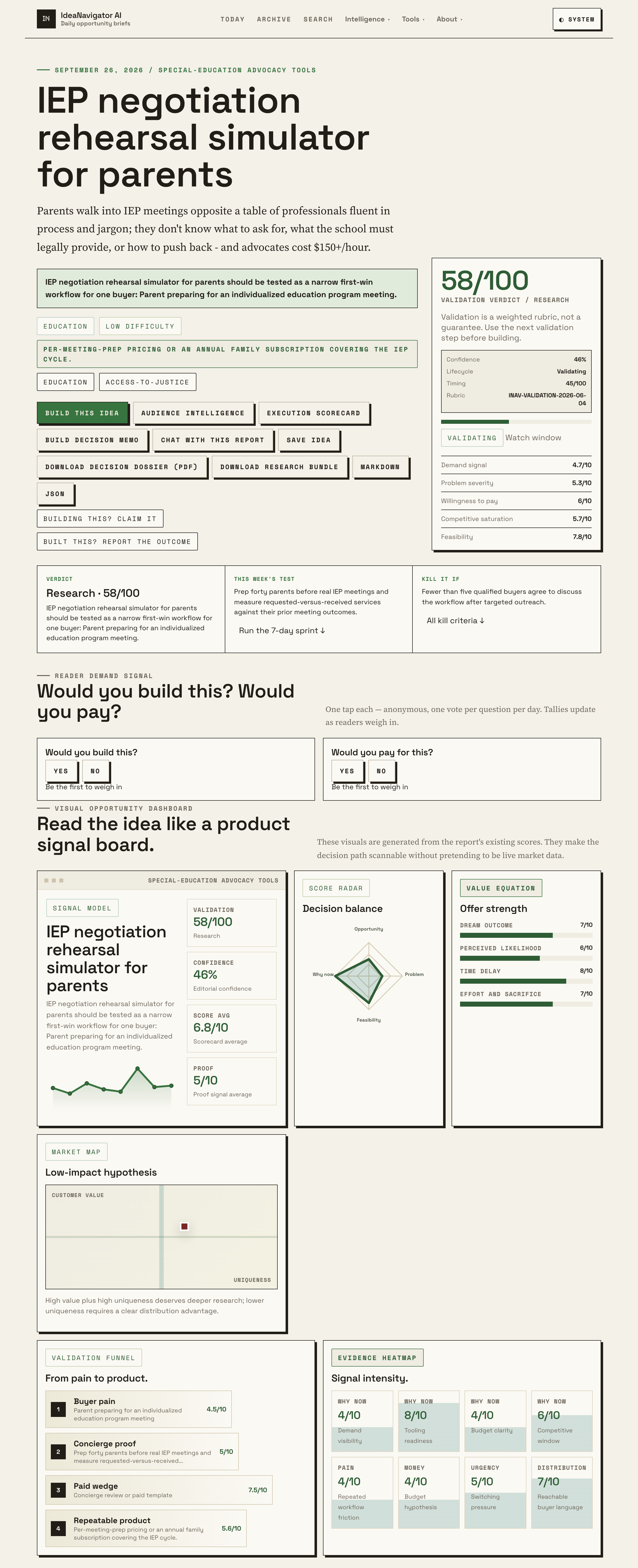
IdeaNavigator AI has outlined an early concept for a simulator that would help parents prepare for individualized education program meetings by reviewing documents and rehearsing requests. No product launch or test results are reported; the proposal recommends testing the workflow with 40 parents before real meetings.
In its proposal, IdeaNavigator AI describes a tool aimed at one user: a parent preparing for an IEP meeting. It would accept the student’s current IEP and evaluation reports, then produce a plain-language explanation of potential entitlements and a list of requests tied to legal requirements. The proposal envisions a simulated meeting in which the parent can practice responding to realistic pushback.
The proposal frames the opportunity around a reported imbalance in familiarity with meeting procedures and terminology: school staff may handle IEP processes regularly, while parents may be preparing for a particular meeting with less experience. It also cites private advocacy costs of $150 or more per hour. The proposal gives no geographic scope, pricing survey or comparison method for that figure.
For an initial test, IdeaNavigator AI recommends preparing 40 parents ahead of real meetings and comparing the services they request and receive with outcomes in earlier meetings. The proposal suggests selling the concept per meeting or through an annual family subscription spanning an IEP cycle. It reports no pilot recruitment, pricing, product availability or measured results.
Preparing Parents for IEP Meetings
If developed and shown to be useful, the simulator could give parents a way to organize questions and practice explaining the support they seek before meeting with school staff. That may be particularly relevant to families who cannot afford private advocacy, although the proposal does not establish how many families face that barrier or whether a simulator could substitute for individualized advice.
Its proposed outcome measure—comparing requested and received services with parents’ prior meeting outcomes—could offer an initial indication of whether preparation changes what happens in meetings. Those comparisons would not by themselves show that the tool caused any difference: student needs, school decisions and the details of each meeting can vary. No evidence is yet provided that parents would receive more services or that those services would be appropriate.
From Document Review to Role-Play
IdeaNavigator AI’s proposed workflow combines document review with conversational practice. A parent would provide an existing IEP and evaluation reports; the tool would turn those documents into a plain-language account, prepare a grounded request list and simulate a discussion until the parent could hold their positions. The proposal asserts that current large language model role-play can produce realistic practice, but identifies no model, test or evaluation.
The proposal places the idea within special-education advocacy tools and argues that rising identification rates and tighter district resources make the timing favorable. It provides no figures, dates or jurisdictions for those trends, so their scale and relationship to meeting conflict cannot be assessed from the proposal. The product remains a suggested opportunity and validation plan.
Legal Guidance and Pilot Results
IdeaNavigator AI reports no prototype, launch, pilot or parent feedback. Its proposal does not explain how the simulator would determine which legal entitlements apply across different jurisdictions, keep guidance current, handle incomplete or sensitive student records, or signal when a family should seek qualified human assistance. It also does not define how it would measure a prior meeting outcome or account for differences between students and schools.
The proposal’s suggestion that IEP meetings are becoming more adversarial is not accompanied by evidence or a defined measure. Likewise, the proposed 40-parent exercise is a recommended test, not a completed study. No results establish whether rehearsing with an AI changes requests, services received or families’ experience.
A 40-Parent Test Proposed
IdeaNavigator AI’s proposal recommends preparing 40 parents for upcoming IEP meetings and comparing their requested and received services with outcomes from their previous meetings. It does not say when recruitment would begin, how participants would be selected, what comparison period would be used or how results would be published.
The proposal leaves open how further development would clarify the tool’s legal references, safeguards for uploaded records and limits on its guidance. Until a pilot or product release is reported, the simulator’s practical value and commercial model remain untested.
Key Questions
Is the IEP rehearsal simulator available now?
IdeaNavigator AI’s proposal describes a product concept and a suggested pilot. It does not report that a simulator has launched or is available to parents.
What would the proposed tool do?
As described in IdeaNavigator AI’s proposal, it would review a parent’s current IEP and evaluation reports, explain potential entitlements in plain language, generate a list of requests with legal grounding and simulate meeting conversations.
Has the simulator been shown to improve services?
No results are reported in the proposal. IdeaNavigator AI recommends testing the approach with 40 parents and comparing requested and received services with prior meeting outcomes.
How much would the tool cost?
IdeaNavigator AI specifies no price in its proposal. It suggests per-meeting preparation or an annual subscription for families.
Source: IdeaNavigator AI
Evergreen bestsellers Picks
bestsellers
As an affiliate, we earn on qualifying purchases.