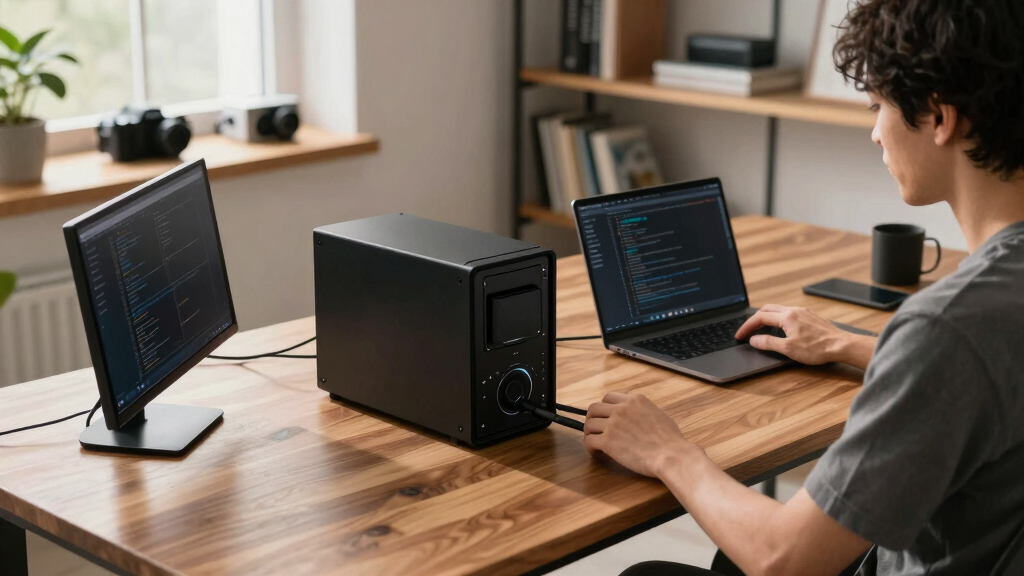

📊 Full opportunity report: The Real Cost of a Local-Inference Rig in 2026 on ThorstenMeyerAI.com — validation score, market gap, and execution plan.

Get privacy and security gear delivered free with Prime
- Fast, free delivery on millions of items
- Prime Video, Amazon Music and more included
- Member-only deals all year
TL;DR
In 2026, building a local AI inference rig involves significant hardware costs, with VRAM capacity being the key factor. Smart buyers focus on VRAM-per-dollar rather than the latest models, making used GPUs a cost-effective choice.
In 2026, the true cost of building a local AI inference rig hinges on VRAM capacity, with hardware choices heavily influenced by the need to fit models within GPU memory limits, rather than raw compute power.
Most AI models in inference are limited by VRAM capacity. For instance, a 70B model requires about 43GB of memory at full precision, making high-end GPUs like the RTX 5090 with 32GB VRAM suitable for some models, but often insufficient for larger ones.
Cost-effective solutions include used GPUs like the RTX 3090, which offers 24GB VRAM at a fraction of the price of newer cards. Four used 3090s can be pooled via NVLink to create a 96GB VRAM setup, enabling the running of larger models at high quality, often for under $3,200.
While flagship cards like the RTX 5090 are capable of running certain models faster, their high cost and diminishing VRAM-per-dollar value make them less attractive for many users. Instead, strategic hardware pooling and used components offer better value for steady, high-utilization inference tasks.
The real cost of a local-inference rig
Owning beats renting for steady AI work — so what does a local rig cost in 2026? The unintuitive, good news: the most expensive build is almost never the smartest one. It all comes down to one rule.
The difference is only whether the weights fit. LLM inference is memory-bandwidth-bound — VRAM capacity is the hard limit you build around. Compute specs are mostly noise.
The squeeze reframes the rig like everything else in this series: discipline beats maximalism. VRAM is exactly the memory under most pressure, so over-buying it is the 128GB-“to-be-safe” trap, only worse per gigabyte. Take the cheap, high-value step to 24GB (the gateway to the 30B class), reach for used 3090s and MoE models, and use quantization to climb a tier without buying silicon. Sized right, the rig pays for itself against the cloud’s ever-rising hidden bill. Next: Apple Silicon’s quiet memory advantage.
Impact of Hardware Choices on Local AI Inference Costs
Understanding the real costs of local inference hardware in 2026 helps users make cost-efficient decisions, avoiding unnecessary expenditure on high-end GPUs that offer limited VRAM advantage. This impacts individual developers, startups, and organizations seeking private, scalable AI deployment without escalating cloud bills.
used NVIDIA RTX 3090 GPU for AI inference
As an affiliate, we earn on qualifying purchases.
As an affiliate, we earn on qualifying purchases.
Hardware Trends and Model Size Constraints in 2026
By 2026, AI models have grown significantly, with 70B+ models requiring extensive VRAM—often beyond what a single consumer GPU can provide. The community has shifted toward optimizing VRAM capacity over raw compute, with strategies like model quantization and multi-GPU pooling becoming standard to manage costs.
Older GPUs, especially used RTX 3090s, remain relevant due to their favorable VRAM-per-dollar ratio, despite being a generation behind the latest flagship models. The importance of VRAM capacity over compute power marks a key trend in local AI deployment.
“A used RTX 3090 offers five times the VRAM-per-dollar of a new RTX 5090, making it the best value for inference at a fixed budget.”
— Community benchmark reports
high VRAM graphics card for AI models
As an affiliate, we earn on qualifying purchases.
As an affiliate, we earn on qualifying purchases.
Remaining Questions About Long-Term Hardware Viability
It is still unclear how rapidly hardware prices will evolve or how new GPU architectures might shift the VRAM-per-dollar balance. Additionally, the impact of future model compression techniques and software optimizations on hardware requirements remains uncertain.
multi-GPU NVLink setup for AI inference
As an affiliate, we earn on qualifying purchases.
As an affiliate, we earn on qualifying purchases.
Upcoming Hardware Developments and Cost-Reduction Strategies
In the coming months, expect further availability of used GPUs, potential price drops in high-VRAM cards, and innovations in model quantization. These developments will influence the most cost-effective configurations for local inference rigs in 2026.
cost-effective AI inference hardware
As an affiliate, we earn on qualifying purchases.
As an affiliate, we earn on qualifying purchases.
Key Questions
What is the most cost-effective GPU for local inference in 2026?
Used RTX 3090s offer the best VRAM-per-dollar value, especially when pooled via NVLink, making them a top choice for budget-conscious inference setups.
How does VRAM capacity affect model performance?
If the model fits entirely in VRAM, inference runs at high speed; spilling into system RAM reduces speed dramatically, often by a factor of 5 to 20, making it impractical for real-time use.
Are flagship GPUs worth the cost for local inference?
While flagship cards like the RTX 5090 can run certain models faster, their high cost and limited VRAM make them less cost-effective compared to pooling multiple used GPUs for most users.
Can Macs or Apple Silicon replace dedicated GPUs for inference?
Yes, Apple Silicon’s unified memory allows large models to run efficiently, but hardware limitations and software support currently restrict its widespread use for the largest models.
What strategies can reduce hardware costs for local inference?
Buying used GPUs, pooling multiple cards with NVLink, and focusing on models that fit within available VRAM are key strategies to minimize expenses while maintaining performance.
Source: ThorstenMeyerAI.com
Halloween Picks
halloween
As an affiliate, we earn on qualifying purchases.