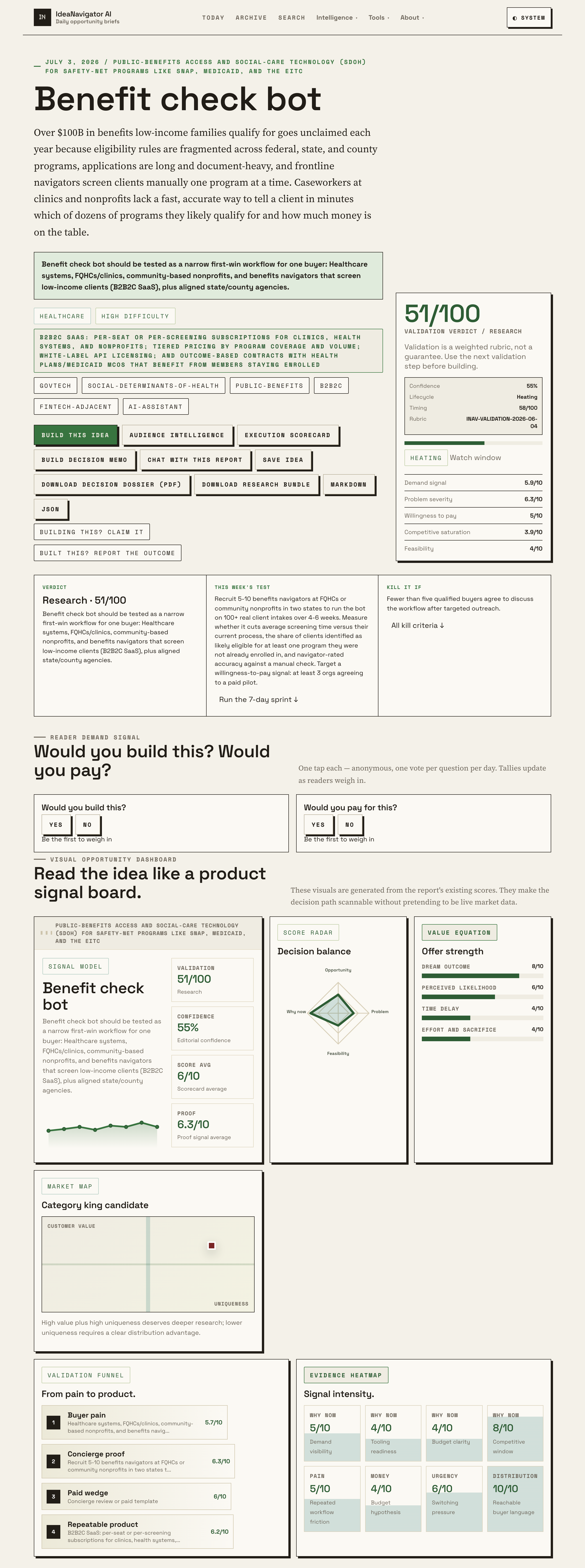
📊 Full opportunity report: Benefit Check Bot on IdeaNavigator AI — validation score, market gap, and execution plan.
Open a free Amazon Business account
Business pricing, bulk buying and tax-exempt orders.
Create a free accountAs an affiliate, we earn on qualifying purchases.
TL;DR
A new AI-powered benefit screening bot is in pilot testing to help clinics and nonprofits identify benefits for low-income clients more efficiently. It responds to a significant gap after a nonprofit closure and the post-pandemic Medicaid redetermination surge.
A new conversational benefits screening bot is entering pilot testing with clinics and nonprofits to help identify programs and benefits for low-income clients more quickly and accurately. This development aims to address a critical gap in benefits access, especially following the closure of a major nonprofit that previously provided similar services and amid increased Medicaid redeterminations post-pandemic.
The benefit check bot is a white-label, AI-driven tool designed to be embedded on healthcare or community organization websites or used via SMS. It conducts brief, branching questionnaires—comprising yes/no and multiple-choice questions—to determine client eligibility for programs such as SNAP, Medicaid, EITC/CTC, WIC, and LIHEAP. The system then provides an estimate of potential benefits, along with next steps and required documentation.
Developed by an initiative inspired by the recent shutdown of a 20-year nonprofit that specialized in benefits enrollment across seven states, the bot aims to fill a capacity gap left in outsourced benefits screening. The tool is initially being tested in two states, with plans to log anonymized screening outcomes, assess accuracy, and measure reductions in screening time. Pilot participants include 5-10 benefits navigators at Federally Qualified Health Centers (FQHCs) and community nonprofits, who will evaluate the tool over 4-6 weeks, focusing on its efficiency and accuracy compared to manual processes.
Revenue models for the system include B2B2C SaaS subscriptions, tiered pricing based on program coverage and volume, API licensing, and outcome-based contracts with health plans and Medicaid managed care organizations. The goal is to offer a scalable, multilingual, near-zero marginal cost solution that improves client access to benefits and reduces administrative burdens.
Why This Benefit Check Bot Matters for Low-Income Populations
This initiative addresses a significant public health and social service challenge: over $100 billion in benefits go unclaimed annually by low-income families due to complex eligibility rules, lengthy applications, and manual screening processes. The shutdown of a longstanding benefits enrollment nonprofit in 2024 has left a capacity gap, especially as post-pandemic Medicaid redeterminations have increased the volume of eligibility checks. The benefit check bot aims to improve screening accuracy and speed, enabling frontline workers to identify benefits more efficiently and help more clients access critical resources.
By leveraging conversational AI, the system could reduce the time required for benefits screening from hours to minutes, increase the number of eligible clients enrolled, and lower operational costs for clinics and nonprofits. If successful, it could transform how benefits access is delivered at scale, especially in underserved communities that rely heavily on safety-net programs.
benefits screening software for clinics
As an affiliate, we earn on qualifying purchases.
As an affiliate, we earn on qualifying purchases.
Background on Benefits Access and Recent Gaps
For years, benefits access for low-income populations has been hampered by fragmented eligibility rules across federal, state, and local programs. Traditionally, caseworkers manually screen clients for each program, a process that is time-consuming and prone to errors. The closure of Benefits Data Trust in 2024, after 20 years of providing benefits enrollment services across seven states, has exacerbated these issues by removing a key capacity for outsourced benefits screening.
Simultaneously, the post-pandemic period has seen a surge in Medicaid redeterminations, with tens of millions of Americans undergoing eligibility reviews. This has increased demand for efficient, accurate screening tools. Advances in conversational AI now make it feasible to deliver multilingual, multi-program screening at near-zero marginal cost, which could significantly improve client outcomes and reduce administrative burdens for providers.
Previous efforts to automate benefits screening have relied on static online forms or manual outreach, but these approaches lack the flexibility and speed of AI-driven chatbots. The new system aims to address these limitations by providing real-time, personalized screening results that can be integrated into existing workflows.
benefits eligibility assessment tools
As an affiliate, we earn on qualifying purchases.
As an affiliate, we earn on qualifying purchases.
Remaining Questions About Implementation and Effectiveness
It is not yet clear how accurately the benefit check bot will perform compared to manual screening, especially across different states with varying eligibility rules. The pilot is still ongoing, and results regarding reductions in screening time, client eligibility detection, and user satisfaction are pending. Additionally, questions remain about scalability, multilingual performance, and integration with existing benefits systems.
healthcare benefits enrollment software
As an affiliate, we earn on qualifying purchases.
As an affiliate, we earn on qualifying purchases.
Next Steps for Pilot Testing and Broader Deployment
The pilot testing phase will involve 5-10 benefits navigators using the system over 4-6 weeks to assess accuracy, efficiency, and user feedback. If results demonstrate significant improvements, the developers plan to expand testing to additional states and organizations, refine the tool based on feedback, and pursue broader adoption through tiered licensing and outcome-based contracts. Success in these pilots could lead to wider deployment across safety-net providers and state agencies.
low-income benefits assistance tools
As an affiliate, we earn on qualifying purchases.
As an affiliate, we earn on qualifying purchases.
Key Questions
How does the benefit check bot work?
The bot conducts a brief, interactive questionnaire asking yes/no and multiple-choice questions to assess eligibility for various programs, then provides an estimate of benefits and next steps.
Who can use the benefit check bot?
It is designed for healthcare systems, clinics, community nonprofits, and benefits navigators working with low-income clients, initially being tested in select states.
What benefits programs does it cover?
The system can screen for programs like SNAP, Medicaid, EITC/CTC, WIC, and LIHEAP, providing benefit estimates and application guidance.
When will the pilot results be available?
Results are expected after the 4-6 week pilot testing period, with broader deployment decisions to follow based on findings.
What are the main challenges ahead?
Key challenges include ensuring accuracy across states, supporting multiple languages, integrating with existing systems, and scaling the solution effectively.
Source: IdeaNavigator AI
College move-in / dorm season Picks
dorm essentials
As an affiliate, we earn on qualifying purchases.