
📊 Full opportunity report: The City That Watches Itself: The Living Digital Twin, and the God’s-Eye View We’re Building on ThorstenMeyerAI.com — validation score, market gap, and execution plan.

Get privacy and security gear delivered free with Prime
- Fast, free delivery on millions of items
- Prime Video, Amazon Music and more included
- Member-only deals all year
TL;DR
Cities are increasingly building dynamic digital twins that integrate real-time data from sensors and AI to monitor and simulate urban environments. This development enhances planning but raises significant surveillance concerns. The technology is rapidly advancing, with key applications and unresolved issues.
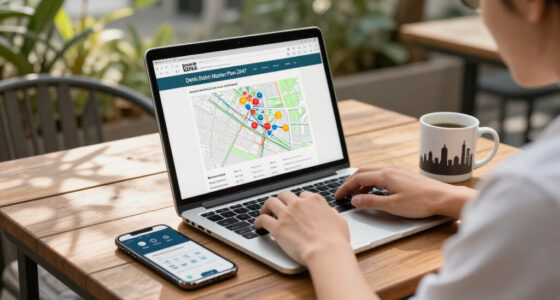
Urban environments are now being represented by living digital twins—dynamic, real-time virtual replicas of cities that integrate data from sensors, satellites, and AI. These models, which can be interrogated in plain language, are transforming city management and planning, but also raising profound surveillance concerns.
The concept of a digital twin involves creating a three-dimensional, live model of a city that reflects current conditions and can simulate future scenarios. Cities like Singapore, Helsinki, and Las Vegas already operate such models, with Singapore’s Virtual Singapore being a notable example, covering buildings, infrastructure, and underground utilities.
Recent technological convergence has enabled these models to become living systems. The integration of Wide-Area Motion Imagery (WAMI) allows continuous tracking of every vehicle and pedestrian, creating a time-scrubbable record of city life. Additionally, all-weather radar and satellite imagery fill in data gaps caused by weather or darkness, making the models more comprehensive.
The AI leap—powered by frontier models capable of understanding heterogeneous data and natural language queries—has shifted these models from static maps to interactive, interrogable urban systems. This allows city officials and planners to simulate scenarios, optimize operations, and answer complex questions about city dynamics in real time.
The city that watches itself: the living digital twin, and the god’s-eye view we’re building
Soon most cities will exist twice — once in concrete, once as a live data model you can rewind, simulate, and question in plain language. Persistent sensing + frontier AI turn the planner’s digital twin into an oracle. The most useful thing we’ve built — and the most powerful surveillance instrument. Both at once.
- Plan better — cities & rural: traffic, zoning, energy, land use
- Emergency response — route crews, one live picture, ~50% faster
- Disaster resilience — simulate, track live, assess damage in hours
- Mass surveillance — track everyone, retroactively, forever
- Pattern-of-life — AI links movements, infers associations
- Social control — no warrant, no suspicion (cf. Baltimore, 2021 ruling)
We’re building a city that watches itself, remembers everything, and can be asked anything. The technology won’t choose between saving lives and ending privacy — we will, through the rules we write now, while the twin is still under construction and the defaults haven’t yet hardened into permanence. WAMI and the living twin open our lives to a view from the heavens that, from the dawn of civilization until a heartbeat ago, was reserved for gods and stars. The question is no longer whether we can see everything — it’s who gets to look, and who watches the watchers.
Implications of Self-Monitoring Urban Models
This technology can support urban planning by enabling more informed decision-making, potentially leading to improved efficiency and infrastructure resilience. It also has applications in rural land management and agriculture. However, these systems also raise concerns related to surveillance and privacy, as they involve continuous data collection on city inhabitants.
The potential for misuse or overreach warrants careful consideration. Governments and private entities could leverage these models for extensive monitoring, which raises questions about privacy rights and data sovereignty. The ability to query and analyze city data using natural language interfaces represents a significant advancement, but also necessitates discussions on ethical use and oversight.
As an affiliate, we earn on qualifying purchases.
Technological Foundations of the Digital Twin Revolution
The development of digital twins in urban environments is driven by advances in sensor technology, satellite imagery, and AI. Cities such as Singapore initiated virtual models following significant flooding events in 2012, aiming to improve disaster response and urban planning. The integration of WAMI sensors, capable of tracking moving objects over large areas, has been a key development, transforming static models into live, interactive systems.
Recent breakthroughs in frontier AI models—such as GPT-5.6—have improved AI’s ability to interpret complex, heterogeneous data streams. These advancements enable models to understand scenes, recognize patterns, and respond to natural language queries, making the concept of a city oracle more feasible and accessible as a source of urban knowledge.
“The convergence of sensors, AI, and data fusion is transforming cities into data-driven environments.”
— Thorsten Meyer, AI researcher
As an affiliate, we earn on qualifying purchases.
Unresolved Risks and Ethical Concerns
While technological capabilities are advancing, several issues remain to be addressed. It is unclear how privacy protections will be implemented or enforced, and how regulations will govern the use of these surveillance systems. The security of AI models against manipulation or misuse is also a concern. Additionally, questions about data sovereignty and reliance on foreign AI providers are ongoing topics of discussion.
AI-powered city monitoring devices
As an affiliate, we earn on qualifying purchases.
As an affiliate, we earn on qualifying purchases.
Next Steps in Developing and Regulating Urban Digital Twins
Future efforts will focus on improving sensor networks and AI understanding to enhance system accuracy and reliability. Policymakers and developers will need to establish privacy safeguards and regulatory frameworks to prevent misuse. International cooperation may be necessary to address sovereignty issues and promote ethical deployment. Transparency and public engagement will be important as these systems become more integrated into urban environments.
As an affiliate, we earn on qualifying purchases.
Key Questions
How do digital twins improve city planning?
They allow urban planners to simulate potential changes, assess impacts, and optimize infrastructure projects before implementation, which can improve efficiency and reduce errors.
What are the privacy risks associated with living digital twins?
They involve continuous data collection on city residents, which raises concerns about privacy and potential misuse of data by authorities or third parties.
Are these systems vulnerable to hacking?
As with any connected system, cybersecurity is a concern, and measures need to be in place to protect sensitive infrastructure data from malicious attacks.
Will cities become fully transparent and monitored?
The extent of monitoring depends on policy decisions; the technology enables pervasive data collection, but regulatory frameworks will determine its scope.
Who controls the data and AI models used in these digital twins?
Control varies by city and provider, with ongoing discussions about reliance on foreign AI firms and issues of data sovereignty.
Source: ThorstenMeyerAI.com
Halloween Picks
halloween
As an affiliate, we earn on qualifying purchases.