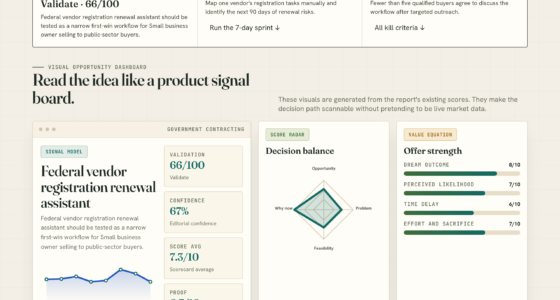
📊 Full opportunity report: Celebrating A Kidney’s 100Th Birthday Through A Consumer Health Lens on IdeaNavigator AI — validation score, market gap, and execution plan.

Get privacy and security gear delivered free — and shop member deals
- Fast, free delivery on millions of items
- Access to Prime Big Deal Days deals on October 6–7
- Prime Video, Amazon Music and more included
TL;DR

IdeaNavigator AI has framed a story about a kidney donated to a teenager reaching its 100th birthday as a test case for a proposed consumer-health and safety signal monitor. The proposal is to deliver short, role-specific briefs to safety and compliance leads; no pilot results, customer decisions or product launch are reported.
IdeaNavigator AI has proposed testing a news-monitoring service for safety and compliance leads at consumer-health and food brands, using a story described as a kidney donated to a teenager reaching its 100th birthday as a sample item. The proposal is a product concept and validation plan, not evidence that the monitor has launched or that the story prompted a business or medical decision.
The proposed monitor would watch Hacker News and similar feeds for health, safety and contaminant developments, then filter items according to their relevance to a particular buyer: a safety or compliance lead at a consumer-health or food company. Each item would be condensed into a brief explaining what changed, why it matters and what to do. The kidney-anniversary story is presented as an example of the kind of item the service might process.
IdeaNavigator AI says the problem it wants to address is that relevant findings and reports appear across news, forums and filings, making it difficult for a designated lead to identify developments that affect their work. The proposal argues that a same-day, role-filtered read could be more useful than waiting for a general weekly roundup. That is the rationale for the product, not a measured comparison of response times or outcomes.
The suggested business model is a subscription for the target professional. To test demand, the proposal calls for delivering a brief and two additional health, safety or contaminant items to five people who fit the intended buyer profile during the current week. It suggests tracking whether recipients change a decision or forward a brief to a colleague. No results from that test are included.
Testing Relevance for Compliance Teams
The proposal focuses on a practical workplace problem: professionals responsible for safety or compliance may need to sift through information from sources that are not organized around their responsibilities. A service that reliably identifies relevant items could help them decide what deserves review, escalation or no action. The key value would be relevance and decision support, rather than simply collecting more headlines.
For consumer-health and food businesses, health and contaminant reports can have implications for product oversight and internal review. But the material does not establish that the particular kidney story has a direct connection to product safety or compliance. Its role here is as a sample signal in a proposed workflow. Whether this kind of story is useful to the intended buyer is precisely something the suggested interviews and forwarding or decision-change measures would need to test.
The small proposed test also matters because it distinguishes a product hypothesis from demonstrated demand. Five targeted recipients could offer early qualitative feedback, but that would not by itself show broad market need, willingness to pay or the monitor’s accuracy. The proposal names subscription interest and changes in work behavior as questions to investigate, not established outcomes.
health safety news monitor subscription
As an affiliate, we earn on qualifying purchases.
As an affiliate, we earn on qualifying purchases.
From Story Signal to Product Test
The idea is framed around a specific buyer rather than a general audience: safety or compliance leads at consumer-health or food brands. The proposed first version would monitor selected online feeds and turn potentially relevant items into concise action-oriented summaries. That narrow scope is intended to test whether filtering by role makes a news alert more useful than an undifferentiated roundup.
IdeaNavigator AI reports that Hacker News surfaced the example with an 88/100 signal. The material does not explain how that score is calculated, what it measures, or the comparison baseline and time window. It should therefore be read only as a score reported in the proposal, not as evidence of rising interest, urgency or market demand.
The specific story is identified by its headline-like description, “Celebrating the 100th birthday of the kidney donated to him as a teenager.” No underlying article, recipient identity, donation date, medical history or reporting organization is supplied in the proposal. The article therefore cannot establish the details of the transplant story independently or add medical claims beyond the description given.
As an affiliate, we earn on qualifying purchases.
Pilot Results and Story Details
No pilot has been reported, and there is no evidence here that any safety or compliance lead has changed a decision, shared a brief or agreed to pay for a subscription. The planned five-person test is a suggested validation step, not a completed study. Its timing is described as “this week,” but no calendar date, participant list or delivery schedule is given.
It is also unclear how the proposed monitor would judge whether a development affects a specific company, how it would verify claims across forums and filings, or how it would handle false alarms and omissions. The proposal does not provide details on coverage, editorial review, alert frequency, pricing, data sources beyond Hacker News and similar feeds, or safeguards for uncertain reports. The kidney story’s underlying facts and its direct relevance to consumer-product safety are also not established in the available description.
As an affiliate, we earn on qualifying purchases.
Five-Person Validation Test
The next step described by IdeaNavigator AI is to deliver the kidney-story brief alongside two other health, safety and contaminant items to five people matching the proposed buyer profile. The test would look for concrete signs of usefulness, especially whether an item changes a decision or is forwarded to a colleague.
Those observations could help determine whether the service should be developed further and which kinds of findings merit attention. Until results are reported, the monitor remains a proposed concept; its accuracy, commercial demand and effect on workplace decisions remain open questions.
Source: IdeaNavigator AI
consumer health risk alert service
As an affiliate, we earn on qualifying purchases.
As an affiliate, we earn on qualifying purchases.
Key Questions
What is the proposed news monitor?
It is a concept for tracking health, safety and contaminant information in Hacker News and similar feeds, filtering it for consumer-health and food-brand safety or compliance leads, and summarizing relevant items in short action-oriented briefs.
Has the kidney story been verified in this report?
The available description identifies a story about a kidney donated to a teenager reaching its 100th birthday, but it does not provide the underlying article or supporting details. The recipient and medical history are not specified, so those details cannot be confirmed here.
Does the proposal show that the story affected product safety?
No. The story is offered as a sample item for testing a monitoring workflow. No direct connection to a product, contaminant finding or compliance decision is documented.
What would the proposed validation test measure?
IdeaNavigator AI suggests sending briefs on three items to five target professionals and checking whether recipients change a decision or forward an item to a colleague. No test results have been reported.
Is the monitor available as a paid service?
The proposal names a subscription as a possible business model, but it does not report a launch, pricing or paying customers.
Source: IdeaNavigator AI
Halloween Picks
halloween
As an affiliate, we earn on qualifying purchases.