
🔍 Read the full analysis: 8 OLED Gaming Monitors To Put On Your List For Immersive Play In 2027 on ThorstenMeyerAI.com

Get privacy and security gear delivered free — and shop member deals
- Fast, free delivery on millions of items
- Access to Prime Big Deal Days deals on October 6–7
- Prime Video, Amazon Music and more included
TL;DR
A source article recommends eight OLED gaming monitors for different setups, from fast 27-inch QHD screens to 4K and ultrawide displays. The list is a buying guide, not confirmation of 2027 prices, availability or newly announced products; buyers should match resolution and size to their hardware and desk.
The ThorstenMeyerAI.com buying guide has listed eight OLED gaming monitors for players planning a 2027 setup, led by the ASUS ROG Strix XG27AQWMG, a 27-inch QHD model rated at 280Hz with a Tandem OLED panel. The recommendations span competitive 27-inch screens, a 32-inch 4K display and curved ultrawides, but the source does not establish 2027 pricing, availability or whether every model will remain on sale then.
The guide ranks models according to the kind of gaming setup they suit rather than treating size or resolution as an automatic measure of quality, a useful contrast with other OLED gaming monitor picks. It identifies the ASUS as its most versatile pick, citing its combination of QHD resolution, 280Hz refresh rate and Tandem OLED. The source gives no price comparisons or independent test results, so the ranking should be read as editorial guidance rather than a lab-based performance finding.
For competitive play in a conventional 27-inch format, the guide also names the Samsung Odyssey OLED G6 G61SH and MSI MAG 274QP QD-OLED X24, categories also covered in these high-refresh gaming monitor recommendations. It places the Samsung Odyssey OLED G5 G50SF and LG UltraGear 27GX704A-B among the other 27-inch QHD choices, offering alternatives for buyers comparing features and panel priorities.
The remaining options target different priorities: Samsung Odyssey OLED G7 G73SH is the 32-inch 4K choice, while the curved Alienware AW3425DW and 49-inch Samsung Odyssey G93SC are aimed at ultrawide gaming. The article does not provide detailed specifications for every model, so shoppers should verify refresh rates, connectivity, warranty terms and current availability with manufacturers or retailers.
The 8 picks
- 1
 Samsung 49" Odyssey G93SC Series Curved Gaming Monitor, QD-OLED, 240Hz, 0.03m…View on Amazon →
 - 2
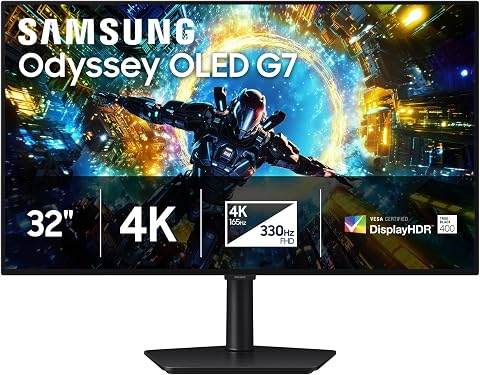 Samsung 32" Odyssey OLED G7 (G73SH) Series Gaming Monitor, 4K ResolutionView on Amazon →
 - 3
 Alienware AW3425DW 34.2-Inch Curved QD-OLED Gaming MonitorView on Amazon →
 - 4
 ASUS ROG Strix XG27AQWMG 27-Inch QHD 280Hz Tandem OLED Gaming MonitorView on Amazon →
 - 5
 Samsung 27" Odyssey OLED G6 (G61SH) QD-OLED Gaming MonitorView on Amazon →
 - 6
 LG UltraGear 27GX704A-B 27-inch QHD OLED Gaming MonitorView on Amazon →
 - 7
 MSI MAG 274QP QD-OLED X24 27-Inch WQHD Gaming Monitor, 2560 x 1440, 240Hz, 0….View on Amazon →
 - 8
 Samsung 27” Odyssey OLED G5 (G50SF) Series QHD Gaming MonitorView on Amazon →
Match the Monitor to Your Setup
The list matters as a practical comparison because OLED gaming screens are available in formats that make different demands on a player’s graphics card, desk and game library. QHD can be a reasonable balance for high frame rates, while 4K offers more pixels but can require more GPU performance. A higher refresh-rate ceiling also helps only when a system can render enough frames in the games being played.
Ultrawide screens can broaden the view, but their physical width and game support matter; a 49-inch display will not fit every desk or suit every title. OLED ownership also involves day-to-day care. The source advises limiting long periods of static imagery, using the monitor’s maintenance features as directed, and checking warranty coverage. Those are considerations to weigh, not evidence that any listed monitor has a particular reliability problem.
Eight Picks, Different Priorities
The guide says its ranking weighs screen size and resolution alongside refresh rate and panel type where specified. It gives the ASUS first place because it combines 27-inch QHD, 280Hz and Tandem OLED, while describing the 4K and ultrawide models as more specialized choices. That reflects the author’s stated criteria, not a universal ranking for all players.
The recommendations are divided into three broad groups: 27-inch QHD screens for competitive or general gaming, a 32-inch 4K model for finer detail, and curved ultrawides for a wider field of view. The guide advises checking real-world frame rates in a player’s own games, measuring desk space and confirming warranty terms before buying. It does not say that the models are new releases or that any specific 2027 launch has been announced.
2027 Pricing and Stock Are Unknown
The source is a buying guide, not a manufacturer announcement or dated retail update. It does not confirm which monitors will be sold in 2027, their prices, regional availability or whether specifications may change. The article also provides no benchmark data, detailed side-by-side testing, or model-by-model warranty information.
Its claims about which model is the strongest all-around choice are the guide’s assessment. Buyers should confirm current specifications and support terms before purchase, particularly because monitor features and product availability can vary by market. The source also does not establish how any model performs with a specific graphics card or game.
Verify Models Before You Buy
For a 2027 purchase, readers should check manufacturer listings and retailer pages closer to buying time for price, stock and final specifications. Compare supported resolution and refresh rate with the graphics card’s performance in the games you play, and confirm that the monitor’s stand and screen dimensions suit the desk.
Before choosing OLED, review the manufacturer’s instructions for panel care and read the warranty’s coverage and conditions. The guide offers a shortlist and selection criteria; it does not identify a next product announcement, launch date or expected price update.
Key Questions
Which monitor does the guide rank first?
It ranks the ASUS ROG Strix XG27AQWMG first, citing its 27-inch QHD format, 280Hz refresh rate and Tandem OLED panel. That ranking reflects the guide’s judgment, not a confirmed independent test result.
Which picks are aimed at competitive gaming?
The guide points to the ASUS ROG Strix XG27AQWMG, Samsung Odyssey OLED G6 G61SH and MSI MAG 274QP QD-OLED X24 as 27-inch QHD options suited to players prioritizing fast, high-refresh gaming. Check each model’s full specifications before comparing them.
Which listed monitor is the 4K option?
The Samsung Odyssey OLED G7 G73SH is the guide’s 32-inch 4K pick. The source notes that 4K gaming can demand more from a graphics card than QHD.
Are these monitors confirmed to be available in 2027?
No. The source gives a list for prospective 2027 buyers but does not confirm future stock, prices or regional availability. Verify those details with manufacturers and retailers near the time of purchase.
What should buyers check before choosing an OLED gaming monitor?
Match resolution and refresh rate to your computer’s performance, measure the desk for larger or ultrawide screens, and check game support for the display format. Review panel-care guidance and warranty terms as well.
Source: ThorstenMeyerAI.com
Fall Picks
fall essentials
As an affiliate, we earn on qualifying purchases.