
TL;DR

Get privacy and security gear delivered free with Prime
- Fast, free delivery on millions of items
- Prime Video, Amazon Music and more included
- Member-only deals all year
A developer has created a software renderer in just 500 lines of C++, showcasing how small, role-specific signals can monitor rapid platform updates. This development aims to help small software teams respond quickly to tooling changes.
A developer has successfully implemented a software renderer in 500 lines of bare C++, demonstrating a minimal, efficient approach that could serve as a targeted signal for product and engineering leads at small software companies. This development is significant because it exemplifies how rapid, role-specific monitoring of platform and tooling changes can be achieved through concise code and focused alerts.
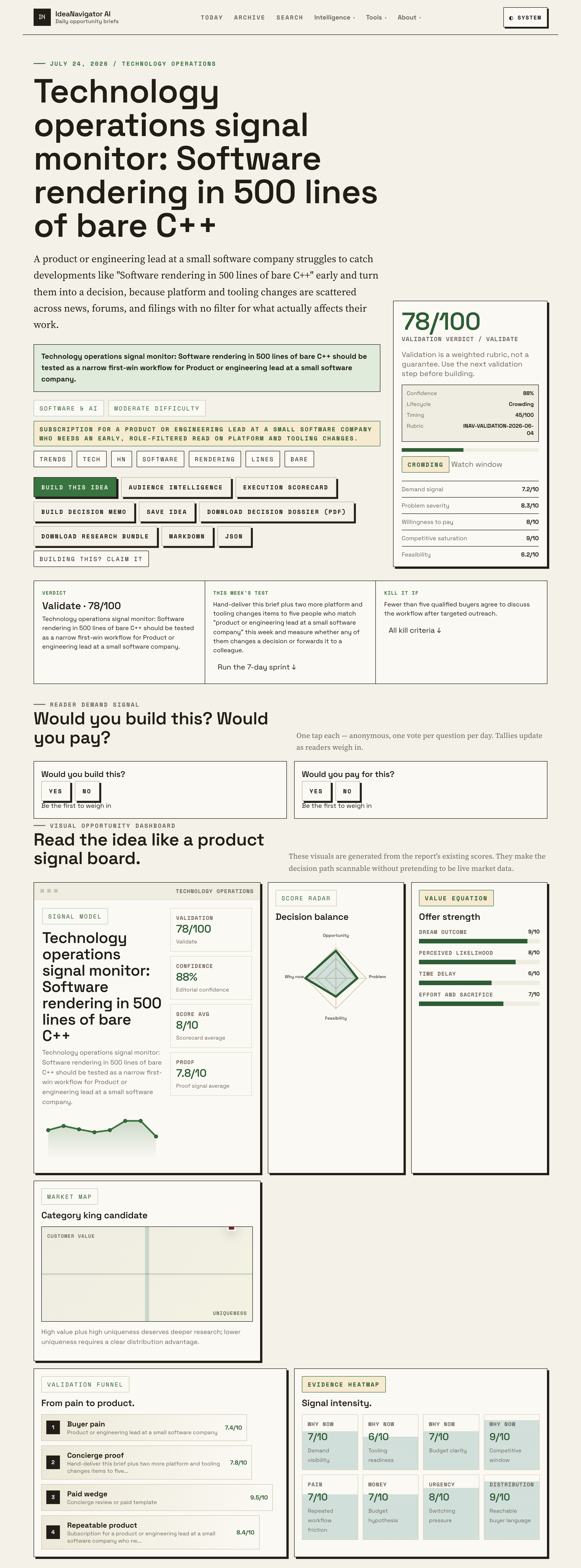
The project involves creating a lightweight, software rendering engine in just 500 lines of C++, designed to detect and interpret platform updates relevant to small teams. You can see a related example in Software Rendering In 500 Lines Of Bare C++. The approach was surfaced via Hacker News, which rated the signal 88/100, indicating high relevance and timeliness. To learn more about signals and monitoring, check out VPNs Are Lawful Technical Tools. The goal is to develop a monitor that filters news feeds, forums, and filings for changes affecting product or engineering decisions, enabling faster reactions to platform shifts.
This initiative responds to the challenge small teams face in tracking scattered news and tooling updates, which often come without clear signals or filters. For more on monitoring signals, see The Future Of Flipper Zero Development. By focusing on a narrow, high-impact workflow, the project aims to deliver role-specific alerts that can influence decision-making and reduce response time to platform changes.
Impact of Role-Filtered Signals on Small Software Teams
This development matters because it offers a concrete example of how small companies can leverage minimal code and targeted monitoring to stay ahead of rapid platform and tooling changes. By focusing on role-specific signals, product and engineering leads can make more informed decisions quickly, reducing delays caused by information overload. The approach demonstrates a scalable model for early detection of technical shifts, potentially improving agility and competitiveness in fast-moving markets.
Products Worth Considering

Samsung 27-Inch Odyssey QD-OLED G8 4K 240Hz Gaming Monitor

Samsung 32-Inch Odyssey OLED G8 (G80SH) 4K Gaming Monitor

LG 34GX90SA-W 34-inch Ultragear WQHD OLED Curved Gaming Monitor
As an affiliate, we earn on qualifying purchases.
Rapid Platform Changes and Signal Monitoring Strategies
In recent months, there has been increased interest in lightweight, role-specific monitoring tools that help small teams respond to fast-moving platform updates. Hacker News and similar feeds have become primary sources for early signals, but their volume and lack of filtering pose challenges. The emergence of a 500-line C++ renderer as a signal prototype reflects ongoing efforts to create concise, effective tools tailored for decision-makers in small organizations.
Historically, small teams have relied on manual tracking or broad alerts, which often result in delayed responses. The current focus on minimal, targeted signals aims to address this gap by providing quick, actionable insights that directly inform product or engineering decisions.
“Creating a 500-line C++ renderer as a signal tool shows that even minimal code can deliver high-relevance alerts for platform changes.”
— an anonymous developer
Unclear Scope and Adoption of the Signal Monitoring Approach
It is not yet clear how widely this 500-line C++ renderer-based signal will be adopted by small teams or how effectively it will scale across different platforms. The long-term reliability of such minimal implementations for comprehensive monitoring remains to be validated. Additionally, the process for integrating these signals into existing workflows is still under development, and user feedback is pending.
Next Steps for Validating and Expanding Signal Monitoring
Further testing and user feedback will determine how this approach can be integrated into small team workflows. Developers plan to deliver additional role-specific signals based on similar minimal code implementations and assess their impact on decision-making. Future updates may include automation, broader platform coverage, and integration with existing alert systems.
Key Questions
What is the significance of a 500-line C++ renderer?
The renderer demonstrates that small, efficient code can serve as a signal for platform updates, enabling quick detection of relevant changes for small teams.
How does this signal help small software companies?
It provides role-specific, early alerts on platform or tooling changes, allowing teams to respond faster and make informed decisions.
Is this approach scalable to larger teams or different platforms?
This is still under evaluation; initial results are promising, but broader adoption and scalability remain to be tested.
When will this monitoring system be available for general use?
Further development and validation are needed before it can be packaged for wider deployment; no specific timeline has been announced.
What are the limitations of using minimal code for signals?
Minimal implementations may miss some updates or lack comprehensive coverage, so ongoing refinement and validation are essential.
Source: IdeaNavigator AI