📊 Full opportunity report: Mac vs GPU Tower for Local LLMs: The Heat-and-Noise Tradeoff on ThorstenMeyerAI.com — validation score, market gap, and execution plan.
TL;DR
This article compares Mac Silicon-based machines and GPU towers for running local large language models, focusing on heat, noise, capacity, and performance tradeoffs. The choice depends on model size and workload priorities.
Apple Silicon machines, such as the Mac Studio with M3 Ultra, operate near-silently and consume significantly less power than GPU towers, which generate substantial heat and noise. This fundamental difference influences the choice for local large language model (LLM) inference, with Mac machines offering a quieter, power-efficient option for models that fit within their memory capacity.
GPU towers equipped with high-end NVIDIA RTX 5090 cards deliver approximately 1,792 GB/s of memory bandwidth, enabling higher tokens per second for models that fit within VRAM, typically 24–32GB per GPU. However, they consume 575W or more, producing considerable heat and requiring extensive thermal management to maintain quiet operation. Achieving a quiet GPU tower involves multiple adjustments, including cooling solutions and airflow tuning.
In contrast, Apple Silicon machines like the Mac Studio with M3 Ultra use unified memory architecture, supporting up to 512GB of shared memory. This allows them to run large models, such as 70 billion parameter models, that cannot fit into a single GPU’s VRAM, albeit at slower inference speeds. Their low power consumption results in near-silent operation, making them ideal for continuous, low-noise environments.
While GPU towers excel in maximum throughput and GPU-specific tasks like fine-tuning with CUDA, they require ongoing thermal management and hardware upgrades. Macs, on the other hand, provide a fixed, maintenance-free solution that prioritizes silence and power efficiency but offers lower raw performance for models within their capacity.
Mac vs GPU tower
for local LLMs.
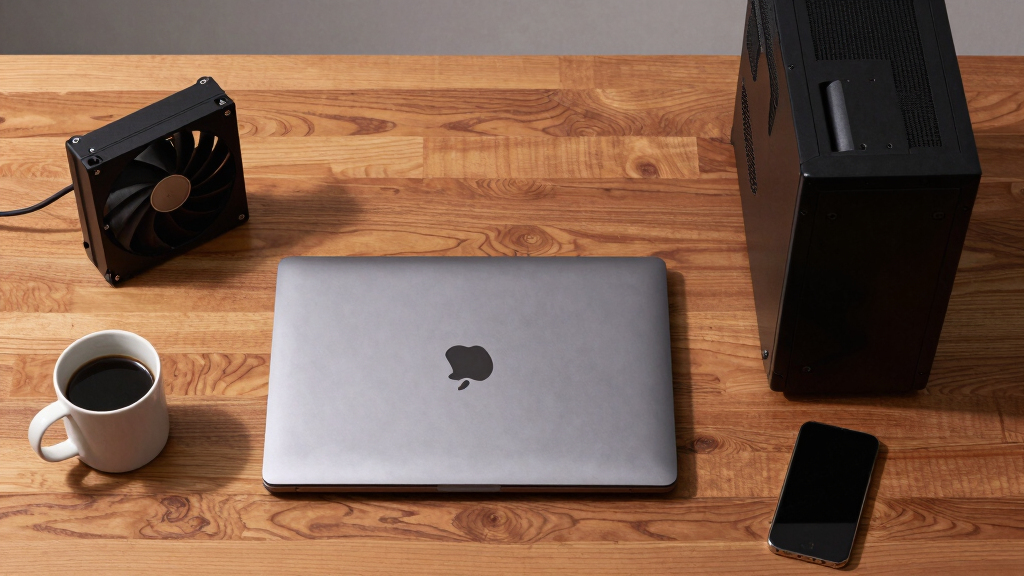
What if you sidestep the heat entirely with a different kind of machine? A tower is a high-bandwidth furnace you spend five levers quieting. Apple Silicon is near-silent by design — but asks for different tradeoffs. Match your priority in Part 2.
Put the loud, hot machine where its noise doesn’t matter, and the quiet one where you do. SSH into the tower when you need raw power; let the Mac handle everything else, silently.
Impact of Heat and Noise on AI Workstation Choices
The choice between a GPU tower and a Mac Silicon machine for local LLM inference hinges on heat, noise, and model size. For users prioritizing maximum throughput on models that fit within VRAM, GPU towers remain superior. However, for those running larger models or seeking a silent, low-power setup, Macs offer a compelling alternative, particularly for continuous operation in office or home environments.
This tradeoff influences deployment strategies, hardware investment, and operational costs, especially in settings where noise and thermal management are critical considerations.

Apple Studio Display: Standard Glass, Tilt-Adjustable Stand
A SIGHT TO BE BOLD — An immersive 27-inch 5K Retina display, 12MP Center Stage camera with Desk...
As an affiliate, we earn on qualifying purchases.
As an affiliate, we earn on qualifying purchases.
Technical Foundations of Heat, Noise, and Capacity
The core difference lies in how each architecture handles memory bandwidth and capacity. GPU towers leverage high memory bandwidth for faster inference speeds on models that fit in VRAM, with each GPU offering around 24–32GB of dedicated memory. Multi-GPU setups can increase throughput but are complex and generate significant heat.
Apple Silicon's unified memory allows sharing up to 512GB across CPU, GPU, and Neural Engine, enabling the execution of larger models that exceed the capacity of consumer GPUs. This architectural choice results in lower power consumption and near-silent operation, but at the cost of slower inference speeds compared to high-bandwidth GPU setups.
Prior developments include the increasing capacity of Macs' unified memory and the evolution of GPU cooling solutions, but the fundamental tradeoff remains: bandwidth versus capacity.
"The heat and noise profile of GPU towers is a space heater versus the near-silence of Apple Silicon, and the decision hinges on model size and workload."
— Thorsten Meyer
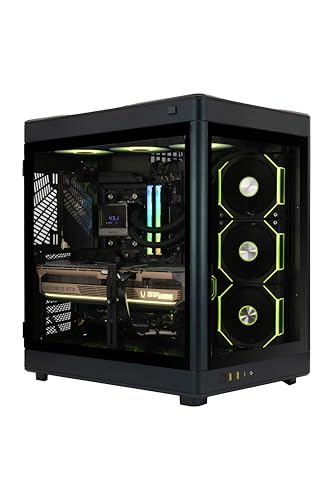
ZOTAC MEK Gaming PC Desktop, NVIDIA GeForce RTX 5090 32GB GDDR7, AMD Ryzen 7 9800X3D Up to 5.2GHz, 32GB DDR5, 2TB NVMe SSD, 1200W 80+ Gold PSU, WiFi 7, Windows 11 Pro
Effortless Gaming: MEK from ZOTAC comes with all hardware and Windows 11 Pro pre-installed. Crafted in the USA,...
As an affiliate, we earn on qualifying purchases.
As an affiliate, we earn on qualifying purchases.
Unresolved Questions About Future Hardware and Workloads
It remains unclear how upcoming GPU architectures with increased VRAM and bandwidth will alter the heat and noise dynamics. Additionally, the long-term performance of Apple Silicon for very large models beyond 70B parameters is still developing, and software ecosystem limitations, such as CUDA compatibility, continue to influence hardware choices.

ASRock Intel Arc Pro B60 Creator 24GB Graphics Card, Workstation GPU, Xe2-HPG, 2400MHz, 24GB GDDR6 192-bit, PCIe 5.0, 4X DP 2.1, Blower
System Compatibility Note: 2-slot card, 271x112x39mm, single 8-pin power, 200W TDP. Verify chassis clearance and PSU capacity before...
As an affiliate, we earn on qualifying purchases.
As an affiliate, we earn on qualifying purchases.
Next Steps in Hardware Development and Model Scaling
Future hardware releases from NVIDIA and Apple are expected to improve capacity, bandwidth, and efficiency. Meanwhile, software advancements may expand the usability of Apple Silicon for larger models, potentially shifting the balance further toward quiet, low-power solutions. Users should monitor these developments for updated recommendations.

be quiet! Dark Rock Pro 5 Quiet Cooling CPU Cooler | Immensely High Airflow | 7 high-Performance Copper Heat Pipes | Speed Switch | Thermal Grease | BK036
Dark Rock Pro 5 features 7 high-performance copper heat pipes and a special black coating with ceramic particles....
As an affiliate, we earn on qualifying purchases.
As an affiliate, we earn on qualifying purchases.
Key Questions
Can a Mac run all large language models efficiently?
Not all large models can run efficiently on a Mac, especially if they exceed the unified memory capacity or require high throughput. However, Macs can handle models up to around 70 billion parameters with quantization, offering a practical solution for many use cases.
Is it possible to make a GPU tower quieter?
Yes, with extensive thermal management, cooling solutions, and airflow optimization, GPU towers can be made quieter, but this requires ongoing effort and investment.
Will future GPUs increase VRAM and reduce heat output?
Upcoming GPU architectures are expected to offer higher VRAM capacities and improved power efficiency, which may reduce heat and noise, but specific details are still emerging.
What are the main tradeoffs between performance and silence?
High performance on models that fit in VRAM favors GPU towers with higher heat and noise, while larger models and silent operation favor Apple Silicon machines, which sacrifice some inference speed for efficiency and quietness.
Source: ThorstenMeyerAI.com