
TL;DR
Europe’s InvestAI program is promoted as a €200 billion AI drive, but the confirmed public money is much smaller than the headline figure. As of late June 2026, the main gigafactory call has not yet opened, most funding depends on private and national capital, and the first large facilities are expected no earlier than 2027 to 2028.
The European Union’s advertised €200 billion InvestAI drive is facing renewed scrutiny ahead of a July 2026 call for AI gigafactories because the confirmed public contribution is far smaller than the headline figure: the Commission says it is mobilizing capital, while much of the total depends on private and national funding that is not yet the same as money spent.
The European Commission launched InvestAI at the Paris AI Action Summit on February 11, 2025, describing it as an initiative to mobilize €200 billion for AI investment, including a €20 billion fund for AI gigafactories. The wording matters: mobilized financing is not the same as direct public expenditure.
The calculation in the source material separates the headline figure into about €50 billion in public money and €150 billion in expected private capital. Of the public share, €20 billion is reserved for four to five large AI gigafactories intended to give European researchers, startups and companies access to training-scale compute.
Even that €20 billion is not presented as a full Brussels check. According to the funding model cited in the source material, the EU contribution can cover up to 17 percent of the investment cost for a gigafactory, with member states and private investors expected to cover the rest. That leaves the Commission’s direct role in the core compute buildout closer to a few billion euros than to the €200 billion headline.
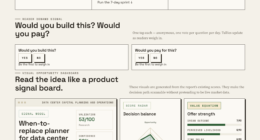
Mobilisiert, nicht ausgegeben
Die EU verkauft eine €200-Milliarden-KI-Offensive. Doch das entscheidende Wort ist „mobilisiert” — nicht „ausgegeben”. Rechnet man nach, schrumpft die Schlagzeile bis zur Wirkung dramatisch.
2027–28 Rechenzentren sollen laufen
1 STANDORT bislang im Bau (Norwegen)
Spät, langsam, noch nicht gebaut.
Ein kleiner, später, teils hypothetischer Scheck — ohne teure Energie, fragmentierte Kapitalmärkte, langsame Genehmigungen oder Talent-Abwanderung anzurühren. Die EU verwechselt einen Fördertopf mit einer Strategie.
Compute Gap Sets The Stakes
The financing gap matters because frontier AI systems require large clusters of advanced chips, reliable power and long-term operating budgets. If Europe’s public support mainly leverages private money rather than funding capacity directly, the program’s impact will depend on whether investors and member states supply the missing capital on schedule.
The comparison with U.S. hyperscalers shows the scale problem. Financial reports based on company guidance put 2026 AI-related capital expenditure by Amazon, Microsoft, Alphabet and Meta at roughly $700 billion, with Amazon near $200 billion and Microsoft near $190 billion. Those are company-level annual figures, while Europe’s dedicated gigafactory fund is a multi-year €20 billion pool.
For European startups, labs and public agencies, the issue is not only prestige. Compute access can affect where AI models are trained, who controls sensitive data, and whether smaller companies can compete without relying mainly on U.S. cloud platforms.

VIVO 12U Freestanding Server Rack, Mobile Open Frame 22 to 40 Inch Adjustable Network Server Cart, Black Steel, CART-SR12U
Data Storage Solution: This 12U mobile server cart contains 4 vertical support rails for servers, UPS's, patch panels,…
As an affiliate, we earn on qualifying purchases.
As an affiliate, we earn on qualifying purchases.
From Paris Pledge To Tender
InvestAI was announced after a wave of AI infrastructure commitments in the United States, including the Stargate project, which was framed around a potential $500 billion buildout. The EU response was pitched as a public-private push to make Europe an AI continent while keeping access open to researchers and companies beyond the largest technology groups.
The gigafactory plan sits beside a network of smaller AI Factories that use existing European supercomputers. According to the source material, 19 smaller AI Factories are active or planned, while only one larger site, in Norway and tied to hydropower, is currently under construction.
The timing remains a constraint. The EuroHPC governing board approved the gigafactory approach in early June 2026, the formal call is expected in July 2026, and the facilities are projected to come online in 2027 to 2028. In a market where U.S. cloud providers are placing hardware orders and expanding capacity in annual spending cycles, that schedule leaves Europe working from plans before the largest machines are built.
“We will mobilise unprecedented capital through InvestAI for European AI gigafactories.”
— European Commission President Ursula von der Leyen

The Scaling Era: An Oral History of AI, 2019–2025
As an affiliate, we earn on qualifying purchases.
As an affiliate, we earn on qualifying purchases.
Private Capital Remains Unproven
It is not yet clear how much of the expected private capital will be committed to specific projects, which member states will back the largest facilities, or how quickly sites can secure permits, power contracts, chips and construction capacity.
The final number, location and technical scale of the gigafactories also remain open. The source material says four to five sites are planned, but the tender has not yet produced selected consortia, binding financing packages or firm delivery dates.
There is also a broader policy gap. The funding plan does not by itself resolve Europe’s high energy costs, fragmented capital markets, slower permitting or AI talent losses to larger U.S. firms. Those issues may shape the result as much as the headline funding figure.
AI gigafactory construction equipment
As an affiliate, we earn on qualifying purchases.
As an affiliate, we earn on qualifying purchases.
July Call Starts The Test
The next milestone is the July 2026 EuroHPC call for AI gigafactories. That process should show which consortia apply, which countries offer sites and funding, and whether private investors are ready to match Brussels’ leverage model.
After that, the key measures will be signed financing, site selection, grid access, chip procurement and construction progress. Until those details are public, the confirmed story is narrower than the headline: Europe has announced a large AI financing target, but the core compute capacity remains mostly ahead of it.

Deep Learning at Scale: At the Intersection of Hardware, Software, and Data
As an affiliate, we earn on qualifying purchases.
As an affiliate, we earn on qualifying purchases.
Key Questions
Is the EU spending €200 billion directly on AI?
No. The Commission describes InvestAI as a plan to mobilize €200 billion. The source material identifies about €50 billion as public money, with the rest dependent on private capital rather than direct EU spending.
How much is set aside for AI gigafactories?
The Commission has identified €20 billion for AI gigafactories, intended to support four to five large compute facilities. The EU share is expected to be only part of each project’s cost.
When will Europe’s AI gigafactories be ready?
The formal call is expected in July 2026. According to the source material, the facilities are expected to become operational in 2027 to 2028, though final schedules depend on site selection, funding and construction.
Why does the word mobilized matter?
It means the headline figure includes money Brussels hopes to draw in from other sources. That can expand the total if investors join, but it also means the full amount is not guaranteed public spending.
What remains the main risk for Europe’s AI plan?
The main risk is that financing, power access and construction move too slowly to close the compute gap with U.S. hyperscalers, which are already committing far larger annual sums to AI infrastructure.
Source: Thorsten Meyer AI