
📊 Full opportunity report: Capacity Planning Tips: Knowing When Your Data Center Needs New Equipment on IdeaNavigator AI — validation score, market gap, and execution plan.

Get privacy and security gear delivered free with Prime
- Fast, free delivery on millions of items
- Prime Video, Amazon Music and more included
- Member-only deals all year
TL;DR
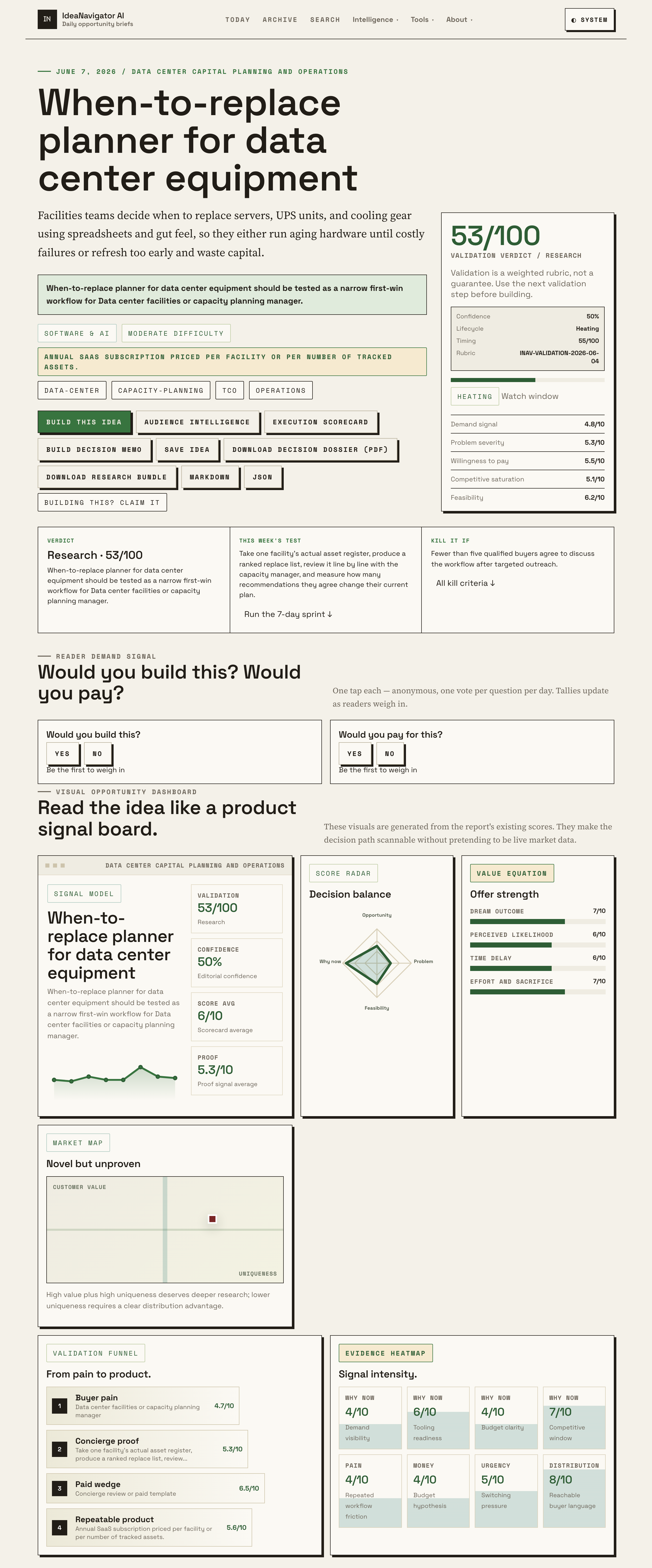
A new capacity planning tool is being tested to help data center managers determine the optimal timing for replacing servers, UPS units, and cooling systems. This development aims to improve decision-making amid rising energy costs and hardware efficiency advances.
A new capacity planning tool for data centers is being tested to help managers decide when to replace aging equipment. This development addresses longstanding challenges in facilities management, offering a data-driven approach to optimize costs and prevent failures. The tool, developed by IdeaNavigator AI, ingests asset data and ranks equipment for replacement based on energy efficiency and failure risk, marking a shift from traditional gut-feel decisions.
The proposed tool is designed for data center facilities and capacity planning managers, aiming to replace spreadsheet-based and intuition-driven decision processes. It uses asset information such as age, power consumption, and maintenance costs to generate a ranked list of equipment for replacement. This approach seeks to balance the rising costs of energy and hardware failures against the benefits of newer, more efficient hardware.
Initial validation involves applying the tool to a single facility’s asset register, then reviewing its recommendations with the capacity manager. Early feedback will determine how closely the tool’s suggestions align with current management plans and whether it effectively improves decision-making. The SaaS-based solution is priced per facility or per number of assets tracked, targeting the data center operations market.
Impact of Data-Driven Equipment Replacement Decisions
This development could significantly improve how data centers manage hardware refresh cycles, reducing unnecessary capital expenditure and minimizing costly failures. With energy costs rising and hardware becoming more efficient, accurate replacement timing is increasingly important. The tool’s adoption may lead to more sustainable, cost-effective operations, and better planning for future capacity needs.
data center server replacement hardware
As an affiliate, we earn on qualifying purchases.
As an affiliate, we earn on qualifying purchases.
Growing Pressure on Data Center Equipment Management
Traditionally, data center facilities teams have relied on spreadsheets and experience to decide when to replace servers, UPS units, and cooling systems. However, rising energy prices and hardware density have made these decisions more complex and economically critical. Hardware aging can lead to failures, downtime, and higher maintenance costs, while premature replacement wastes capital. The advent of more efficient hardware and increased operational costs has prompted a search for more precise, data-driven tools to guide replacement timing.
Previous efforts have focused on manual assessments, but these are often subjective and inconsistent. The new capacity planning tool aims to fill this gap by providing a systematic, analytics-based approach, currently in the validation stage with initial testing underway.
“The replacement decision has become more complex due to rising energy costs and hardware improvements, making a data-driven approach essential.”
— an anonymous researcher
As an affiliate, we earn on qualifying purchases.
Uncertainties in Adoption and Effectiveness
It is not yet clear how widely the tool will be adopted across different types of data centers or how accurately it will predict optimal replacement times in diverse operational environments. The initial validation is limited to one facility, and further testing is needed to confirm its broader effectiveness and integration into existing workflows.
data center cooling systems upgrade
As an affiliate, we earn on qualifying purchases.
As an affiliate, we earn on qualifying purchases.
Next Steps in Validation and Deployment
The next phase involves applying the tool to additional facilities to gather more data on its accuracy and usefulness. Feedback from capacity managers will inform refinements, and if successful, the tool could be offered as a standard SaaS product for data center operations within the next year. Wider adoption will depend on demonstrated improvements in cost savings and operational reliability.
capacity planning tools for data centers
As an affiliate, we earn on qualifying purchases.
As an affiliate, we earn on qualifying purchases.
Key Questions
How does the new capacity planning tool work?
The tool analyzes asset data such as age, power consumption, and maintenance costs, then ranks equipment for replacement based on energy efficiency gains and failure risk, helping managers make informed decisions.
Is this tool applicable to all types of data centers?
It is designed to be adaptable but is currently in early validation stages, with initial testing limited to specific facilities. Broader applicability will be assessed as further validation occurs.
What are the main benefits of using this tool?
It aims to reduce unnecessary capital expenditure, prevent costly failures, and optimize energy use by providing data-driven replacement recommendations.
When will this tool be generally available?
If validation proves successful, the SaaS solution could be commercially available within the next 12 months.
What challenges might hinder its adoption?
Potential challenges include integration with existing management systems, trust in algorithmic recommendations, and variability across different data center environments.
Source: IdeaNavigator AI
Columbus Day / Indigenous Peoples' Day Picks
long weekend sales
As an affiliate, we earn on qualifying purchases.