📊 Full opportunity report: The Small Business Case For Scanning And Auto-Filing Documents on IdeaNavigator AI — validation score, market gap, and execution plan.

Get privacy and security gear delivered free with Prime
- Fast, free delivery on millions of items
- Prime Video, Amazon Music and more included
- Member-only deals all year
TL;DR
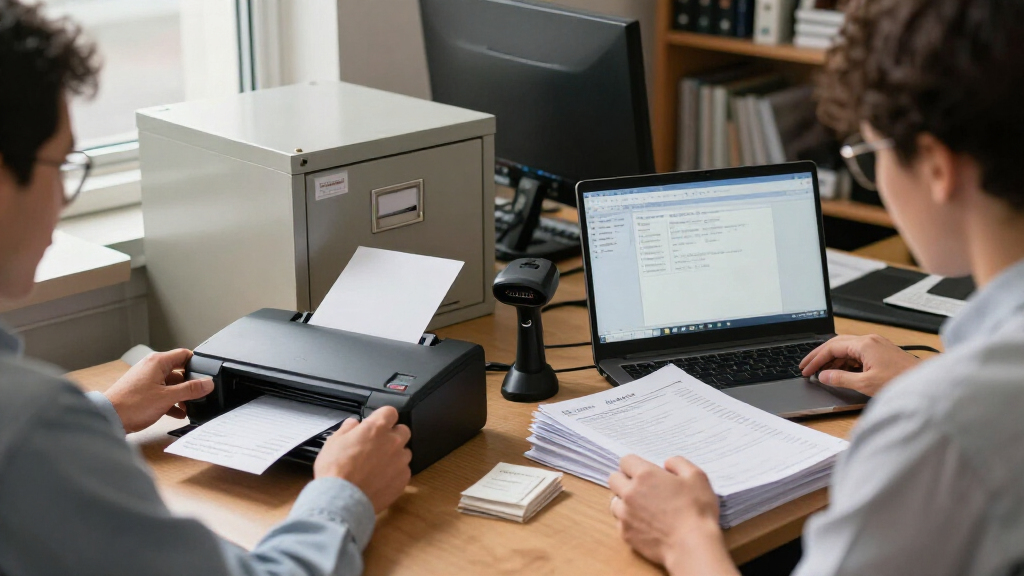
A proposed workflow for small nonprofits, clinics and law offices would use phone scans, OCR and automated naming to file documents in searchable shared folders. The idea has not been shown to work in a completed trial: a suggested one-week pilot with five offices would measure classification accuracy and willingness to pay.
IdeaNavigator AI has proposed testing a phone-based scanning and auto-filing workflow for small nonprofits, clinics and law offices, with a suggested pilot measuring how accurately it sorts documents and whether offices would pay for the service. The proposal addresses a common administrative problem—paper records that are difficult to search—but it is a product concept, not a report of a launched service or completed study.
The proposed app would let an office worker photograph a stack of paper documents and use optical character recognition (OCR) to read the pages. It would then suggest a document category and filename, such as an invoice labeled with its date and vendor, before saving searchable PDFs to a shared folder.
The intended customers are office managers at small, paper-heavy organizations, including nonprofits, clinics and law firms. The proposal identifies intake forms, invoices and records as examples of documents that can accumulate in filing cabinets, while generic scanner apps may leave users with image files that lack useful names or extracted information.
For an initial test, IdeaNavigator AI proposes recruiting five small offices for a one-week pilot. Each office would scan a real backlog of 200 documents. The test would track correct auto-classification and willingness to pay per seat; the proposal does not provide results, a pricing figure or a defined accuracy threshold.
Filing Work Is the Core Test
For a small office without dedicated IT staff, the practical value of scanning software depends on more than making a digital copy. The proposed workflow is aimed at reducing the manual steps between scanning a page and being able to find it later: recognizing its contents, choosing a category, naming it and placing it in a shared location.
If the software classifies documents reliably, staff could spend less time sorting and searching paper or poorly labeled scans. Searchable records may also make routine work easier to hand off between employees. Those are potential benefits, not measured outcomes: the pilot is intended to test them, and no evidence is provided yet about time saved, error rates in day-to-day use or effects on administrative costs.
The proposal also points toward a business model based on a monthly per-seat subscription, with a page-volume allowance and charges for additional scanning. Whether that pricing fits small organizations will depend on the volume they process, the value of time saved and the effort required to correct mistakes. The suggested willingness-to-pay measure is meant to test that demand rather than assume it.
document scanning app for small office
As an affiliate, we earn on qualifying purchases.
As an affiliate, we earn on qualifying purchases.
From Paper Stacks to Searchable PDFs
The concept targets a specific gap between paper records and useful digital filing. A scanner can create an electronic image, but without readable text and consistent organization, employees may still need to open files one by one or rely on manual naming. The proposed combination of OCR, document classification and filename suggestions is designed to make the resulting files searchable and easier to sort.
IdeaNavigator AI’s proposal says on-device and API-based OCR, alongside layout-aware models, are now inexpensive and capable enough to support this kind of workflow without a dedicated IT team. That is the proposal’s rationale for testing the idea; it does not include benchmarks, vendor comparisons or independent evidence establishing accuracy for the intended offices and document types.
The suggested pilot focuses on real backlogs rather than a small set of prepared sample files. Testing 200 documents at each of five offices could expose differences in forms and records across organizations, but the proposed week-long test remains small and short. The plan does not say whether the documents would represent all routine filing, how sensitive records would be handled, or whether the offices have agreed to participate.
As an affiliate, we earn on qualifying purchases.
Accuracy, Privacy and Pricing Unknown
No trial results are available, and the proposal does not identify a product launch, developer, participating offices or timetable. It is unclear how often the system would assign the wrong document type, misread a date or vendor, or produce a filename that needs staff correction. The plan also sets no minimum performance level for deciding whether the pilot succeeds.
Handling records for clinics and law firms may involve sensitive personal or legal information. The proposal does not describe where scans or extracted text would be processed or stored, who could access them, how long they would be retained, or what safeguards would apply. It also does not specify subscription prices, page caps or overage fees. Those details would matter to organizations considering a test or a paid service.
As an affiliate, we earn on qualifying purchases.
Pilot Results Would Set the Direction
The next step described in the proposal is a one-week pilot with five small offices, with each office scanning 200 documents from its backlog. The stated measures are classification accuracy and willingness to pay per seat. No start date or participating organizations have been announced, so it is not clear when or whether the test will proceed.
Any reported results would need to show how accuracy was calculated and how much staff review or correction the workflow required. Further details on privacy, storage, access controls and pricing would also be needed before offices could assess the product for sensitive records or compare its cost with existing filing practices. For now, the proposal sets out a testable business idea, not proof that automated filing will solve the problem.
Source: IdeaNavigator AI
As an affiliate, we earn on qualifying purchases.
Key Questions
What is the proposed document-scanning app meant to do?
It would use a phone camera to capture documents, OCR to read them, and automated suggestions to classify and name files before saving searchable PDFs to a shared folder.
Who is the product designed for?
The proposal targets office managers at small nonprofits, clinics and law offices with substantial paper records and limited IT support.
Has the app been tested or launched?
No completed pilot or product launch is reported. A one-week test involving five offices is proposed, but there is no start date or participant list.
How would the proposed pilot measure success?
Each office would scan 200 documents. The stated measures are the rate of correct automatic classification and offices’ willingness to pay per seat; the proposal sets no target accuracy rate.
What remains unknown about the service?
Its accuracy in routine use, subscription prices, page limits, data storage and privacy safeguards have not been specified. The proposal also does not say how much human review would be needed.
Source: IdeaNavigator AI
Halloween Picks
halloween
As an affiliate, we earn on qualifying purchases.