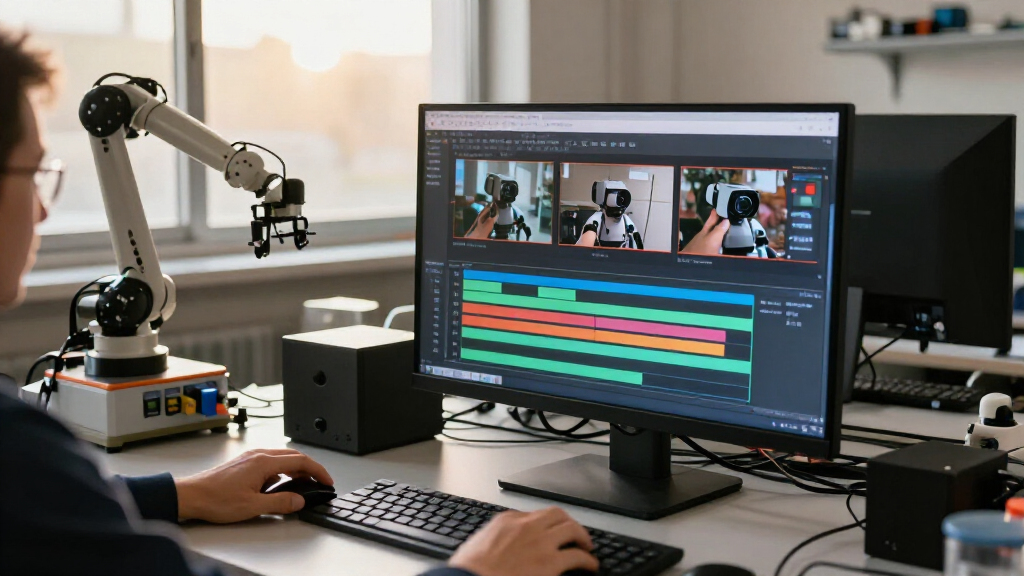

🔍 Read the full analysis: Robot Video Labeling With Flora: Nvidia’s Cost Savings And License Terms on ThorstenMeyerAI.com

Get privacy and security gear delivered free with Prime
- Fast, free delivery on millions of items
- Prime Video, Amazon Music and more included
- Member-only deals all year
TL;DR
Nvidia’s GEAR robotics lab released Flora, three models for segmenting, captioning and scoring robot videos. Nvidia estimates captioning costs $0.72 per video hour, compared with $88.49 for GPT-6 Astra on a selected test set, but Flora’s figure is modeled rather than a measured production bill. The models are licensed for research and evaluation, not commercial use.
Nvidia’s GEAR robotics lab has released Flora, a set of three models that label robot and human videos, and estimates that its captioning system can process video for $0.72 per hour. That cost is a modeled GPU estimate, not a measured production bill; Nvidia’s paper compares it with $88.49 per video hour for GPT-6 Astra on a 50-episode test set. Flora’s license also permits research and evaluation, but not commercial use.
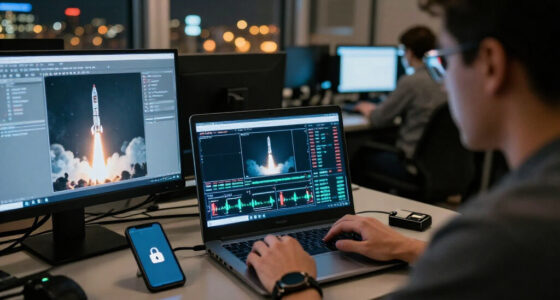
Flora consists of three models built on Alibaba’s Qwen3.5: a 9-billion-parameter segmenter that marks when actions begin and end; a 27-billion-parameter captioner that describes each interval; and a 27-billion-parameter rewarder that scores an episode or individual steps. The project paper and model cards say the system was used as a data engine for Nvidia’s GR00T-2 robot model and was trained on fewer than 10,000 hours of robot and human video.
The cost comparison uses 50 episodes from Nvidia’s DenseCaptionBench, totaling 4,483 seconds, or about 75 minutes. Nvidia reports GPT-6 Astra captioning costs of $88.49 per video hour based on public API rates and usage recorded for the test. Flora’s $0.72 estimate assumes eight GB300 GPUs rented at $10 per GPU-hour and modeled throughput. The paper gives a range of $0.51 to $1.26 per hour, excluding storage and other overhead. Its authors state that the production GPU-hour denominator has not been verified.
On the same test set, Nvidia reports Flora scored 57.1%, compared with 53.7% for Astra, 38.3% for Gemini 3.8 Flash and 30.4% for Claude Opus 5. Those figures do not establish that Flora is better across robot-video tasks: the paper’s benchmark results vary by task, and Nvidia conducted most of the testing. The reported 125-times cost difference is a rounded ratio between the Astra API figure and Flora’s modeled estimate, and applies to captioning—not to all three Flora models.
Infographic 01 · What Flora does
Three models that turn robot video into training labels.
Flora cuts a recording into actions, describes each one and grades how well it went. The 200,000-hour figure is Nvidia’s own production claim.
Flora-TempSeg
9B · adapter on Qwen3.5-9B
- Job: Finds where each action starts and ends
- In: Video windows (one camera, or main + two wrist cameras)
- Out: Time intervals as JSON
Flora-Captioner
27B · fine-tuned Qwen3.5-27B
- Job: Describes each action, using the video before and after
- In: One interval plus context
- Out: One English instruction, e.g. “Place the blue mug on the tray with your right hand.”
Flora-Rewarder
27B · fine-tuned Qwen3.5-27B
- Job: Judges how well the robot did
- In: An episode or a 16-second window, plus the task
- Out: Score 1–5 per episode · normal / suboptimal / failure per 0.5 s · rubric scores
Three labels, three uses
Why robot models need each one, per the paper
| Label | Used for | Made by |
|---|---|---|
| Timestamped captions | Filtering and rebalancing pretraining data | TempSeg + Captioner |
| Process rewards | Reinforcement learning after pretraining: which step went wrong | Rewarder |
| Outcome rewards | Monitoring robots after deployment | Rewarder |
What it is not
model cards
- Not a robot controller: outputs are annotations only
- Not meant to be the sole safety monitor for a physical system
- Not for commercial or production use (noncommercial license)
- Hardware: tested on Nvidia H100, Linux; ~55 GB of weights per 27B model (estimate)
Sources: Flora paper, Nvidia (20 Oct 2026); Hugging Face model cards (15 Oct 2026); Nvidia GEAR project page. Weight-size estimate: Thorsten Meyer (27B parameters × 2 bytes).
Powered by Thorsten Meyer AI
Lower Labeling Costs, With Limits
Video labels help robotics teams identify what a robot did, when it did it and whether each step succeeded. Lower annotation costs could make it easier to sort and use large video collections for training and evaluation. Nvidia says Flora can label data at up to 200,000 hours of video per day using 512 GB300 GPUs; that is a company-reported capacity figure, not an independently verified production result.
The license is a direct constraint on who can put the release into a product. All three models are distributed under Nvidia’s OneWay Noncommercial License, which limits use to research or evaluation and carries the same restriction to derivatives. Businesses can examine Flora as a research tool or reference point, but the published terms do not grant a general commercial production license. Nvidia says it may use the models commercially.
Even if labeling becomes cheaper, it does not resolve other costs and risks in robotics. Teams still need robot video, suitable hardware, and methods for checking whether labels and reward scores are reliable. A low estimated inference cost is one part of the data pipeline, not evidence that deploying a capable or safe robot has become inexpensive.
NVIDIA RTX workstation GPU for AI video processing
As an affiliate, we earn on qualifying purchases.
As an affiliate, we earn on qualifying purchases.
Three Models, Three Labeling Jobs
Robot-learning data can include recordings from robot cameras as well as human demonstrations. The Flora paper describes three kinds of annotation: timestamped captions that connect instructions to video intervals; process rewards that classify short steps as normal, suboptimal or failed; and outcome scores that rate an entire attempt or assess it against a rubric. Flora assigns a separate model to segmentation, captioning and reward scoring.
The captioner can use a single camera or a main camera together with wrist cameras, according to the model description. The rewarder can assign an overall score from one to five, label half-second intervals, or score against a user-provided rubric. Nvidia says the models were trained on robot and human footage and were used in GR00T-2’s data pipeline.
The reported quality results are mixed across benchmarks. Nvidia says Flora leads Astra on the human-video subset of DenseCaptionBench, scoring 37.4% to 29.7%, and on WGO-Bench segmentation, scoring 50.3 to 46.0. On the public RoboRewardBench, the paper reports Flora’s error as 27.8% lower than Astra’s. The source material also says Astra performs better on robot videos, caption accuracy and rubric scoring. These results describe particular tests and should not be treated as a single overall ranking.
“research or evaluation purposes only”
— NVIDIA OneWay Noncommercial License
GPU server for machine learning model inference
As an affiliate, we earn on qualifying purchases.
As an affiliate, we earn on qualifying purchases.
How the Cost Holds Up
The figures do not show what a company would pay to run Flora at production scale. The GPU price is an assumption, throughput is modeled, and the paper says the production GPU-hour denominator has not been verified. Nvidia’s comparison also excludes storage and overhead. Astra’s API total includes 106 of 7,062 attempts that reported no usage, making the paper’s figure a known-usage subtotal, according to the source material.
The test comprised about 75 minutes of video from 50 episodes selected from Nvidia’s own benchmark. It is not clear from the provided material how the cost or quality results would change across larger datasets, different video formats, other hardware or independent tests. The 57.1% and 53.7% scores are benchmark results, not a general measure of performance in deployed robots.
The scope of the cost claim is also limited: it concerns captioning, not the cost of using the segmenter and rewarder together. The provided license description bars commercial use, but does not establish whether Nvidia will later offer separate commercial terms, hosted access or a production service. Those details remain unknown.
robotics camera for robot training data collection
As an affiliate, we earn on qualifying purchases.
As an affiliate, we earn on qualifying purchases.
Independent Tests and License Terms
The next useful evidence would be independent testing on additional robot-video datasets, with methods that report both annotation quality and fully measured operating costs. Such results could show whether Flora’s modeled savings hold when teams include hardware utilization, storage, overhead and the full labeling workflow.
For organizations considering the models, the immediate next step is to review the license and model cards before use. The released terms permit research and evaluation, not commercial deployment. Nvidia has not, in the material provided, announced commercial licensing terms or a timeline for expanded access. Until it does, Flora’s cost estimate is relevant as a research comparison, while its applicability to production remains unresolved.
high capacity NAS for video dataset storage
As an affiliate, we earn on qualifying purchases.
As an affiliate, we earn on qualifying purchases.
Key Questions
What is Nvidia Flora?
Flora is a set of three models for labeling video used in robotics: one segments action intervals, one writes captions for them, and one scores steps or complete episodes.
Is the $0.72-per-hour cost a measured bill?
No. Nvidia’s $0.72 per video hour is a modeled estimate based on eight GB300 GPUs, an assumed rental price of $10 per GPU-hour and modeled throughput. The paper gives a range of $0.51 to $1.26 and says the production GPU-hour denominator has not been verified.
Does Flora beat GPT-6 Astra on every test?
No. Nvidia reports Flora scoring higher on the selected overall DenseCaptionBench test and on some other measures, including human videos and action segmentation. The reported results also favor Astra on robot videos, caption accuracy and rubric scoring.
Can a company use Flora commercially?
The published models use Nvidia’s OneWay Noncommercial License, which allows research or evaluation purposes only and extends that restriction to derivatives. The supplied material does not describe a separate commercial license.
Does the 125-times figure cover all of Flora?
No. It compares Astra’s measured API cost with Flora’s modeled GPU cost for captioning on the paper’s 50-episode test. It does not establish the cost of running all three Flora models or the full expense of a production labeling pipeline.
Source: ThorstenMeyerAI.com
Halloween Picks
halloween
As an affiliate, we earn on qualifying purchases.