

The Local Document Pipeline, End To End

📊 Full opportunity report: The Local Document Pipeline, End To End on ThorstenMeyerAI.com — validation score, market gap, and execution plan.

TL;DR

A new local document pipeline architecture enables processing documents entirely within an organization’s infrastructure. It emphasizes simplicity, modularity, and data provenance, reducing reliance on external services. This development impacts AI deployment, data security, and compliance strategies. For more on related challenges, see our analysis of GoPro’s recent struggles.

A detailed architecture for a fully local, end-to-end document processing pipeline was publicly outlined this week, emphasizing its emphasis on simplicity, modularity, and data security. Is This The End Of The Once-mighty GoPro? This approach enables organizations to process documents entirely within their own infrastructure, avoiding external dependencies and enhancing compliance.The pipeline architecture is designed around five core stages: ingestion, OCR, queuing, structured extraction, and storage with provenance. To understand more about OCR and document processing, visit our article on GoPro’s latest developments. Each component is intentionally narrow and single-purpose, facilitating maintainability and flexibility across model versions. The system uses PostgreSQL as the backbone for queuing and storage, with a content-hash-based approach ensuring idempotency and safe retries. OCR is performed via CLI tools, with model choice being a configurable routing decision. The extraction stage converts markdown output from OCR into structured data, validated against schemas. Provenance data links each extracted artifact back to its source document, page, and model version, supporting auditability and debugging.
At a glance
reportWhen: announced during the week of October 23…
The developmentThis week, a detailed architecture for a fully local, end-to-end document processing pipeline was publicly described, emphasizing its design principles and operational components.
The Local Document Pipeline — AI Dispatch Infographic
AI Dispatch · Insights JULY 2026 · THORSTENMEYERAI.COM

Documents in. Typed rows out.
Nothing leaves the building.

The reference architecture this week was pointing at: a hash, a Postgres queue, two model passes, a review loop, provenance columns — boring architecture around rapidly-improving models. Commands live in the companion repo; the design lives here.

Five stages, one spine

01Ingestbytes stored, content hash, ~300 dpi page renders. Too boring to fail.
02OCRpages in, markdown out. Model choice = routing, not religion.narrow Python CLI
03Queueclaim, process, complete — transactionally. Resist making it interesting.
04Extractmarkdown → schema-validated JSON rows, local LLM, confidence + evidence per field.
05Storerows + provenance: hash, page span, model IDs. Audits become joins.
PostgreSQL · SELECT … FOR UPDATE SKIP LOCKED max-attempts → dead letter · lock-timeout sweep · per-type concurrency caps · ~150 lines, no broker

Idempotent by content hash: reprocessing is always safe, “did we do this file?” is a primary-key lookup. Two model passes on purpose — transcription errors and extraction errors have different fixes.

The four principles everything hangs on

Model as appliancePixels in, markdown out. No opinions about your pipeline — this layer WILL be swapped within a year.
Python at the boundarySingle-file CLIs, JSON to stdout, invoked as subprocesses. Nothing more.
Queue is the architectureSame DB as the data. The operational surface you don’t add is the best kind.
Hash-keyed idempotencyEvery artifact keys to the content hash. Retries and DSGVO deletion cascade cleanly.

Exceptions are the product

Confidence routing

Low-confidence fields, schema failures, unparseable pages → human_review jobs in the same queue. Corrections stored as data — your ground-truth set for the next model swap builds itself.

Field observations

Exception rate is dominated by input quality, not model quality — a scanner upgrade often beats a model upgrade. And a 93% benchmark means the real design problem is the other 7%.

⚠ When this architecture is the wrong call — honestly
  • Low volume: under ~10–20K pages/month, one week of this engineering costs more than a year of API invoices.
  • Prebuilt schemas fit: if your documents are exactly the invoice/receipt/ID categories and DSGVO permits, the cloud prebuilt tier is the honest recommendation.
  • Degraded inputs: phone photos and crumpled scans invert the benchmarks (Real5-OmniDocBench). Test on YOUR documents first.
  • No owner: a local pipeline is infrastructure. If nobody patches it and watches the dead-letter queue, buy the cloud’s real product — their ops team.

DSGVO: what local removes

The Auftragsverarbeitung surface for processing itself — no vendor DPA, no transfer analysis, no sub-processor audits for the core path.

DSGVO: what remains

GDPR itself. Purpose limitation, retention, deletion, access controls — local processing is still processing. Simplifies compliance; never waives it.

POS Software – All in One Retail Point of Sale Software - Credit Card Processing – Store Management Features, 90 Days Money Back, Free Updates/e-mail Support/video Tutorials

POS Software – All in One Retail Point of Sale Software – Credit Card Processing – Store Management Features, 90 Days Money Back, Free Updates/e-mail Support/video Tutorials

Affordable POS Software

As an affiliate, we earn on qualifying purchases.

As an affiliate, we earn on qualifying purchases.
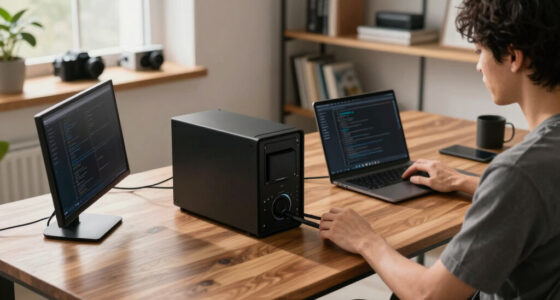
Implications for Data Security and AI Infrastructure

This architecture allows organizations to run complex document processing entirely on-premises, reducing exposure to data leaks and regulatory issues. It also simplifies model swapping and upgrades, enabling more flexible AI deployment. The emphasis on provenance and schema validation enhances auditability, critical for regulated industries. Overall, this approach shifts the paradigm from cloud-dependent AI pipelines to self-contained, maintainable systems.
Amazon

OCR command line tools

As an affiliate, we earn on qualifying purchases.

As an affiliate, we earn on qualifying purchases.

Development of Local AI Pipelines and Industry Trends

Recent discussions in AI and data governance have highlighted the need for local, self-hosted pipelines that preserve data privacy and control. Past efforts often relied on cloud services, raising concerns over data security and compliance. This week’s detailed pipeline architecture builds on these trends, offering a practical blueprint for organizations seeking to operate entirely within their own infrastructure. The approach aligns with broader industry movements toward transparency, modularity, and operational resilience in AI deployment.

“This pipeline is designed to be model-agnostic, simple to maintain, and fully contained within your infrastructure, ensuring data privacy and operational control.”

— Thorsten Meyer

Production Data Engineering for AI: Master Layout-Aware Parsing, Semantic Chunking, and Sub-10ms Database Retrieval

Production Data Engineering for AI: Master Layout-Aware Parsing, Semantic Chunking, and Sub-10ms Database Retrieval

As an affiliate, we earn on qualifying purchases.

As an affiliate, we earn on qualifying purchases.

Remaining Questions About Deployment and Scalability

It is not yet clear how well this architecture scales for very large document volumes or complex workflows. Details about real-world deployment experiences, performance benchmarks, and integration with existing enterprise systems are still emerging.
Amazon

document provenance tracking tools

As an affiliate, we earn on qualifying purchases.

As an affiliate, we earn on qualifying purchases.

Next Steps for Adoption and Validation

Organizations are expected to pilot this pipeline architecture in controlled environments to evaluate performance, flexibility, and compliance benefits. Further developments may include automation tools for schema management, model versioning, and monitoring, along with community feedback shaping future iterations.

Key Questions

Can this pipeline handle large-scale document processing?

While designed for flexibility and maintainability, real-world scalability depends on deployment specifics. Organizations are encouraged to pilot and adapt the architecture to their needs.

Is this approach suitable for regulated industries?

Yes, the emphasis on provenance, schema validation, and local processing makes it well-suited for regulated environments requiring auditability and data control.

How easy is it to swap models within this architecture?

The pipeline’s modular design, with separate CLI components and routing flexibility, allows models to be swapped or upgraded with minimal disruption.

What are the main technical challenges to implementing this pipeline?

Ensuring performance at scale, managing schema updates, and integrating with existing data systems are potential challenges, but the architecture’s simplicity aims to mitigate these issues.

Will this architecture support future AI model improvements?

Yes, its modular design and version-controlled prompts facilitate ongoing upgrades and experimentation without overhauling the entire system.

Source: ThorstenMeyerAI.com

You May Also Like
The Free-Download Question: When Running Your Own Model Actually Beats Paying

The Free-Download Question: When Running Your Own Model Actually Beats Paying

Analysis of when owning and operating open-weight AI models is more cost-effective than paying API fees, considering hardware, operational costs, and performance.

The Benefits Of Using Webcam Technology For Eye Comfort

Webcam-based blink-rate tracking apps show promise in reducing eye strain for remote workers by encouraging regular breaks and monitoring eye health.
Norway imposes broad restrictions on AI for elementary school kids

Norway imposes broad restrictions on AI for elementary school kids

Norway enforces a strict ban on generative AI for students aged 6-13, citing concerns over educational development and digital safety, starting this school year.
15 Best AI-Powered Student Planners For Academic Organization In 2026

15 Best AI-Powered Student Planners For Academic Organization In 2026

Discover the 15 best AI-driven student planners for academic success in 2026, including features, benefits, and what to consider before choosing.