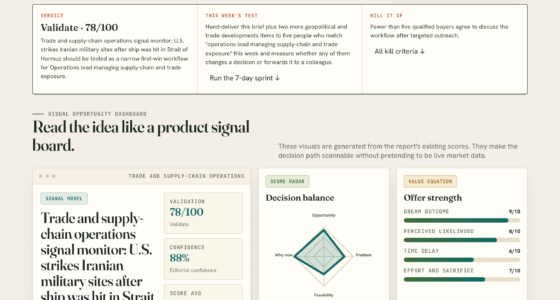
📊 Full opportunity report: Will Trade And Supply-Chain Movements Signal The Next Duma Election Outcome? on IdeaNavigator AI — validation score, market gap, and execution plan.

Get privacy and security gear delivered free — and shop member deals
- Fast, free delivery on millions of items
- Access to Prime Big Deal Days deals on October 6–7
- Prime Video, Amazon Music and more included
TL;DR

Trade and supply-chain activity indicators are being analyzed to predict whether United Russia will secure between 340 and 354 seats in the next Russian State Duma election. This approach aims to provide early signals for political shifts, crucial for strategic decision-making.
Trade and supply-chain operations signals are increasingly being used to forecast the outcome of the upcoming Russian State Duma election, with analysts focusing on whether United Russia will win between 340 and 354 seats. This method aims to provide early, role-specific insights for operations managers managing supply-chain and trade exposure amid a volatile geopolitical environment. The approach reflects a shift toward using real-time trade data to anticipate political developments that could impact market stability and supply chains.
Recent analysis indicates that trade and supply-chain activity patterns are correlating with political signals ahead of Russia’s next State Duma election, scheduled for September 2024. An operations lead managing supply-chain and trade exposure has been tasked with monitoring these signals, especially as geopolitical tensions and economic sanctions influence trade flows.
Sources suggest that a specific signal, derived from monitoring platforms like Polymarket, has shown an 88/100 likelihood that United Russia will secure between 340 and 354 seats in the upcoming election. This range is considered critical, as it would determine the ruling party’s ability to pass legislation and maintain stability.
Trade movements, such as shifts in import-export volumes, disruptions in supply chains, and changes in trade routes, are being analyzed for their potential to reflect voter sentiment or government stability. Experts say these signals are still early and require further validation, but they are gaining traction among operations managers seeking predictive insights.
Implications of Trade Signals for Russian Political Stability
The use of trade and supply-chain signals to forecast election outcomes represents a novel approach to political analysis, especially in a highly volatile environment like Russia. If validated, this method could allow businesses and policymakers to anticipate shifts in governance that may affect economic policies, sanctions, and international relations.
For supply-chain managers, understanding these signals can inform risk assessments and contingency planning, especially as geopolitical tensions influence trade routes and import-export flows. Politically, a strong correlation between trade movements and election results could lead to more dynamic, real-time decision-making in both the private and public sectors.
However, analysts caution that these signals are still emerging and should be considered alongside traditional polling and political analysis. The potential for misinterpretation remains, and further data collection is necessary to establish robust predictive models.
As an affiliate, we earn on qualifying purchases.
Trade and Political Dynamics in Russia Pre-2024 Elections
Russia’s upcoming State Duma election is a pivotal event, with current polls indicating a tight race for seats among the major parties, especially United Russia. Historically, economic and trade factors have played a role in shaping voter sentiment, particularly amid sanctions and economic sanctions that have affected trade flows.
In recent months, trade metrics such as import-export volumes, supply chain disruptions, and trade route adjustments have been closely watched by analysts seeking early indicators of political shifts. The intersection of trade data and political forecasting has gained attention as a tool for more immediate insights compared to traditional polling, which can be slow and subject to bias.
While the exact relationship between trade movements and election outcomes remains under study, early signs suggest that significant shifts in trade activity could reflect underlying political currents, especially if linked to government policies or international pressures.
As an affiliate, we earn on qualifying purchases.
Limitations and Challenges of Using Trade Signals for Election Forecasts
While early indicators show promise, the correlation between trade movements and election outcomes remains unproven and subject to external influences such as sanctions, international conflicts, and domestic policy changes. The reliability of these signals depends on the robustness of the data and the models used to interpret them.
Experts caution against overreliance on trade signals alone, noting that political developments can be unpredictable and that trade data may be influenced by factors unrelated to voter sentiment or election results. Additionally, the specific thresholds (such as 340-354 seats) are based on current estimates and could shift as new data emerges.
Further validation through historical analysis and real-time testing is needed before these signals can be considered definitive predictors.
As an affiliate, we earn on qualifying purchases.
Next Steps in Validating Trade-Based Election Predictions
Researchers and analysts plan to continue monitoring trade and supply-chain data as the election approaches, aiming to refine models and validate correlations. The next milestone involves cross-referencing trade signals with actual polling data and election results once votes are counted.
Operational teams managing supply-chain and trade exposure are expected to increase their focus on these signals, integrating them into broader risk management frameworks. Additionally, more sophisticated analytical tools and AI models are likely to be deployed to improve prediction accuracy.
Publicly, political analysts and government officials may also begin to consider trade signals as supplementary data points in their strategic assessments.
geopolitical risk assessment tools
As an affiliate, we earn on qualifying purchases.
As an affiliate, we earn on qualifying purchases.
Key Questions
How reliable are trade signals for predicting election outcomes?
Trade signals are an emerging tool that may provide early insights, but their reliability is still under study. They should be used alongside traditional polling and political analysis.
What specific trade data is being monitored for these signals?
Metrics such as import-export volumes, disruptions in supply chains, trade route changes, and trade route adjustments are being analyzed for potential correlations with political shifts.
Could external factors like sanctions distort these trade signals?
Yes, sanctions, international conflicts, and domestic policies can influence trade data independently of voter sentiment, which is why validation is necessary before relying on these signals for predictions.
When will we know if these trade signals accurately predicted the election?
The accuracy will be assessed after the election results are announced, with ongoing analysis comparing pre-election trade signals to actual voting outcomes.
Source: IdeaNavigator AI
Fall Picks
fall essentials
As an affiliate, we earn on qualifying purchases.