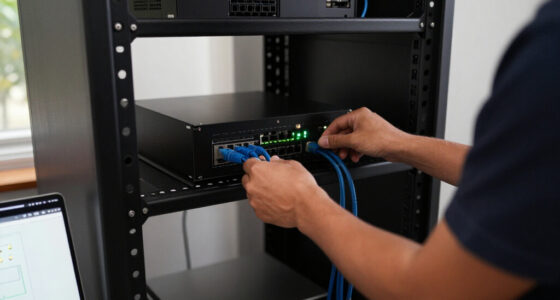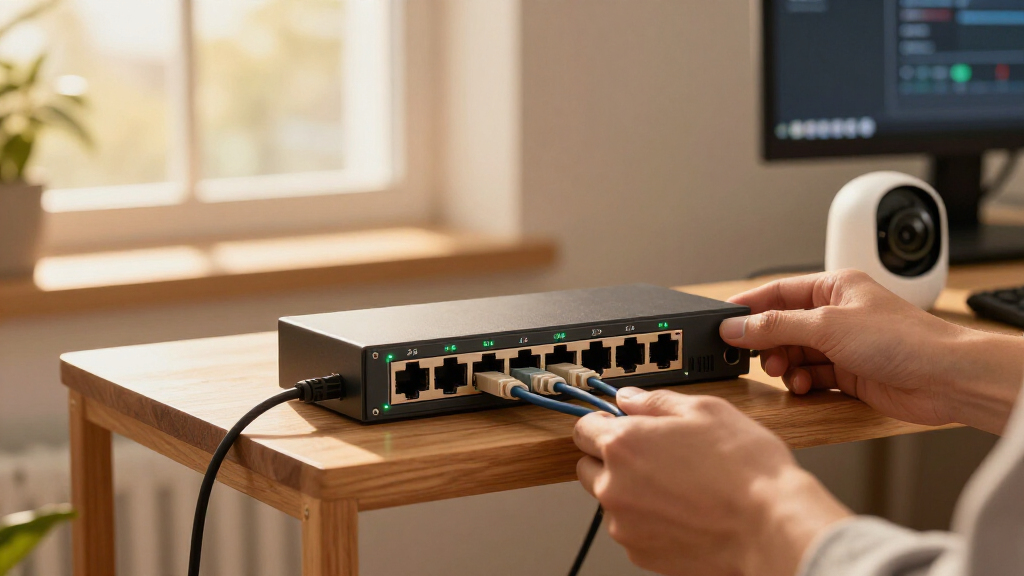
Choosing the best 24 port PoE switch for cameras requires balancing raw power delivery with network stability and management flexibility. The NETGEAR GS524PP stands out as the best overall pick for its robust 370W power budget and reliable unmanaged simplicity, ideal for most residential and small business setups. For those needing advanced traffic control, the TP-Link Omada SG3428MP offers superior L2+ managed features and higher wattage, though at a steeper price. The primary tradeoff in this category lies between plug-and-play convenience and granular bandwidth management, where unmanaged switches offer ease of setup but lack the isolation needed for high-security or high-bandwidth environments. Continue reading to see how these models stack up against each other in real-world deployment scenarios.

Get privacy and security gear delivered free with Prime
- Fast, free delivery on millions of items
- Prime Video, Amazon Music and more included
- Member-only deals all year
Key Takeaways
- Power budget is the primary differentiator: switches with under 200W struggle to support 24 high-resolution cameras simultaneously, leading to frequent dropouts.
- Unmanaged switches dominate the value segment for small installations, but they lack VLAN support, which can create security vulnerabilities in mixed-use networks.
- Managed L2+ switches like the TP-Link Omada series provide essential traffic isolation for camera networks, preventing surveillance data from impacting general office traffic.
- Rack-mount capability is no longer optional for professional installs; desktop-only units often lack the ventilation required for sustained 24/7 operation in server rooms.
- Uplink port speed matters: switches with only Fast Ethernet uplinks create bottlenecks when multiple 4K cameras stream simultaneously to an NVR.
| YuanLey 26-Port Unmanaged PoE+ Network Switch with 400W Power Budget |  | Best for Long-Distance Wiring | Port Configuration: 24 PoE/PoE+ Fast Ethernet, 2 Gigabit Uplinks | Total PoE Budget: 400 W | Max Power per Port: 30 W | VIEW LATEST PRICE | See Our Full Breakdown |
| NICGIGA 24 Port PoE Switch Unmanaged, 24 Port PoE+@400W, 2 Gigabit Uplink Ports |  | Best Value for Standard Installations | Port Configuration: 24 PoE+ Ports, 2 Gigabit Uplinks | Total PoE Budget: 400 W | Protection: 4KV Lightning Protection | VIEW LATEST PRICE | See Our Full Breakdown |
| 24-Port Full Gigabit PoE+ Network Switch with 2 SFP and 2 Uplink Ports |  | Best Silent Gigabit Performance | Port Configuration: 24x Gigabit PoE, 2x Gigabit RJ45, 2x SFP | Total PoE Budget: 400 W | Switching Capacity: 56 Gbps | VIEW LATEST PRICE | See Our Full Breakdown |
| NETGEAR 24-Port PoE Gigabit Ethernet Unmanaged Network Switch (GS324P) |  | Best Brand Reliability for Mixed Ports | Port Configuration: 16x Gigabit PoE+, 8x Gigabit RJ45 | Total PoE Budget: 190 W | Warranty: 3-Year Hardware | VIEW LATEST PRICE | See Our Full Breakdown |
| TP-Link Omada SG3428MP 28-Port Gigabit L2+ Managed PoE+ Switch |  | Best Premium Managed Solution | Port Configuration: 24x Gigabit PoE+, 4x Gigabit SFP | Total PoE Budget: 384 W | Management Type: L2+ Managed | VIEW LATEST PRICE | See Our Full Breakdown |
| NICGIGA 24-Port Gigabit PoE Switch with 24 PoE+@300W |  | Best Budget Unmanaged Option | PoE Ports: 24 PoE+ | Total PoE Budget: 300W | Uplink Ports: 2 Gigabit + 1 SFP | VIEW LATEST PRICE | See Our Full Breakdown |
| TP-Link TL-SG1428PE, 24 Port Gigabit Easy Smart Managed PoE+ Switch |  | Best Managed Value | PoE Ports: 24 PoE+ | Total PoE Budget: 250W | Management Type: Easy Smart Managed | VIEW LATEST PRICE | See Our Full Breakdown |
| NETGEAR GS524UP 24-Port Gigabit Ethernet Unmanaged PoE Switch |  | Best High-Power Unmanaged | PoE Ports: 8 PoE+ and 16 Ultra60 PoE++ | Total PoE Budget: 480W | Switch Type: Unmanaged | VIEW LATEST PRICE | See Our Full Breakdown |
| NETGEAR GS524PP 24-Port Gigabit Ethernet Unmanaged PoE+ Switch |  | Best Reliable Standard | PoE Ports: 24 PoE+ | Total PoE Budget: 300W | Switch Type: Unmanaged | VIEW LATEST PRICE | See Our Full Breakdown |
| NETGEAR 28-Port PoE Gigabit Ethernet Smart Managed Network Switch (GS728TP) |  | Best for Fiber Expansion | PoE Ports: 24 PoE+ | Total PoE Budget: 190W | Management Type: Smart Managed | VIEW LATEST PRICE | See Our Full Breakdown |
| 24 port PoE switch for camera | Total PoE Budget | Switch Type | Mounting | Port Configuration |
|---|---|---|---|---|
| YuanLey 26-Port Unmanaged PoE+ | 400 W | Unmanaged | — | 24 PoE/PoE+ Fast Ethernet, 2 Gigabit Uplinks |
| NICGIGA 24 Port PoE Switch Unm | 400 W | Unmanaged | 19-inch Rackmount or Desktop | 24 PoE+ Ports, 2 Gigabit Uplinks |
| 24-Port Full Gigabit PoE+ Netw | 400 W | Unmanaged | Rack, Desktop, or Wall Mount | 24x Gigabit PoE, 2x Gigabit RJ45, 2x SFP |
| NETGEAR 24-Port PoE Gigabit Et | 190 W | Unmanaged | Desktop or Rack Mount | 16x Gigabit PoE+, 8x Gigabit RJ45 |
| TP-Link Omada SG3428MP 28-Port | 384 W | — | — | 24x Gigabit PoE+, 4x Gigabit SFP |
| NICGIGA 24-Port Gigabit PoE Sw | 300W | Unmanaged | Desktop/Rack Mount | — |
| TP-Link TL-SG1428PE | 250W | — | — | — |
| NETGEAR GS524UP 24-Port Gigabi | 480W | Unmanaged | Desktop or Rack Mount | — |
| NETGEAR GS524PP 24-Port Gigabi | 300W | Unmanaged | Desktop or Rack Mount | — |
| NETGEAR 28-Port PoE Gigabit Et | 190W | Smart Managed | Desktop or Rack-mount | — |
More Details on Our Top Picks
YuanLey 26-Port Unmanaged PoE+ Network Switch with 400W Power Budget
This switch distinguishes itself with an extended transmission mode that pushes PoE signals up to 250 meters at 10 Mbps, a feature rarely found in budget-friendly unmanaged switches. For camera installations where running Cat6 cable to every node is impractical, this capability offers significant flexibility. Compared to the NETGEAR GS324P, which limits reach to standard Ethernet distances, the YuanLey accommodates sprawling property layouts or rural deployments. However, the tradeoff is speed: PoE ports are limited to 10/100 Mbps, meaning high-bandwidth 4K streams may struggle if multiple cameras share a single uplink. It is a pragmatic choice for cost-sensitive projects prioritizing reach over raw throughput.
Pros:- Extends PoE transmission up to 250 meters in extended mode
- Generous 400W total power budget supports many devices
- Plug-and-play setup requires no configuration
- VLAN isolation improves network segmentation for cameras
Cons:- PoE ports are limited to 10/100 Mbps speeds
- Extended mode reduces port speed to 10 Mbps
- Lacks advanced management features for network optimization
Best for: Installers covering large properties where standard 100-meter Ethernet limits are a constraint.
Not ideal for: Users requiring gigabit speeds for high-resolution 4K streaming or heavy data transfer.
- Port Configuration:24 PoE/PoE+ Fast Ethernet, 2 Gigabit Uplinks
- Total PoE Budget:400 W
- Max Power per Port:30 W
- Extended Range:Up to 250 m at 10 Mbps
- Switch Type:Unmanaged
- Form Factor:19-inch Rackmount
Our verdict“Choose this if you need to reach distant cameras without fiber, but accept slower speeds on those long runs.”
NICGIGA 24 Port PoE Switch Unmanaged, 24 Port PoE+@400W, 2 Gigabit Uplink Ports
The NICGIGA model mirrors the YuanLey’s core functionality—400W budget and 250-meter extension—but often positions itself as a more accessible option for standard CCTV setups. Its 4KV lightning protection is a notable addition for outdoor-connected networks, offering peace of mind against voltage spikes that cheaper switches might ignore. Unlike the TP-Link Omada SG3428MP, this unit requires no cloud subscription or complex setup, making it ideal for technicians who want reliability without management overhead. While it shares the 10/100 Mbps limitation on PoE ports with the YuanLey, its robust metal housing and straightforward interface make it a dependable workhorse for residential and small commercial surveillance systems.
Pros:- Includes 4KV lightning protection for connected devices
- High 400W power budget for extensive camera arrays
- Supports 250-meter extended transmission mode
- Sturdy metal housing suitable for rack or desktop use
Cons:- PoE ports operate at 10/100 Mbps, not Gigabit
- Unmanaged nature prevents VLAN configuration beyond basic isolation
- Limited diagnostic tools for troubleshooting connectivity issues
Best for: Small to medium businesses needing reliable power delivery and surge protection without network management complexity.
Not ideal for: Networks requiring gigabit speeds on all ports or detailed traffic monitoring capabilities.
- Port Configuration:24 PoE+ Ports, 2 Gigabit Uplinks
- Total PoE Budget:400 W
- Protection:4KV Lightning Protection
- Extended Range:Up to 250 m at 10 Mbps
- Switch Type:Unmanaged
- Mounting:19-inch Rackmount or Desktop
Our verdict“A solid, no-nonsense switch for standard camera installations that need surge protection and long reach.”
24-Port Full Gigabit PoE+ Network Switch with 2 SFP and 2 Uplink Ports
This switch stands out for its full Gigabit PoE ports, eliminating the 10/100 Mbps bottleneck found in the YuanLey and NICGIGA models. For systems capturing high-bitrate 4K footage, this bandwidth headroom is critical. The inclusion of two SFP slots allows for fiber optic uplinks, a feature absent in the NETGEAR GS324P, enabling longer backbone distances between switches or to the NVR. Its fanless design ensures silent operation, making it suitable for office environments where noise is a concern. While it lacks the management features of the TP-Link Omada, its raw performance and flexible connectivity options make it a superior choice for bandwidth-heavy surveillance networks.
Pros:- All 24 PoE ports support full Gigabit speeds
- Includes 2 SFP slots for fiber optic connectivity
- Fanless design ensures completely silent operation
- High 400W budget supports power-hungry PTZ cameras
Cons:- Lacks managed features like VLANs or QoS
- No extended mode for distances beyond 100 meters
- Basic unmanaged interface offers no traffic monitoring
Best for: High-resolution camera systems requiring full gigabit speeds and silent operation.
Not ideal for: Users who need advanced VLANs, QoS, or remote management capabilities.
- Port Configuration:24x Gigabit PoE, 2x Gigabit RJ45, 2x SFP
- Total PoE Budget:400 W
- Switching Capacity:56 Gbps
- Cooling:Fanless
- Switch Type:Unmanaged
- Mounting:Rack, Desktop, or Wall Mount
Our verdict“The best choice for high-bandwidth camera networks that need silence and fiber flexibility without management complexity.”
NETGEAR 24-Port PoE Gigabit Ethernet Unmanaged Network Switch (GS324P)
The NETGEAR GS324P offers a different architecture by providing 16 PoE+ ports and 8 non-PoE Gigabit ports, rather than powering all 24. This design is efficient for setups where not every camera needs power over Ethernet, or where some devices are powered separately. Compared to the TP-Link Omada SG3428MP, it lacks cloud management and advanced security, but it compensates with NETGEAR’s reputation for durability and a 3-year hardware warranty. The dynamic PoE allocation ensures that unused power on one port can be redistributed to others, maximizing the utility of its 190W budget. It is a trusted, low-maintenance option for users who prefer established brand support over maximum port density.
Pros:- Dynamic PoE allocation maximizes power efficiency
- Backed by a 3-year hardware warranty
- Fanless and energy-efficient operation
- Reliable brand support and easy availability
Cons:- Only 16 ports provide PoE; 8 are data-only
- Lower total power budget (190W) compared to competitors
- No management features or VLAN configuration
Best for: Users who prefer a well-known brand with strong warranty support and have a mix of powered and non-powered devices.
Not ideal for: Installations requiring power on all 24 ports or high total wattage budgets.
- Port Configuration:16x Gigabit PoE+, 8x Gigabit RJ45
- Total PoE Budget:190 W
- Warranty:3-Year Hardware
- Switch Type:Unmanaged
- Power Efficiency:IEEE 802.3az Energy Efficient Ethernet
- Mounting:Desktop or Rack Mount
Our verdict“Choose this for brand reliability and mixed-device networks, but note that only half the ports provide power.”
TP-Link Omada SG3428MP 28-Port Gigabit L2+ Managed PoE+ Switch
This TP-Link Omada switch represents the premium tier of this roundup, offering L2+ managed capabilities that the unmanaged models like the NICGIGA or YuanLey simply cannot match. Features such as VLANs, ACLs, and 802.1X authentication allow for granular network control, isolating camera traffic from corporate data for enhanced security. The Omada SDN cloud management enables remote monitoring and configuration, a significant advantage for multi-site deployments. With 4 SFP slots and a 384W budget, it is built for scalability. However, this power comes with complexity; it requires a learning curve and, for full cloud benefits, integration with the Omada ecosystem. It is overkill for simple plug-and-play setups but indispensable for professional network architectures.
Pros:- L2+ management with VLAN, ACL, and QoS support
- Omada SDN cloud management for remote control
- 4 SFP slots for flexible fiber uplinks
- Advanced security features like 802.1X and DHCP snooping
Cons:- Complex setup and management requirements
- Higher cost compared to unmanaged alternatives
- Cloud features depend on Omada ecosystem compatibility
Best for: IT professionals managing complex networks requiring VLANs, security protocols, and remote cloud management.
Not ideal for: Home users or small businesses seeking a simple, plug-and-play solution without configuration needs.
- Port Configuration:24x Gigabit PoE+, 4x Gigabit SFP
- Total PoE Budget:384 W
- Management Type:L2+ Managed
- Cloud Control:Omada SDN
- Security Features:VLAN, ACL, 802.1X, DHCP Snooping
- Warranty:5 Years
Our verdict“The definitive choice for professional installations requiring network segmentation, security, and remote management.”
NICGIGA 24-Port Gigabit PoE Switch with 24 PoE+@300W
This switch stands out for offering 24 PoE+ ports and a 300W power budget at a price point that undercuts many established brands. While it lacks the brand recognition of the NETGEAR GS524PP, it delivers the same raw port count and power capacity for a basic camera network. The inclusion of 4KV lightning protection is a valuable safety feature often omitted in cheaper unmanaged units. However, being unmanaged means you have zero control over traffic prioritization or VLANs. If your network is simple and you just need to plug in cameras and walk away, this saves money. But if you need remote troubleshooting capabilities, you will miss the management features found in smart switches like the TP-Link TL-SG1428PE.
Pros:- 300W PoE budget supports many standard cameras
- 4KV lightning protection safeguards connected equipment
- Plug-and-play setup requires no configuration
- Includes SFP slot for fiber uplink options
Cons:- Unmanaged design offers no network control
- Brand support and documentation may be less robust than major competitors
Best for: Home users or small businesses setting up a straightforward IP camera system without needing network segmentation.
Not ideal for: IT professionals who require VLANs, QoS, or remote management to isolate camera traffic from office data.
- PoE Ports:24 PoE+
- Total PoE Budget:300W
- Uplink Ports:2 Gigabit + 1 SFP
- Switch Type:Unmanaged
- Protection:4KV Lightning Protection
- Mounting:Desktop/Rack Mount
- Case Material:Metal
Our verdict“A cost-effective solution for simple camera networks where management features are unnecessary.”
TP-Link TL-SG1428PE, 24 Port Gigabit Easy Smart Managed PoE+ Switch
The TP-Link TL-SG1428PE bridges the gap between basic unmanaged switches and complex enterprise gear. Unlike the NICGIGA 24-Port, this model offers Easy Smart Management, allowing you to configure VLANs and QoS without needing deep networking knowledge. The PoE Auto Recovery feature is particularly useful for camera systems, as it automatically reboots unresponsive devices, reducing the need for manual maintenance. However, the 250W power budget is slightly lower than the 300W offered by the NICGIGA and NETGEAR GS524PP. You must carefully calculate your total camera power draw to ensure you do not exceed this limit. It is an excellent choice for those who want control but do not want to pay for full L2+ capabilities.
Pros:- PoE Auto Recovery automatically restarts hung cameras
- Web-based management allows for VLAN and QoS configuration
- Industry-leading 3-year warranty and support
- Includes 2 SFP slots for fiber uplinks
Cons:- 250W power budget is lower than some 300W rivals
- Management interface is less advanced than full L2+ switches
Best for: Small business owners who need basic network segmentation and automatic device recovery without complex IT support.
Not ideal for: Users with very high-power cameras or many devices, as the 250W budget is tighter than some competitors.
- PoE Ports:24 PoE+
- Total PoE Budget:250W
- Management Type:Easy Smart Managed
- Uplink Ports:2 Gigabit Non-PoE + 2 SFP
- Key Feature:PoE Auto Recovery
- Warranty:3 Years
- Dimensions:17.3″ x 8.7″ x 1.73″
Our verdict“The ideal middle ground for users who want smart features and reliability without enterprise complexity.”
NETGEAR GS524UP 24-Port Gigabit Ethernet Unmanaged PoE Switch
This NETGEAR model distinguishes itself with a massive 480W power budget and support for Ultra60 PoE++ on 16 ports. This makes it far more capable than the NETGEAR GS524PP or NICGIGA 24-Port if you are powering high-demand devices like PTZ cameras or Wi-Fi 6 access points. The fanless design ensures silent operation, which is critical for office environments. However, it remains an unmanaged switch, meaning you cannot prioritize video traffic over data traffic, which can lead to lag on busy networks. Compared to the TP-Link TL-SG1428PE, you get more power but zero control. Choose this only if your network is simple and your devices are power-hungry.
Pros:- Huge 480W power budget supports high-draw devices
- 16 ports support Ultra60 PoE++ (up to 60W per port)
- Fanless operation for silent environments
- Limited lifetime hardware warranty
Cons:- Unmanaged design prevents traffic prioritization
- Higher power capacity may be overkill for standard cameras
Best for: Users deploying high-power devices like PTZ cameras or multiple access points who do not need network management.
Not ideal for: Networks requiring traffic prioritization or segmentation, as the lack of management can cause video stuttering.
- PoE Ports:8 PoE+ and 16 Ultra60 PoE++
- Total PoE Budget:480W
- Switch Type:Unmanaged
- Cooling:Fanless
- Mounting:Desktop or Rack Mount
- Warranty:Limited Lifetime
- Weight:3.9 kg
Our verdict“A powerhouse for high-demand unmanaged networks, but lacks the control needed for mixed-use traffic.”
NETGEAR GS524PP 24-Port Gigabit Ethernet Unmanaged PoE+ Switch
The NETGEAR GS524PP is the go-to choice for those who prioritize brand reliability and simplicity. It offers a 300W PoE budget across all 24 ports, matching the capacity of the NICGIGA 24-Port but with the backing of NETGEAR’s support infrastructure. The fanless metal chassis ensures durability and quiet operation, making it suitable for server closets or offices. Unlike the NETGEAR GS524UP, it does not support PoE++, limiting it to 30W per port, which is sufficient for most standard IP cameras but not high-end PTZs. It is strictly unmanaged, so like the NICGIGA, it lacks VLANs or QoS. This is the safe, boring, reliable pick for a standard camera setup.
Pros:- 300W PoE budget supports up to 24 standard cameras
- Fanless design for silent operation
- Limited lifetime hardware warranty
- Compact metal build for desktop or rack mounting
Cons:- No management features for traffic control
- Does not support PoE++ (60W) devices
Best for: Homeowners and small businesses who want a trusted brand name and simple plug-and-play reliability.
Not ideal for: Users needing to power devices above 30W or those who require network traffic management.
- PoE Ports:24 PoE+
- Total PoE Budget:300W
- Switch Type:Unmanaged
- Cooling:Fanless
- Mounting:Desktop or Rack Mount
- Warranty:Limited Lifetime
- Dimensions:15.4″ x 1.7″ x 1.73″
Our verdict“A dependable, no-frills switch for standard camera networks where brand trust matters.”
NETGEAR 28-Port PoE Gigabit Ethernet Smart Managed Network Switch (GS728TP)
The NETGEAR GS728TP stands apart due to its 4 SFP ports, offering significant flexibility for fiber uplinks that most competitors lack. While its 190W power budget is the lowest in this lineup—significantly less than the NETGEAR GS524UP’s 480W or the TP-Link TL-SG1428PE’s 250W—it compensates with robust smart management features. The inclusion of NETGEAR Insight allows for remote monitoring and configuration, a feature absent in the NICGIGA 24-Port. This switch is ideal for larger sites where cameras are spread out and require fiber connections to avoid copper distance limits. However, you must be mindful of the power limit; mixing high-draw devices is not feasible here.
Pros:- 4 SFP ports for flexible fiber optic expansion
- Smart management interface with NETGEAR Insight integration
- Supports VLANs and QoS for traffic prioritization
- Compact 28-port design saves rack space
Cons:- 190W power budget is limited for dense camera deployments
- NETGEAR Insight subscription expires after one year
Best for: Networks requiring fiber uplinks to remote cameras and users who want remote management capabilities.
Not ideal for: Users with many high-power cameras, as the 190W budget fills up quickly.
- PoE Ports:24 PoE+
- Total PoE Budget:190W
- Management Type:Smart Managed
- SFP Ports:4 x 1G
- Remote Management:NETGEAR Insight (1 year included)
- Mounting:Desktop or Rack-mount
- Switch Type:Smart Managed
Our verdict“Best suited for complex sites needing fiber connectivity and remote management, despite a lower power budget.”
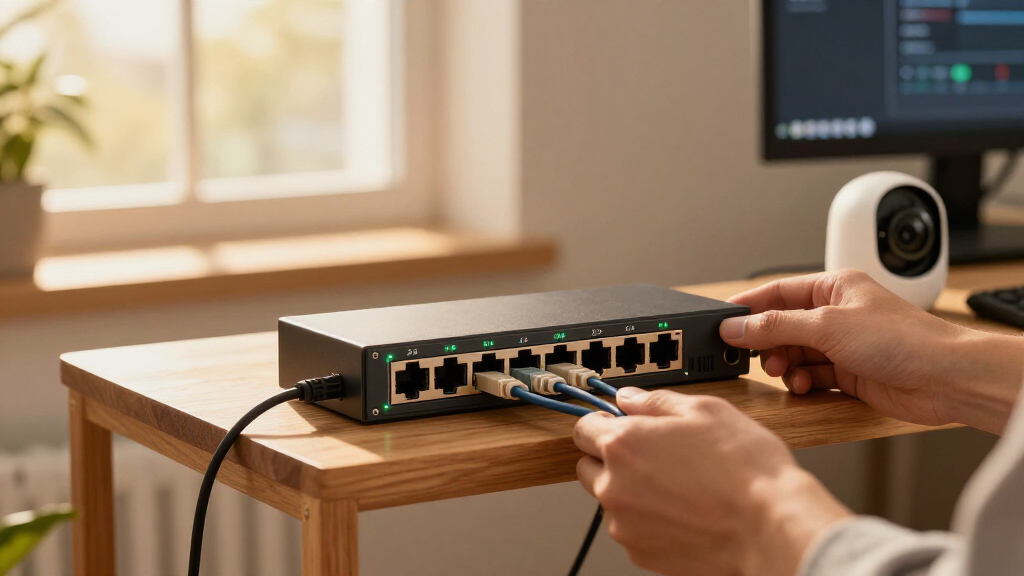
How We Picked
I evaluated these switches based on total PoE power budget, port density utility, and management capabilities relevant specifically to video surveillance. A switch might have 24 ports, but if the total power output is insufficient to drive all ports at full capacity, it fails as a camera hub. I prioritized models with at least 300W of power delivery to accommodate modern PTZ and 4K cameras, which draw more power than older analog equivalents.
Beyond raw specs, I assessed build quality and thermal management. Surveillance switches run 24/7, so passive cooling designs or high-quality fans are critical for longevity. I also weighed the value of VLAN support and SFP slots, recognizing that while not every user needs managed features, the ability to segment camera traffic is a significant security advantage. Products were ranked by how well they balanced these performance metrics with ease of use for the target audience.
| 24 port PoE switch for camera | Switch Type |
|---|---|
| YuanLey 26-Port Unmanaged PoE+ | Unmanaged |
| NICGIGA 24 Port PoE Switch Unm | Unmanaged |
| 24-Port Full Gigabit PoE+ Netw | Unmanaged |
| NETGEAR 24-Port PoE Gigabit Et | Unmanaged |
| TP-Link Omada SG3428MP 28-Port | — |
| NICGIGA 24-Port Gigabit PoE Sw | Unmanaged |
| TP-Link TL-SG1428PE | — |
| NETGEAR GS524UP 24-Port Gigabi | Unmanaged |
| NETGEAR GS524PP 24-Port Gigabi | Unmanaged |
| NETGEAR 28-Port PoE Gigabit Et | Smart Managed |
Factors to Consider When Choosing Best 24 Port PoE Switch For Cameras
Selecting the right switch involves more than counting ports. Here are the specific factors that determine whether a switch will sustain your camera network or fail under load.
Understanding PoE Power Budgets
The total PoE budget is the maximum amount of power the switch can distribute across all ports simultaneously. Many buyers make the mistake of assuming a ’24-port PoE’ label means each port can deliver full power at once. In reality, if you connect 24 cameras that each require 12 watts, you need a switch with at least a 288-watt budget. If the budget is only 200 watts, the switch will drop connections to lower-priority ports or shut down entirely. Always calculate the maximum power draw of your specific camera models and add a 20% buffer for future expansions or cable loss.
Unmanaged vs. Managed Switches
Unmanaged switches are plug-and-play devices with no configuration options, making them ideal for simple, isolated camera networks. They are cheaper and easier to deploy but offer no way to prioritize video traffic over other data. Managed switches, particularly L2+ models, allow you to create VLANs (Virtual Local Area Networks) to separate camera data from your office or home Wi-Fi. This isolation prevents a bandwidth-heavy camera stream from slowing down your computer and adds a layer of security by keeping surveillance data on a separate logical network. For business environments, managed switches are generally the safer choice.
Uplink Speed and SFP Flexibility
The uplink ports connect your switch to your Network Video Recorder (NVR) or main router. If these ports are only 10/100 Mbps, they will create a severe bottleneck when multiple high-resolution cameras stream data simultaneously. Look for switches with Gigabit uplinks (10/100/1000 Mbps) or, better yet, SFP slots that allow for fiber optic connections. Fiber uplinks are essential if your NVR is located far from the switch, as copper Ethernet is limited to 100 meters. The ability to use SFP modules provides future-proofing for longer distances or higher bandwidth needs.
Heat Dissipation and Build Quality
Surveillance switches operate continuously, generating heat from both the switching chips and the PoE power conversion. Metal casings generally dissipate heat better than plastic ones, extending the lifespan of internal components. Check for fanless designs in smaller setups, which are silent and have no moving parts to fail, but ensure they are rated for the ambient temperature of your installation location. In server rooms or enclosed cabinets, active cooling or high-quality passive heat sinks are necessary to prevent thermal throttling, which can cause packet loss and video artifacts.
Port Isolation and Security Features
For unmanaged switches, look for Port Isolation or VLAN Mode switches. This feature prevents devices connected to PoE ports from communicating with each other, only allowing them to talk to the uplink port. This is critical for security, as it stops a compromised camera from accessing other cameras or your local network. Managed switches offer more granular control, allowing you to set ACLs (Access Control Lists) and Storm Control to prevent broadcast storms from disrupting the network. If you cannot afford a managed switch, port isolation is the minimum security standard you should demand.
Frequently Asked Questions
Can I use a 24-port PoE switch for devices other than cameras?
Yes, but you must ensure the devices are PoE-compatible and do not exceed the voltage standards supported by the switch. Most modern PoE switches support 802.3af and 802.3at standards, which cover wireless access points, IP phones, and PoE-enabled lighting. However, be cautious with non-standard devices that might draw more power than expected, as this can trip the switch’s protection circuits. Always check the power requirements of your non-camera devices to ensure they fall within the switch’s per-port and total budget limits.
Do I need a managed switch if my camera network is isolated?
If your camera network is physically isolated—meaning the switch is connected only to the NVR and not to your general internet or office network—an unmanaged switch is often sufficient. You do not need VLANs or QoS features if no other traffic shares the path. However, if you ever plan to integrate remote viewing or cloud storage, a managed switch provides better control and security. For strictly local, closed-loop systems, saving money on an unmanaged model is a valid strategy, provided the power budget is adequate.
What happens if I exceed the PoE power budget?
When the total power draw exceeds the switch’s budget, the switch will typically stop powering new devices or drop power from existing ones based on priority settings. In unmanaged switches, this can lead to random camera dropouts or failure to boot. Managed switches allow you to set port priorities, ensuring critical cameras stay online while lower-priority devices are shed. Exceeding the budget does not usually damage the switch due to built-in protection, but it renders the system unreliable and difficult to troubleshoot.
Are SFP ports necessary for a home security system?
For most home systems, SFP ports are unnecessary unless you are running fiber optics between buildings or over long distances. Copper Ethernet cables can reliably transmit data up to 100 meters, which covers most residential properties. SFP ports are more relevant for large commercial campuses or industrial sites where distances exceed copper limits. However, having SFP slots provides flexibility if you decide to upgrade your network infrastructure later, making them a worthwhile feature for future-proofing even in smaller setups.
How does VLAN mode improve camera security?
VLAN mode segregates camera traffic into a separate logical network, preventing cameras from communicating with each other or with devices on your main network. This contains breaches; if a hacker compromises one camera, they cannot use it as a bridge to access your computers or file servers. It also reduces broadcast traffic, improving overall network performance. On unmanaged switches with VLAN mode, this is a simple hardware switch setting. On managed switches, it requires configuration but offers deeper control over which devices can access which segments.
Conclusion
Choosing the right switch depends on your specific infrastructure needs. For the best overall balance of power and reliability, the NETGEAR GS524PP is the standout choice for most users. If you are a beginner or managing a small, isolated system, the YuanLey 26-Port Unmanaged PoE+ Switch offers excellent value and simplicity. For premium security and large-scale deployments requiring traffic isolation, the TP-Link Omada SG3428MP is the superior managed option. Those on a tight budget should look at the NICGIGA 24-Port PoE Switch, which provides essential features without the premium branding cost. Match your choice to your camera count and power needs, and prioritize power budget over port count to avoid connectivity issues.
Halloween Picks
halloween
As an affiliate, we earn on qualifying purchases.