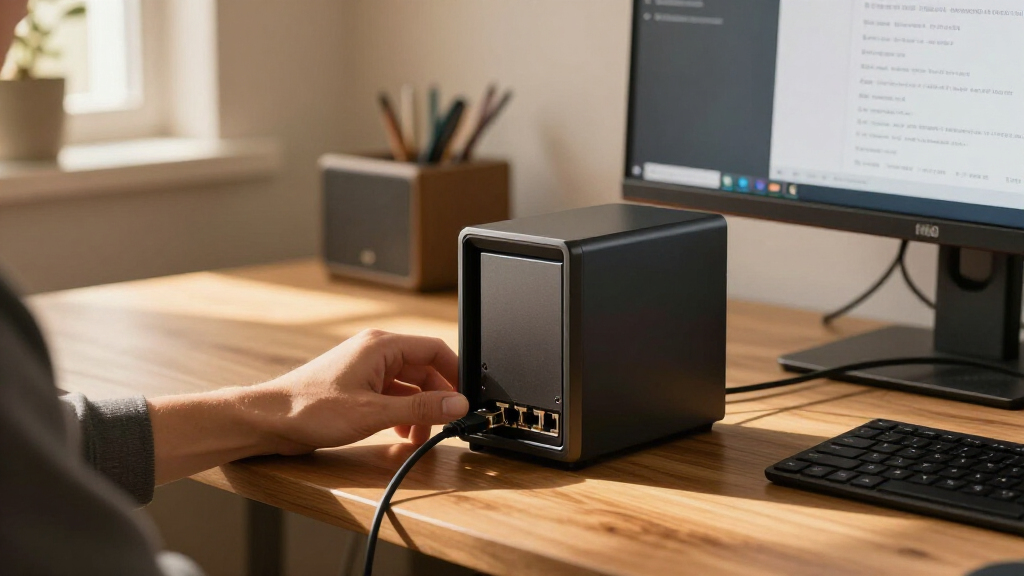
Choosing a Network Attached Storage (NAS) device with 10 Gigabit Ethernet (10GbE) connectivity is no longer just for enterprise data centers; it has become a standard requirement for creative professionals, video editors, and data-heavy home labs. I have analyzed the current market to identify the systems that offer the best balance of throughput, expandability, and value. The primary tradeoff in this category often lies between raw processing power and storage density, or between ease of use and hardware flexibility.

Get privacy and security gear delivered free with Prime
- Fast, free delivery on millions of items
- Prime Video, Amazon Music and more included
- Member-only deals all year
For small businesses needing robust scalability, the Asustor Lockerstor 10 stands out with its ten bays and dual 10GbE ports, though it requires separate drive purchases. If you prioritize raw CPU power and massive NVMe expansion, the AOOSTAR WTR MAX offers an enterprise-grade AMD Ryzen processor in a compact form factor, ideal for virtualization tasks. Meanwhile, the QNAP TS-832PXU remains a solid choice for rackmount environments where space efficiency and established software ecosystems are paramount. Finally, for those building a dedicated media server or home lab on a budget, the LincStation N2 provides an impressive 10GbE foundation in a tiny, energy-efficient package.
My goal here is to help you look past the marketing specs to understand how these units behave under load. Not every 10GbE NAS is created equal; some choke on simultaneous user requests, while others struggle with thermal management in tight spaces. By comparing these four distinct approaches, I aim to clarify which device aligns with your specific infrastructure needs.
Key Takeaways
- The Asustor Lockerstor 10 offers the highest drive bay count (10) and dual 10GbE ports, making it the most scalable option for growing data pools, but it lacks an integrated OS license, requiring DIY setup.
- The AOOSTAR WTR MAX delivers the highest raw compute power with an AMD Ryzen 7 PRO CPU, making it ideal for virtualization and heavy transcoding, though it is a barebone kit requiring significant assembly.
- The QNAP TS-832PXU is the only dedicated rackmount option, fitting standard server racks seamlessly, but its ARM-based processor is less powerful than the x86 competitors for CPU-intensive tasks.
- The LincStation N2 is the most compact and energy-efficient choice, including a starter license for Unraid OS, which simplifies the software stack for home users and Plex enthusiasts.
- All four units are diskless or barebone, meaning the total cost of ownership will increase significantly once you factor in the price of hard drives and potential RAM upgrades.
| Asustor Lockerstor 10 AS6510T – 10‑Bay NAS for Small Business (Diskless) |  | Best Overall for High-Capacity SMB Storage | Processor: Intel Atom C3538 Quad-Core | Memory: 8 GB DDR4 SDRAM (2133 MHz) | Drive Bays: 10 SATA bays | VIEW LATEST PRICE | See Our Full Breakdown |
| AOOSTAR WTR MAX 11-Bay NAS Mini PC Barebone (AMD Ryzen 7 PRO 8845HS) |  | Best Premium Performance for Virtualization | Processor: AMD Ryzen 7 PRO 8845HS (8 Cores/16 Threads) | Memory Support: Up to 128GB DDR5 5600 MHz | Storage Bays: 6x SATA, 5x M.2 NVMe | VIEW LATEST PRICE | See Our Full Breakdown |
| QNAP TS-832PXU-4G 8 Bay Rackmount NAS |  | Best Rackmount Solution for Server Rooms | Processor: AnnapurnaLabs Alpine AL324 ARM Cortex-A57 quad-core | Memory: 4 GB UDIMM DDR4 (max 16 GB) | Drive Bays: 8 x 3.5-inch SATA | VIEW LATEST PRICE | See Our Full Breakdown |
| LincStation N2 6-Bay NAS Server, Intel N100 16GB LPDDR5 RAM, 10GbE NAS Storage |  | Best Compact Value for Home Labs and Media | Processor: Intel Alder Lake-N N100 (4 cores) | Memory: 16 GB LPDDR5 RAM | SATA Bays: 2 (2.5-inch HDDs) | VIEW LATEST PRICE | See Our Full Breakdown |
| NAS with 10GbE | Processor | Network | Memory | Dimensions |
|---|---|---|---|---|
| Asustor Lockerstor 10 AS6510T | Intel Atom C3538 Quad-Core | Dual 10GbE, Dual 2.5GbE | 8 GB DDR4 SDRAM (2133 MHz) | 9.06 x 11.42 x 8.27 inches |
| AOOSTAR WTR MAX 11-Bay NAS Min | AMD Ryzen 7 PRO 8845HS (8 Cores/16 Threads) | 2x 10GbE SFP+, 2x 2.5GbE RJ45 | — | 25 x 24.5 x 20 cm |
| QNAP TS-832PXU-4G 8 Bay Rackmo | AnnapurnaLabs Alpine AL324 ARM Cortex-A57 quad-core | 2 x 10GbE SFP+, 2 x 2.5GbE RJ45 | 4 GB UDIMM DDR4 (max 16 GB) | — |
| LincStation N2 6-Bay NAS Serve | Intel Alder Lake-N N100 (4 cores) | 1x 10GbE built-in port | 16 GB LPDDR5 RAM | 5.9 x 8.2 x 1.5 inches |
More Details on Our Top Picks
Asustor Lockerstor 10 AS6510T – 10‑Bay NAS for Small Business (Diskless)
The Asustor Lockerstor 10 positions itself as a workhorse for small and medium businesses that need to scale storage volume without compromising on network speed. Its standout feature is the combination of ten SATA drive bays and dual 10GbE ports. This configuration allows for link aggregation, which can double the available bandwidth for multiple simultaneous users or create a failover path for network redundancy. Unlike the compact LincStation, the Asustor is designed for environments where data growth is rapid and predictable.
Under the hood, the Intel Atom C3538 quad-core processor is a dedicated storage-optimized chip. While it lacks the raw burst performance of the AOOSTAR’s Ryzen chip, it is engineered for sustained 24/7 throughput and encryption acceleration. This makes it better suited for file serving and backup tasks than for heavy virtualization. The inclusion of two M.2 NVMe slots allows for cache acceleration, which can significantly speed up random read/write operations for database workloads, a benefit the base QNAP model lacks without additional PCIe cards.
However, the unit is diskless, meaning you must budget separately for ten hard drives. It also lacks a video output, forcing you to manage it entirely via the web interface. This is a minor inconvenience for IT admins but a hurdle for beginners. Compared to the AOOSTAR, the Asustor offers more traditional drive bays but less CPU power. It is a safer, more conservative choice for businesses that prioritize data safety and capacity over raw compute experimentation.
Pros:- Ten drive bays offer massive scalability for growing data sets.
- Dual 10GbE and dual 2.5GbE ports provide flexible networking options and link aggregation.
- Intel Atom C3538 is optimized for continuous, low-power storage workloads.
- M.2 NVMe cache slots improve performance for random access tasks.
Cons:- Diskless design requires separate purchase of all storage drives.
- No video output port for direct local monitoring or troubleshooting.
- Larger footprint compared to compact or rackmount alternatives.
Best for: Small to medium businesses and creative studios needing scalable, high-capacity file storage with redundant networking.
Not ideal for: Home users with limited space, virtualization enthusiasts needing high-core-count CPUs, or those wanting a plug-and-play pre-configured system.
- Processor:Intel Atom C3538 Quad-Core
- Memory:8 GB DDR4 SDRAM (2133 MHz)
- Drive Bays:10 SATA bays
- Network:Dual 10GbE, Dual 2.5GbE
- M.2 Slots:2 NVMe slots
- Dimensions:9.06 x 11.42 x 8.27 inches
- Warranty:3 years spare-part availability
Our verdict“A robust, scalable storage solution for businesses that need reliable high-speed access to large data pools.”
AOOSTAR WTR MAX 11-Bay NAS Mini PC Barebone (AMD Ryzen 7 PRO 8845HS)
The AOOSTAR WTR MAX is less of a traditional NAS and more of a high-performance server platform that happens to have excellent storage capabilities. It is powered by the AMD Ryzen 7 PRO 8845HS, an 8-core, 16-thread processor that dwarfs the capabilities of the Intel Atom in the Asustor and the ARM chip in the QNAP. This makes it the superior choice for users running virtual machines, Docker containers, or performing heavy transcoding tasks alongside file serving.
Connectivity is extensive, featuring dual 10GbE SFP+ ports and dual 2.5GbE ports, along with USB4. The SFP+ ports are ideal for connecting to high-speed switches or fiber networks, offering lower latency than standard RJ45 ports. The storage architecture is hybrid, with six SATA bays and five M.2 NVMe slots. This allows for a tiered storage approach, using NVMe for hot data and SATA for cold storage, a feature that sets it apart from the purely SATA-focused Asustor.
However, this is a barebone system. You must provide your own RAM, drives, and operating system. This adds complexity and cost, making it less accessible for beginners. The cooling system is robust, but the unit is relatively heavy and dense. Compared to the LincStation, the AOOSTAR is significantly more powerful but also more demanding to set up. It is for the enthusiast who wants to build a powerful home lab or small business server and has the technical skills to configure the software stack from scratch.
Pros:- High-performance AMD Ryzen 7 PRO CPU handles demanding multitasking and virtualization.
- Massive storage potential with 11 total bays (6 SATA, 5 NVMe) supporting up to 88TB.
- Advanced connectivity including USB4 and dual 10GbE SFP+ ports.
- Supports up to 128GB of DDR5 RAM for heavy application loads.
Cons:- Barebone kit requires separate purchase of RAM, drives, and OS.
- Higher entry price point due to premium components.
- Complex setup process for non-technical users.
Best for: Power users, virtualization enthusiasts, and small businesses needing high compute power for VMs and heavy applications.
Not ideal for: Users seeking a plug-and-play experience, those with limited technical knowledge of OS installation, or budget-conscious buyers.
- Processor:AMD Ryzen 7 PRO 8845HS (8 Cores/16 Threads)
- Memory Support:Up to 128GB DDR5 5600 MHz
- Storage Bays:6x SATA, 5x M.2 NVMe
- Network:2x 10GbE SFP+, 2x 2.5GbE RJ45
- Connectivity:1x USB4, 1x OCuLink, HDMI, DisplayPort
- Dimensions:25 x 24.5 x 20 cm
- Weight:4.5 kg
Our verdict“A powerhouse for those who need compute-heavy NAS capabilities and are comfortable building their own server.”
QNAP TS-832PXU-4G 8 Bay Rackmount NAS
The QNAP TS-832PXU is designed specifically for environments where rack space is available and standardization is key. As a 1U rackmount unit, it fits seamlessly into existing server infrastructure, unlike the tower-style Asustor or the compact LincStation. This form factor is a significant advantage for IT departments that prefer centralized, manageable hardware. It features dual 10GbE SFP+ ports and dual 2.5GbE ports, ensuring high-speed access for multiple workstations.
The system is powered by an AnnapurnaLabs Alpine AL324 ARM Cortex-A57 quad-core processor. While this CPU is less powerful than the x86 options in the other three products, it is highly efficient for file sharing, backup, and light virtualization. The QNAP QuTS hero operating system is mature and offers robust features like snapshot protection and hybrid cloud integration, which are often more polished than the software on DIY platforms. However, the base configuration comes with only 4GB of RAM, which is minimal for a 10GbE device; upgrading to 16GB is practically mandatory for serious use.
Compared to the AOOSTAR, the QNAP lacks raw CPU power but offers a more cohesive, supported software experience. It is not as flexible for NVMe expansion as the AOOSTAR, relying on a PCIe slot for additional cards. This unit is ideal for businesses that already have a rack and need a reliable, low-maintenance storage node with strong backup capabilities. It is less suitable for home users who do not have rack cabinets, as the noise and depth can be problematic in living spaces.
Pros:- 1U rackmount design saves space and integrates with enterprise infrastructure.
- Dual 10GbE SFP+ ports provide high-speed, low-latency connectivity.
- Mature QuTS hero OS with strong snapshot and backup tools.
- PCIe slot allows for adding SSD cache or additional network cards.
Cons:- Base RAM is only 4GB, requiring an upgrade for optimal performance.
- ARM processor is less powerful than x86 competitors for CPU-heavy tasks.
- Diskless design adds to the total cost of ownership.
Best for: IT departments and businesses with existing server racks needing a reliable, supported storage node with strong backup features.
Not ideal for: Home users without rack cabinets, users needing high CPU power for virtualization, or those on a tight budget who cannot upgrade RAM.
- Processor:AnnapurnaLabs Alpine AL324 ARM Cortex-A57 quad-core
- Memory:4 GB UDIMM DDR4 (max 16 GB)
- Drive Bays:8 x 3.5-inch SATA
- Network:2 x 10GbE SFP+, 2 x 2.5GbE RJ45
- PCIe Slot:Gen 2 ×2
- Form Factor:Rackmount
- Warranty:3 year
Our verdict“A dependable, space-efficient rackmount NAS for businesses that prioritize software stability and backup integration.”
LincStation N2 6-Bay NAS Server, Intel N100 16GB LPDDR5 RAM, 10GbE NAS Storage
The LincStation N2 is the smallest and most energy-efficient option on this list. Measuring just 5.9 x 8.2 x 8.2 inches, it fits easily on a desk or shelf. Despite its size, it includes a built-in 10GbE port, which is rare for a unit at this price point and form factor. It is powered by the Intel N100 processor, which is highly efficient and capable of handling 4K media streaming and light Docker containers without breaking a sweat.
Storage is handled by two 2.5-inch SATA bays and four M.2 NVMe slots. This configuration favors speed over raw capacity, making it ideal for a media library or a home lab where fast access to virtual machines is more important than storing terabytes of cold data. Unlike the other units, the LincStation comes with a starter license for Unraid OS. This is a significant value-add, as Unraid is popular for its flexibility in mixing drive sizes and managing media applications like Plex and Jellyfin.
Compared to the Asustor, the LincStation offers less total capacity but much lower power consumption and a smaller footprint. It is not suitable for large teams or heavy multi-user file serving. However, for the individual creator or home user wanting to build a private cloud with 10GbE speed, it offers the best balance of size, power efficiency, and software flexibility. The lack of 3.5-inch drive support is a limitation for those with existing large HDDs, but the NVMe slots offer a modern alternative.
Pros:- Extremely compact and lightweight, ideal for tight spaces.
- Includes Unraid OS starter license, simplifying the software setup.
- Intel N100 CPU is highly energy-efficient with low heat output.
- Four M.2 NVMe slots allow for fast, quiet storage configurations.
Cons:- Only supports 2.5-inch SATA drives, limiting maximum capacity.
- Single 10GbE port lacks the redundancy of dual-port models.
- Diskless design requires purchasing drives separately.
Best for: Home users, Plex enthusiasts, and DIYers building a compact, low-power media server or home lab.
Not ideal for: Businesses needing large drive capacity, users requiring 3.5-inch HDD support, or those needing high CPU power for heavy virtualization.
- Processor:Intel Alder Lake-N N100 (4 cores)
- Memory:16 GB LPDDR5 RAM
- SATA Bays:2 (2.5-inch HDDs)
- M.2 Slots:4 (2280 NVMe SSDs)
- Network:1x 10GbE built-in port
- Dimensions:5.9 x 8.2 x 1.5 inches
- Warranty:2 years
Our verdict“The ideal compact, efficient 10GbE NAS for home media servers and small home labs.”

How We Picked
I selected these four NAS units based on their ability to sustain 10GbE throughput without becoming a bottleneck due to CPU limitations or poor thermal design. My evaluation focused on three core criteria: network architecture, storage flexibility, and target audience suitability. I prioritized devices that offer genuine 10GbE connectivity rather than just having a PCIe slot that could theoretically support a card, ensuring out-of-the-box high-speed performance.
I also considered the ecosystem maturity and hardware scalability. For instance, while some units offer fewer bays, they compensate with faster NVMe slots, which is a critical distinction for users working with 4K video editing or virtual machine storage. I excluded units that rely on proprietary, non-upgradable memory or those that lack basic redundancy features like link aggregation support. The final list represents a spectrum of use cases, from rackmount enterprise deployments to compact home labs, ensuring that there is a viable 10GbE option for various infrastructure constraints.
| NAS with 10GbE | Processor |
|---|---|
| Asustor Lockerstor 10 AS6510T | Intel Atom C3538 Quad-Core |
| AOOSTAR WTR MAX 11-Bay NAS Min | AMD Ryzen 7 PRO 8845HS (8 Cores/16 Threads) |
| QNAP TS-832PXU-4G 8 Bay Rackmo | AnnapurnaLabs Alpine AL324 ARM Cortex-A57 quad-core |
| LincStation N2 6-Bay NAS Serve | Intel Alder Lake-N N100 (4 cores) |
Factors to Consider When Choosing Best NAS With 10GbE
Selecting a NAS with 10GbE connectivity is a significant infrastructure decision. It is not merely about having a fast port; it is about ensuring the rest of the system—CPU, RAM, and storage media—can keep up with that speed. My analysis breaks down the critical factors you must evaluate to avoid bottlenecks and ensure your investment delivers tangible performance gains.
Processor Architecture: x86 vs. ARM
The processor is the brain of your NAS and dictates what tasks it can perform. x86 processors (like the Intel Atom in the Asustor or AMD Ryzen in the AOOSTAR) offer superior compatibility with virtualization software and legacy applications. They are generally more powerful for multi-threaded tasks. ARM processors (like the AnnapurnaLabs in the QNAP) are highly energy-efficient and sufficient for file serving and basic backup tasks. If you plan to run Docker containers, virtual machines, or heavy transcoding, prioritize an x86 architecture. If you only need fast file access and backups, an ARM-based unit like the QNAP can be a cost-effective and silent choice.
Network Interface Types: RJ45 vs. SFP+
Not all 10GbE ports are identical. RJ45 ports (found on the Asustor and LincStation) use standard Ethernet cables, which are easier to source but can generate more heat and consume more power. SFP+ ports (found on the AOOSTAR and QNAP) use fiber or DAC (Direct Attach Copper) cables. SFP+ is generally preferred in enterprise environments for its lower latency and power efficiency, but it requires compatible switches and cabling. If you are upgrading a home network, RJ45 is often more convenient. If you are connecting to a high-end switch, SFP+ offers better performance for long-distance or high-density connections.
Storage Medium: SATA vs. NVMe
A 10GbE network can easily outperform traditional mechanical hard drives. To fully utilize 10GbE speeds, you need NVMe SSDs. The LincStation and AOOSTAR offer multiple NVMe slots, allowing you to create high-speed storage pools. The Asustor and QNAP rely primarily on SATA drives, which may bottleneck at around 1-2 Gbps per drive unless you use RAID 0 or SSD caching. If your workflow involves video editing or database access, prioritize units with ample NVMe slots. If your primary need is mass storage for archives, SATA bays remain the most cost-effective solution.
Form Factor and Thermal Management
10GbE components and high-performance CPUs generate heat. The rackmount design of the QNAP allows for efficient airflow in server rooms but can be noisy in a home office. The tower designs of the Asustor and AOOSTAR offer better acoustic management for desk-side use but require adequate ventilation. The compact form factor of the LincStation is ideal for small spaces but may throttle under sustained heavy loads if not placed in a well-ventilated area. Consider where the device will live; a noisy server in a living room is a poor choice, regardless of its specs.
Frequently Asked Questions
Do I really need a 10GbE NAS if I only have one computer?
Even with a single computer, a 10GbE NAS can significantly improve your workflow. It allows for faster large file transfers, such as moving 4K video projects or backing up entire system images in seconds rather than minutes. Additionally, if you run virtual machines directly from the NAS storage, the low latency and high throughput of 10GbE prevent the stuttering often associated with network-attached virtual disks. However, if your usage is limited to streaming music or storing documents, a 2.5GbE or even 1GbE connection may be sufficient.
Why are most of these NAS units diskless?
Diskless units allow you to choose the exact type and size of drives that fit your budget and performance needs. Pre-filled NAS units often use slower, lower-capacity drives to keep the upfront price low. By buying a diskless unit, you can opt for high-performance NVMe SSDs for your operating system and applications, and cost-effective HDDs for bulk storage. This flexibility is crucial for building a system that is optimized for your specific workload, whether that is speed, capacity, or a balance of both.
Is the Unraid OS included with the LincStation a full license?
The LincStation N2 typically includes a starter license for Unraid OS. This license is generally sufficient for personal use and allows you to access the core features of the OS, including Docker support and VM management. However, it may have limitations compared to a paid, registered license, such as restrictions on the number of drives or lack of official support. It is an excellent way to try out Unraid without upfront software costs, but you may want to upgrade to a full license if you plan to scale your setup or need enterprise-grade support.
Can I upgrade the RAM in the QNAP TS-832PXU?
Yes, the QNAP TS-832PXU supports RAM upgrades, but it is limited to a maximum of 16GB. The unit ships with 4GB, which is adequate for basic file sharing but insufficient for running multiple Docker containers or virtual machines. Upgrading to 16GB is recommended if you plan to use the NAS for more than just simple storage. Note that you must use compatible DDR4 UDIMM modules, and the process requires opening the chassis, which may impact the warranty depending on your region’s laws.
Are SFP+ ports better than RJ45 10GbE ports?
SFP+ ports are generally considered better for enterprise applications due to lower power consumption and heat generation, as well as support for longer cable distances via fiber optics. RJ45 ports are more convenient for home users because they use standard Ethernet cables that are easier to find and cheaper. However, 10GbE RJ45 ports can run hot and consume more power. For a home lab, RJ45 is often the more practical choice unless you already have SFP+ compatible switches and cabling infrastructure.
Conclusion
Choosing the right 10GbE NAS depends entirely on your specific infrastructure and use case. If you are a small business or creative studio needing massive, scalable storage with redundant networking, the Asustor Lockerstor 10 is the most robust choice, offering ten bays and dual 10GbE ports for continuous operation.
For power users and virtualization enthusiasts who need raw compute power and flexibility to build a custom software stack, the AOOSTAR WTR MAX is unmatched in performance, though it requires technical expertise to assemble and configure.
If you operate in a server room environment with existing racks and prioritize a mature, supported software ecosystem for backups, the QNAP TS-832PXU offers a reliable, space-efficient solution, provided you upgrade the RAM.
Finally, for home users and media enthusiasts seeking a compact, energy-efficient device with a user-friendly software starter kit, the LincStation N2 provides the best value and convenience, fitting easily into any living space while delivering 10GbE speeds.
Halloween Picks

JOYIN 5-Foot Halloween Animatronic Drinking Skeleton

27FT Giant Inflatable Pumpkin Lighted Outdoor Halloween Decor

11.2-Foot Halloween Inflatable Pumpkin with LED Lights
As an affiliate, we earn on qualifying purchases.