
📊 Full opportunity report: The Critical Role Of Vision-Model Inspections In Food Safety Assurance on IdeaNavigator AI — validation score, market gap, and execution plan.

Get privacy and security gear delivered free with Prime
- Fast, free delivery on millions of items
- Prime Video, Amazon Music and more included
- Member-only deals all year
TL;DR
An AI-driven vision model is being piloted to improve food safety inspections in restaurants. It captures photos during daily checks, flags violations, and creates verifiable reports, potentially transforming compliance processes.
Restaurant operators are beginning to test an AI-based vision model for conducting kitchen safety inspections, aiming to replace traditional, often unverified checklists with verifiable, photo-based reports. This development could significantly enhance the accuracy and accountability of food safety compliance, crucial for public health and regulatory adherence.
The innovation involves using a vision model to analyze photographs taken during morning kitchen walk-throughs. Managers photograph key areas such as prep stations, storage, and sinks, and the AI flags violations with severity ratings. The system then generates timestamped reports, enabling better tracking of compliance trends across multiple restaurant locations.
This approach addresses a common problem: current checklists often record only that a task was checked, not the actual state of the kitchen. As a result, violations like uncovered containers or propped cooler doors may go unnoticed until a health inspection, when they are formally documented. The new system aims to provide a verifiable record that can be reviewed and audited, reducing reliance on subjective or incomplete manual checks.
The pilot involves running two weeks of walk-through photos from five restaurant locations through the AI model. The results will be compared against findings from a hired health-inspection consultant to assess accuracy and reliability. If successful, this could lead to a subscription-based service offering real-time, verifiable safety inspections for restaurant groups.
The Critical Role Of Vision-Model Inspections In Food Safety Assurance
A restaurant pilot is testing whether AI-analyzed kitchen photographs can turn routine walk-throughs into verifiable, timestamped safety records—flagging visible violations before they become inspection findings.
A checked box is not evidence of a safe kitchen.
Traditional checklists usually confirm that someone completed a task—not what the kitchen looked like at that moment. Photo-based analysis creates a reviewable record of actual conditions.
Records an action
Completion may be logged without proving the condition was properly inspected or corrected.
- Relies on staff observation and memory
- Can miss transient or subtle violations
- Offers limited evidence during audits
- Varies between shifts and locations
Records the condition
Images preserve visible kitchen conditions while AI applies consistent checks and severity labels.
- Creates verifiable photographic evidence
- Flags issues for rapid human review
- Produces timestamped, auditable reports
- Supports trend analysis across locations
From kitchen walk-through to accountable action.
The model is designed as an assistance and verification layer. Managers still conduct inspections; AI makes the observations more consistent, searchable and reviewable.
Capture
Managers photograph prep stations, food storage, coolers, sinks and sanitation areas.
Analyze
The vision model examines each image for visible food-safety violations.
Prioritize
Potential violations receive severity ratings to guide attention and corrective action.
Document
A timestamped report preserves evidence and enables comparison across shifts and sites.
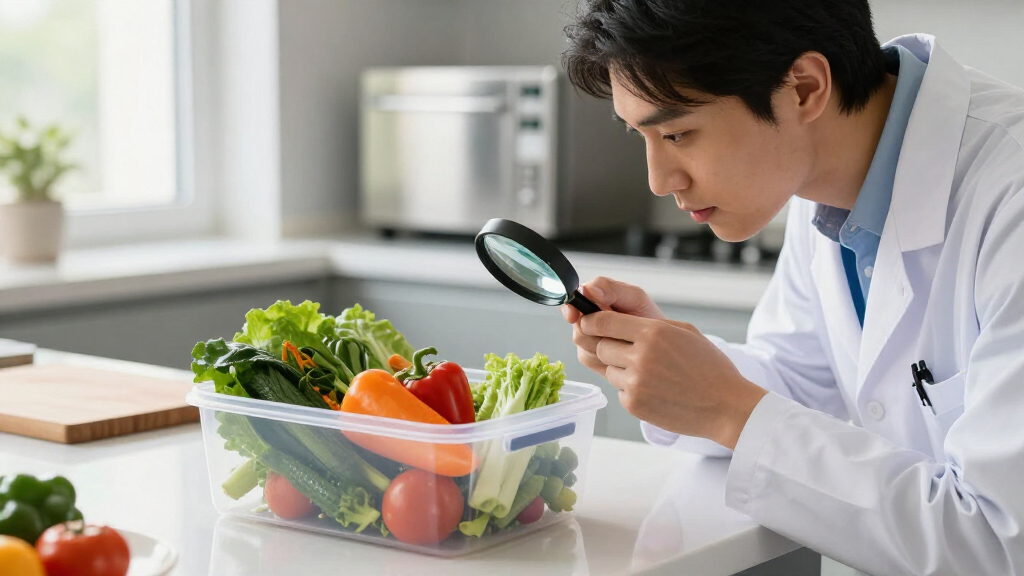
Visible conditions in focus
What the report adds
The promise depends on measured agreement with experts.
The restaurant group will compare the model’s flags with findings from a health-inspection consultant. Pilot results are pending, so effectiveness should be treated as unconfirmed.
| Evaluation dimension | Manual checklist | Vision model | Human consultant |
|---|---|---|---|
| Photographic verification | ✗ Usually absent | ✓ Built in | ✓ Can document |
| Consistency at scale | ~ Variable | ✓ Potentially high | ~ Resource limited |
| Contextual judgment | ~ Staff dependent | ~ Still validating | ✓ Strong |
| Timestamped audit trail | ~ Basic log | ✓ Detailed record | ✓ Formal report |
| Daily multi-site coverage | ~ Inconsistent | ✓ Designed to scale | ✗ Costly at frequency |
| Regulatory acceptance | ✓ Established | ~ Evolving | ✓ Established |
Verification can reshape safety operations.
If validated, visual AI could add a scalable evidence layer between routine staff checks and formal regulatory inspections—without removing human oversight.
Earlier intervention
Visible risks can be flagged during daily operations, supporting corrective action before violations persist or contribute to foodborne illness.
Multi-site consistency
Restaurant groups gain a common inspection standard and a clearer view of recurring issues across shifts, teams and locations.
Audit-ready evidence
Timestamped images and reports may streamline audits, strengthen accountability and reduce reliance on subjective recollection.
Using vision models to analyze photos from daily kitchen inspections could significantly improve verification and accountability in food safety.
Anonymous researcher / industry observationEvidence connects the kitchen to the compliance record.
Each stage adds context, but human review remains essential for ambiguous conditions, corrective decisions and regulatory judgment.
What must be resolved before broader adoption?
How accurate is the model?
Agreement with expert findings must be measured across varied lighting, layouts, equipment and kitchen conditions.
Will it replace inspectors?
No. The proposed role is to assist and verify routine checks, while trained people retain judgment and authority.
Can it scale affordably?
Subscription economics, image capture burden, system integration and staff adoption remain to be tested.
Will regulators accept the evidence?
Jurisdictions may require independent validation, clear standards and documented reliability before formal acceptance.
Enhanced Food Safety Verification Through AI
This development matters because it could transform how restaurant chains ensure food safety compliance. By making inspections more reliable and transparent, the AI model can help reduce violations, prevent foodborne illnesses, and improve regulatory adherence. It also offers a scalable solution for large multi-unit operations, where manual oversight can be inconsistent or incomplete.
Furthermore, verifiable inspection data could streamline audits and reduce liability for restaurant operators, while providing regulators with more accurate, timestamped records. As food safety remains a top priority for public health, innovations like this could become a standard part of operational protocols.
As an affiliate, we earn on qualifying purchases.
Growing Interest in AI for Food Safety Checks
Food safety inspections traditionally rely on manual checklists completed by staff or inspectors, which are often subject to human error or oversight. Recent advances in AI, particularly vision models capable of analyzing photos for violations, have opened new opportunities to automate and verify these inspections.
Previous efforts have focused on digital checklists or sensor-based monitoring, but visual AI offers a direct, scalable way to verify the actual state of kitchen environments. The concept of using AI for kitchen walk-throughs has been discussed in industry circles, but practical testing is only now beginning, with pilot programs like the one described here.
This initiative aligns with broader trends toward automation and data-driven compliance in the restaurant industry, driven by both technological feasibility and the need for more rigorous food safety standards.
“Using vision models to analyze photos from daily kitchen inspections could significantly improve verification and accountability in food safety.”
— an anonymous researcher
As an affiliate, we earn on qualifying purchases.
Unclear Effectiveness and Adoption Challenges
It is not yet confirmed how accurately the vision model will flag violations compared to human inspectors, nor how well it will perform across diverse kitchen environments. The pilot results are pending, and questions remain about scalability, cost, and integration with existing operations.
Additionally, regulatory acceptance of AI-verified inspections is still evolving, and some jurisdictions may require further validation before widespread adoption.
As an affiliate, we earn on qualifying purchases.
Next Steps in Pilot Testing and Validation
The restaurant group will analyze the two-week pilot data, comparing AI flags with expert assessments. If the results show high accuracy, the system could be rolled out more broadly, with a subscription model for multiple locations. Further validation and regulatory engagement will likely follow to establish credibility and compliance standards.
Additional development may include refining the AI’s violation severity ratings and expanding the types of violations it can detect, moving toward a comprehensive, automated food safety verification system.
verifiable kitchen safety report tools
As an affiliate, we earn on qualifying purchases.
As an affiliate, we earn on qualifying purchases.
Key Questions
How does the vision model improve food safety inspections?
The model analyzes photographs taken during inspections to identify violations automatically, providing verifiable, timestamped reports that reduce reliance on manual checklists.
Will this replace human inspectors?
It is intended as a tool to assist and verify human inspections, not fully replace them. It aims to enhance accuracy and accountability, especially for routine checks.
What types of violations can the AI detect?
Initially, the system focuses on violations like uncovered containers, missing date labels, propped cooler doors, and sanitation issues, with potential to expand to other common violations.
When will this technology be widely available?
The pilot results are expected within a few weeks. If successful, a commercial rollout could follow within the next year, depending on validation and regulatory approval.
Are there regulatory hurdles for AI-based inspections?
Yes, regulators may require validation of AI accuracy and reliability before accepting automated inspection reports, which could influence adoption timelines.
Source: IdeaNavigator AI
Halloween Picks
halloween
As an affiliate, we earn on qualifying purchases.