
📊 Full opportunity report: Dollar Cost Calculator For Investors Questioning Fees on IdeaNavigator AI — validation score, market gap, and execution plan.

Get privacy and security gear delivered free with Prime
- Fast, free delivery on millions of items
- Prime Video, Amazon Music and more included
- Member-only deals all year
TL;DR
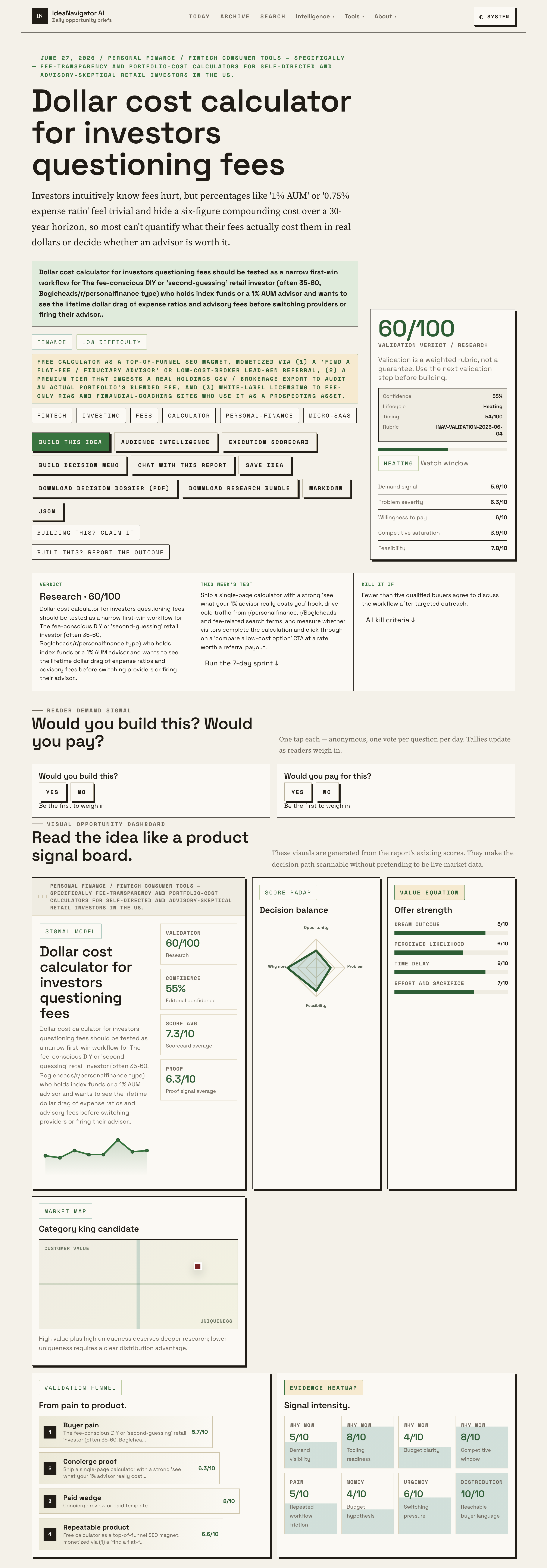
A new online calculator allows fee-conscious investors to quantify the total dollar drag of expense ratios and advisory fees over their investment horizon. This tool aims to improve fee awareness among retail investors, especially those holding index funds or using AUM advisors. Its launch signals a shift toward greater fee transparency in personal finance.
A new web-based dollar cost calculator has been introduced to help retail investors quantify the lifetime dollar impact of expense ratios and advisory fees. The tool is aimed at fee-conscious DIY investors and those second-guessing their financial advisors, providing a clear picture of how fees erode investment growth over time. This development comes amid rising fee awareness and changing regulatory landscapes, making fee transparency more critical than ever.
The calculator, still in its initial testing phase, prompts users to input their current investment balance, monthly contributions, investment horizon, expected annual return, and fee rates (including expense ratios and AUM advisory fees). It then outputs the total dollars lost to fees over the specified period, the ending balance gap compared to a low-cost baseline, and the proportion of withdrawals consumed by fees. Users can generate a shareable PDF or chart without needing to log in, making it accessible and easy to share.
Developed as a minimal viable product (MVP), the tool aims to serve as a top-of-funnel SEO asset and lead generator for fee-focused financial services. It is designed to be integrated into personal finance websites, robo-advisors, and fee-only RIA platforms, with monetization options including referral links to low-cost brokers, premium portfolio fee audits, and white-label licensing for financial coaching sites.
Why This Calculator Changes Fee Awareness
This calculator addresses a key gap in investor knowledge: many retail investors underestimate or cannot quantify how fees impact their long-term wealth. While percentages like 1% AUM or 0.75% expense ratios seem trivial, they can compound into six-figure losses over decades. By providing a concrete dollar figure, the tool empowers investors to make more informed decisions about switching providers or firing advisors. As fee transparency becomes a regulatory and consumer priority, tools like this could shift the landscape of retail investing.
As an affiliate, we earn on qualifying purchases.
Rising Focus on Fee Transparency in Personal Finance
Over recent years, there has been increased scrutiny of investment fees, especially as low-cost index funds and robo-advisors have normalized sub-0.10% costs. Regulatory changes, such as the 2024 Department of Labor fiduciary rule, aimed to enhance fee transparency, but the rule was vacated in 2026, restoring non-fiduciary advice and shifting the burden of fee scrutiny back onto investors. Meanwhile, awareness campaigns and online communities like Bogleheads and personal finance forums have amplified investor focus on fees.
The new calculator responds to this environment by offering a simple, accessible way for investors to see the real dollar impact of fees, helping them evaluate whether their current advisors or fund choices are cost-effective over their investment horizon.
As an affiliate, we earn on qualifying purchases.
Unanswered Questions About Adoption and Effectiveness
It is not yet clear how widely the calculator will be adopted or whether it will significantly influence investor decisions. Effectiveness depends on user engagement, understanding, and whether investors act on the insights provided. Further testing and user feedback will be necessary to determine its long-term impact on fee-related choices.
As an affiliate, we earn on qualifying purchases.
Next Steps for Deployment and Validation
The developers plan to launch the calculator publicly, promote it through personal finance communities, and track user engagement and conversion rates. They aim to refine the tool based on feedback, expand its features—such as portfolio fee auditing—and explore partnerships with financial advisory platforms. Monitoring how many users compare their current fees to low-cost alternatives will be key to assessing its potential to influence fee negotiations or provider switches.
As an affiliate, we earn on qualifying purchases.
Key Questions
How accurate is the calculator in estimating lifetime fees?
The calculator provides estimates based on user inputs for balance, contributions, returns, and fees. Its accuracy depends on the accuracy of these inputs and assumptions about consistent returns and fee rates over time.
Can I use the calculator for my current investment portfolio?
Yes, the calculator can be used to simulate your current holdings by inputting your balances, contributions, and fees. Future versions aim to allow importing actual brokerage data for more precise analysis.
Will this tool help me decide whether to fire my advisor?
The calculator can show you how much fees are costing you over time, which may inform your decision. However, it does not account for other factors like service quality or investment performance.
Is the calculator free to use?
Yes, the initial version is planned as a free tool, with monetization options including referrals and premium features for portfolio fee analysis.
When will the calculator be available to the public?
Deployment is currently in testing; a broader rollout is expected in the coming months after further refinement and feedback collection.
Source: IdeaNavigator AI
Halloween Picks
halloween
As an affiliate, we earn on qualifying purchases.