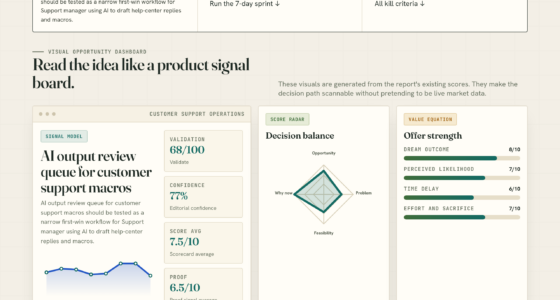

📊 Full opportunity report: Harnessing Talent Density For More Effective AI Development on ThorstenMeyerAI.com — validation score, market gap, and execution plan.

Get privacy and security gear delivered free — and shop member deals
- Fast, free delivery on millions of items
- Access to Prime Big Deal Days deals on October 6–7
- Prime Video, Amazon Music and more included
TL;DR
AI-native companies are demonstrating unprecedented productivity by focusing on talent density—small, high-capability teams that leverage AI tools. This shift is enabling firms to scale rapidly with fewer employees, fundamentally changing traditional metrics and organizational models.
AI-native companies in 2026 are surpassing traditional productivity metrics by focusing on talent density—small, high-performing teams leveraging AI tools to achieve outsized results. This shift is redefining organizational scale and efficiency, making talent concentration a key driver of growth and innovation.
Recent data shows that companies like Midjourney, Cursor, Gamma, and Lovable are posting revenue per employee figures ranging from $3.3 million to nearly $4.7 million, far exceeding traditional SaaS benchmarks of $130,000 to $400,000. These companies operate with teams of fewer than 100 people, yet generate hundreds of millions in revenue, demonstrating a new productivity paradigm driven by AI integration.
Experts attribute this phenomenon to the absorption of entire functions—such as support and content creation—into AI-powered software, reducing headcount without sacrificing output. Additionally, a small, dense team of individuals with expertise in AI capabilities, customer understanding, and product taste can operate at a scale previously thought impossible, thanks to the multiplier effect of AI leverage.
While these figures are compelling, analysts caution that some of the reported revenue per employee may be inflated due to last-month annualization and rapid growth rates. Nonetheless, the trend indicates a fundamental shift in how organizations operate and scale in the AI era.
For a decade, revenue per employee was stable and boring. AI-native companies posted figures that don’t fit on the same chart — a 10-to-38× break.
Why Talent Density Is a Game-Changer in AI Economy
This shift to talent density fundamentally alters organizational efficiency, enabling small teams to serve millions and scale rapidly without the traditional overhead. It challenges long-held metrics like revenue per employee and emphasizes the importance of high-skill, AI-savvy individuals in driving growth. For investors and executives, understanding and cultivating talent density will be critical to competing effectively in the evolving AI landscape.
As an affiliate, we earn on qualifying purchases.
Emergence of AI-Driven Organizational Models
Historically, software companies relied on large workforces—Google with 32,000 employees at $30 billion revenue, or Salesforce with nearly 79,000—to scale. In 2026, AI-native firms are breaking this mold, reaching billions in revenue with a fraction of the workforce. This change is rooted in the ability of AI to absorb functions, reduce coordination overhead, and amplify individual capabilities, creating a new operating mode centered on talent density.
This development builds on earlier insights from management philosophies like Netflix’s 'talent density,' now amplified by AI’s multiplier effect, which allows a small number of highly capable individuals to operate at a scale once reserved for much larger teams.
"Talent density is not just about efficiency; it’s a different operating mode that becomes possible only above a certain concentration of capability. AI accelerates this shift, enabling small teams to serve millions."
— Thorsten Meyer
As an affiliate, we earn on qualifying purchases.
Uncertainties Around Long-Term Sustainability
It remains unclear whether the current high revenue per employee figures are sustainable over the long term or primarily a result of rapid growth and last-month annualization. The extent to which talent density can be maintained as companies scale further, and whether this model is universally applicable across different sectors, is still under investigation.
AI-powered team collaboration tools
As an affiliate, we earn on qualifying purchases.
As an affiliate, we earn on qualifying purchases.
Future Developments in AI-Driven Talent Strategies
Expect continued experimentation with team structures and AI integration, alongside more rigorous analysis of revenue sustainability. Investors and companies will likely focus on identifying the key skills that constitute talent density and developing strategies to attract and retain such talent. Additionally, regulatory and ethical considerations around AI use and workforce composition are poised to influence this evolution.
high-performance laptop for AI development
As an affiliate, we earn on qualifying purchases.
As an affiliate, we earn on qualifying purchases.
Key Questions
What exactly is talent density in an AI context?
Talent density refers to the concentration of highly capable, AI-savvy individuals within a team who leverage AI tools to perform functions traditionally requiring larger groups, enabling faster decision-making and higher productivity.
How are companies achieving such high revenue per employee?
By integrating AI to automate and absorb functions like support, content creation, and design, and by assembling small, expert teams with deep AI fluency, companies can generate outsized revenue with fewer staff.
Is this model applicable across all industries?
While promising, the model's applicability depends on the nature of the industry and tasks involved. Sectors heavily reliant on routine processes may benefit more quickly, but broader adoption will require further validation.
What are the risks of relying on talent density?
Overreliance on a small number of high-capability individuals may pose risks related to talent retention, organizational resilience, and potential bottlenecks if key personnel leave or if AI models encounter limitations.
Source: ThorstenMeyerAI.com
Halloween Picks
halloween
As an affiliate, we earn on qualifying purchases.