
🔍 Read the full analysis: IBM’s CEO On The Business Case For On-Prem AI on ThorstenMeyerAI.com

Get privacy and security gear delivered free with Prime
- Fast, free delivery on millions of items
- Prime Video, Amazon Music and more included
- Member-only deals all year
TL;DR
IBM CEO Arvind Krishna said open-weight AI models can deliver about 90% of frontier-model performance at 10% to 25% of the token cost, arguing that some enterprises should run them on their own infrastructure. Independent benchmark figures in the source put the leading downloadable model at 80% of the leading proprietary model; the economics of buying hardware also depend heavily on usage, staffing and operating costs.
IBM CEO Arvind Krishna used the company’s October 21 earnings call to argue that enterprises can run open-weight AI models on their own infrastructure at a fraction of frontier-model token costs. He said the models can be “90% as effective” while costing 10% to 25% as much, a case with direct relevance to companies weighing cloud bills against hardware, staffing and data-control requirements.
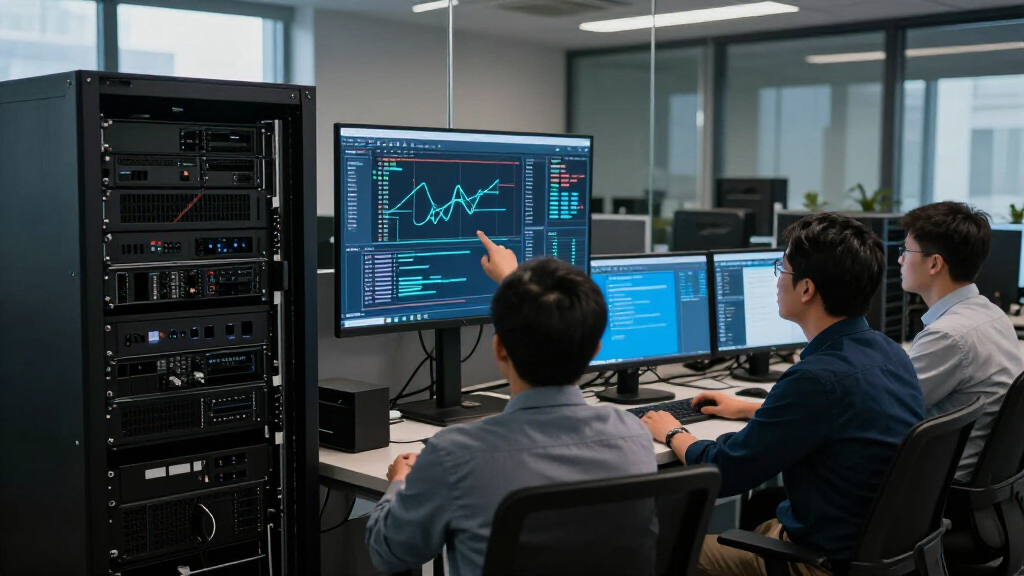
Krishna said some large enterprises could begin with “two or three racks” of equipment. He pointed to routine tasks such as summarizing email, reviewing contracts, answering customer calls and drafting messages as work that may not require the most capable available model. He also argued that open-weight models give customers permission to run them on-premises or in private clouds, and that organizations in sectors such as banking may want control over their data and logs.
The 90% figure was an illustration in Krishna’s answer, not a result tied to a named benchmark. Artificial Analysis figures cited in the source, read on October 26, show its leading downloadable model, Xiaomi’s MiMo-V2.6-Pro, at 46.3 points, compared with 57.6 for the leading proprietary model, Claude Opus 5.5. That makes the open model about 80% of the proprietary score on that index. The comparison is not a direct test of every enterprise task, and benchmark scores do not establish equivalent performance in every use case.
Artificial Analysis’s historical figures show the leading open model at 51% of the leading proprietary score at the end of 2024 and 74% at the end of 2025. The source says Moonshot’s Kimi K3.1 Pro scores 55.1, close to Claude Opus 5.5’s 57.6, but its weights had only been promised by November 4. Until they are released, it does not qualify as an available open-weight model for this comparison. The score is also not a substitute for confirming the model’s licence and deployment requirements.
IBM's 90% claim, checked
Open weights reach 80% of the leader
Krishna says open-weight models are "90% as effective". On an independent index the best model you can download today reaches 80% of the best closed one, up from about half two years ago.
Best open model as a share of the best closed
Artificial Analysis Intelligence Index, current version, best downloadable vs. best proprietary model at each date.
What Krishna said
Illustrations from the earnings call, not a named benchmark.
- Late 2024"70" vs. "20 or 30"Krishna, Q3 call, 21 Oct · no named benchmark
- Late 2025"70 to 50"Krishna, Q3 call, 21 Oct · no named benchmark
- Now"90% as effective"Krishna, Q3 call, 21 Oct · no named benchmark
Top downloadable models today
Intelligence Index score and licence type. Read the licence before the leaderboard.
| Model | Index | Licence |
|---|---|---|
| MiMo-V2.6-Pro Xiaomi | 46.3 | MIT |
| DeepSeek V4.1 Flash 1017 DeepSeek | 45.1 | MIT |
| GLM-5.3 Z AI | 44.8 | own commercial licence |
| Step 5 Preview StepFun | 43.7 | own commercial licence |
| Muse Spark Open Meta | 38.9 | licence with conditions |
In points the gap did not shrink: 7.5 points at the end of 2024, 11.3 today. Closed models moved too.
Sources: Artificial Analysis, Intelligence Index v4.3.2 (read 26 Oct 2026), IBM Q3 2026 earnings call transcript (21 Oct 2026), Artificial Analysis on Kimi K3.1 Pro (23 Oct 2026).
Powered by Thorsten Meyer AI
The Economics Depend on Utilization
Krishna’s pitch matters because an on-premises deployment changes the cost calculation from a per-token bill to a combination of capital spending and operating costs. The source compares an 8-GPU H200 server listed from $172,643 with renting the same GPU class on AWS for $63.30 an hour. Its calculation estimates that purchase costs could be recouped in about 114 days at full utilization, or about 15 months at 25% utilization. Those are simplified estimates, not a full cost-of-ownership analysis: they exclude staff, cooling and networking.
That leaves utilization as a central uncertainty. A company with steady demand and technical staff may spread the equipment cost across substantial workloads. An organization with intermittent usage could pay for capacity that sits idle, while retaining responsibility for maintenance and deployment. The source also cites low-cost hosted alternatives: DeepSeek V4.1 Flash 1017 is listed at 3% to 6% of Claude Opus 5.5’s price, while OpenAI’s GPT-6 Luna is listed at $0.10 per million input tokens and $0.50 per million output tokens. Those prices underscore that “open” does not automatically mean the cheapest option.
Control over data is another part of the business case. Running a model on a company’s own systems can support policies around data handling and logs, but the source does not establish that on-premises deployment alone guarantees sovereignty or privacy. The outcome depends on the systems, access controls and operating practices a customer puts in place.
Products Worth Considering

DJI Osmo Mobile 8 Standard Combo Phone Gimbal Stabilizer

Apple iPad Air 11-inch (M2), 512GB, Wi-Fi, Space Gray

Samsung 32-Inch Odyssey OLED G8 (G80SH) 4K Gaming Monitor
As an affiliate, we earn on qualifying purchases.
IBM’s Pitch and Its Limits
Krishna described the performance gap as having narrowed over time, recalling examples of open and proprietary model scores in late 2024 and late 2025. The Artificial Analysis series cited in the source also shows the top open model gaining relative ground. But its latest comparison is 80%, not 90%, and the absolute score gap between the cited leaders is 11.3 points, compared with 7.5 points in the source’s end-of-2024 figures. Proprietary models have improved too, so a rising relative share does not mean the score gap has steadily narrowed in every comparison.
Model access and licensing complicate the label “open.” The source says MiMo-V2.6-Pro and DeepSeek V4.1 Flash 1017 use MIT licences, while other models carry custom or commercial terms. A downloadable model may still have conditions on use, and its licence may not grant every right a business needs. Companies would need to review those terms alongside model quality and infrastructure costs.
IBM has a commercial interest in the discussion: it sells on-premises hardware and expects demand to support sales of its Spyre cards. Krishna also identified a practical constraint, saying companies need kernel and networking engineers and that this gap remains outside the most sophisticated enterprises. IBM’s prepared remarks claimed its llm-d project can run large models at five to 10 times lower cost; the source provides no independent measurement for that figure. These points make the remarks a vendor’s business case, rather than a neutral cost audit.
Costs and Model Access Still Vary
It remains unclear how many enterprises can reach the utilization levels needed to make hardware purchases economical after electricity, cooling, networking, staffing and maintenance are included. The server-versus-cloud figures in the source are list-price comparisons with limited cost categories, not a complete financial model. Actual contracts, discounts and workloads can change the result.
The performance comparison also has limits: Krishna’s 90% estimate is not tied to the Artificial Analysis index, and a model’s score does not predict performance on every company’s tasks. Kimi K3.1 Pro’s cited score cannot establish an open-model comparison until its weights are available; the source says they were promised by November 4 and reports that no licence had been published. It is also unclear whether IBM’s llm-d cost claim has been independently tested.
Watch for Weights and Cost Evidence
The next checks are whether Moonshot releases Kimi K3.1 Pro’s weights as promised, what licence accompanies them, and how the model performs once independently assessed in its downloadable form. Enterprises considering on-premises AI will also need workload-specific tests and full cost estimates that include utilization, staff and facility expenses.
Further evidence about IBM’s llm-d cost claim, including a clearly described measurement method and an independent comparison, would help distinguish the company’s projection from demonstrated savings. Until then, Krishna’s comments outline a case for on-prem AI, while the return on investment remains dependent on each customer’s models, workloads and operating capacity.
Key Questions
What did IBM CEO Arvind Krishna claim about open-weight AI?
Krishna said open-weight models can be 90% as effective as the best frontier models while costing 10% to 25% as much per token. The source presents this as his earnings-call claim, not a result from a named benchmark.
Do independent benchmark figures support the 90% estimate?
Not in the comparison cited here. On Artificial Analysis’s index, read October 26, 2026, the leading downloadable model scored 46.3 and the leading proprietary model scored 57.6, putting the open model at about 80% of the proprietary score.
When can on-premises AI be cheaper than cloud computing?
It depends on utilization and the full cost of ownership. The source’s list-price estimate says an H200 server purchase could match rental costs in about 114 days at full load or 15 months at 25% load, before staffing, cooling and networking expenses.
Why might a company choose on-premises AI?
Krishna cited data control and the ability to run models on company infrastructure or private clouds. On-premises deployment may suit organizations with sustained demand and the technical staff to operate it, but it does not by itself guarantee privacy or lower costs.
Source: ThorstenMeyerAI.com