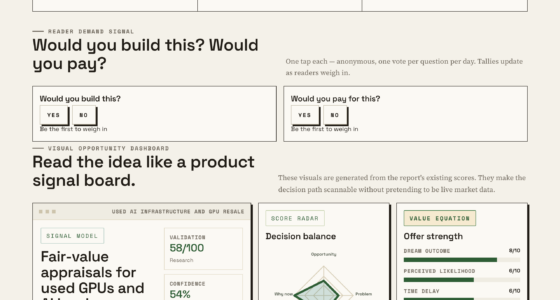

📊 Full opportunity report: The $60 Billion Bargain: Why Cursor Could Be a Steal for SpaceX on ThorstenMeyerAI.com — validation score, market gap, and execution plan.

Get privacy and security gear delivered free with Prime
- Fast, free delivery on millions of items
- Prime Video, Amazon Music and more included
- Member-only deals all year
TL;DR
SpaceX announced it is acquiring Cursor, an AI coding tool company, for $60 billion in all-stock deal. The acquisition aims to secure a profitable, fast-growing AI business and strategic control over developer workflows. The deal’s valuation appears more favorable when considering Cursor’s rapid revenue growth and in-house potential.
SpaceX has announced it will acquire Cursor, the AI coding platform, for $60 billion in all-stock. This move, announced just days after SpaceX’s IPO valuation exceeded $2 trillion, positions the aerospace giant to gain a profitable, rapidly expanding AI business with strategic implications for its future in software and AI development.
The acquisition was executed through SpaceX exercising an option to buy Cursor at a valuation of $60 billion, representing about 3.4% dilution of SpaceX’s market cap at IPO. The deal was completed entirely in SpaceX stock, which appreciated immediately following the announcement, boosting SpaceX’s valuation to nearly $2.94 trillion. Cursor, which reported roughly $4 billion in annualized revenue and is growing rapidly, is expected to reach $6 billion in revenue by 2026. The company’s revenue growth has been exponential, doubling in four months from $2 billion to $4 billion, making its valuation multiple shrink from 15x to approximately 10x forward revenue. The deal gives SpaceX access to Cursor’s profitable enterprise AI segment, developer platform, and its own coding model, Composer, built on open weights. Importantly, Cursor has turned down offers from OpenAI and Microsoft, positioning it as a key asset to limit rivals’ access to developer workflows. The acquisition also addresses Cursor’s previous reliance on third-party models, which increased costs and limited margins, by integrating its AI stack in-house, leveraging SpaceX’s own supercomputers and models from xAI. The market reaction was positive, with SpaceX’s stock rising 16%, reflecting investor confidence in the strategic value of the deal.The $60B bargain: why Cursor could be a steal
$60 billion for a code editor sounds like a bubble. Look past the headline and the price isn’t the scandal — it’s the discount. Here’s the case that SpaceX got Cursor cheap.
A melting multiple, paid in appreciating paper that cost almost nothing, for the profitable leader of the only AI category reliably making money — plus the missing app layer and an escape from the margin trap. If the growth holds and integration doesn’t break the product, $60B will read like a down payment. The risk isn’t overpaying for what Cursor is — it’s breaking what made it worth buying.
Why the Cursor Deal Could Reshape AI and SpaceX Strategy
This acquisition offers SpaceX a rare opportunity to integrate a profitable, rapidly growing AI business into its operations, potentially transforming its margins and competitive position. By owning Cursor’s developer platform, SpaceX gains a strategic foothold in enterprise AI workflows, which are crucial as AI adoption shifts from benchmarking to real-world application. The deal also blocks competitors like OpenAI and Microsoft from acquiring Cursor, strengthening SpaceX’s influence in the AI ecosystem. Additionally, the move exemplifies a broader trend of vertical integration, enabling SpaceX to reduce costs associated with third-party AI models and API fees, and to develop proprietary AI infrastructure, which could significantly improve profit margins and long-term growth prospects.
As an affiliate, we earn on qualifying purchases.
Cursor’s Rapid Growth and Strategic Positioning Before Acquisition
Cursor, founded by Anysphere, experienced a remarkable growth trajectory, reaching $2 billion in revenue by February, $3 billion by late April, and $4 billion by early June. Its exponential revenue increase—doubling in four months—set a record for the fastest growth in software history. The company leads in AI coding tools, with over a million paying users and 50,000 enterprise customers, including more than half of the Fortune 500. It also developed Composer, its own coding model, which by late 2025 was handling the majority of its work. Cursor’s strategy included turning down offers from OpenAI and Microsoft, positioning it as a key player with independence from major AI labs. Despite its growth, Cursor faced economic pressures, paying retail prices for API models while its suppliers, like Anthropic, gained market share. This reliance on external models increased costs and limited profit margins, creating an opportunity for vertical integration that SpaceX aims to capitalize on.
“This acquisition aligns with our goal to build integrated, profitable AI capabilities that support our core missions.”
— SpaceX spokesperson
As an affiliate, we earn on qualifying purchases.
Remaining Questions About the Acquisition’s Long-Term Impact
It is still unclear how effectively SpaceX will integrate Cursor’s AI platform and whether the expected margin improvements will materialize. The long-term impact on SpaceX’s core aerospace business remains to be seen, as does Cursor’s ability to sustain its rapid growth within a competitive AI landscape. Additionally, the regulatory and market response to such a high-profile, all-stock deal is yet to unfold.
As an affiliate, we earn on qualifying purchases.
Next Steps in SpaceX’s AI and Business Integration
SpaceX will likely focus on integrating Cursor’s technology into its existing infrastructure, developing proprietary AI models, and expanding its enterprise customer base. Monitoring Cursor’s revenue growth and profitability over the coming quarters will be key to assessing the deal’s success. Regulatory reviews and market reactions will also shape the deal’s long-term outcome. Further announcements on product development, AI model releases, and strategic partnerships are expected in the upcoming months.
As an affiliate, we earn on qualifying purchases.
Key Questions
Why did SpaceX buy Cursor for $60 billion?
SpaceX acquired Cursor to gain a profitable, rapidly growing AI coding platform, secure a strategic foothold in developer workflows, and prevent competitors from gaining access to this valuable asset.
How does the valuation compare to Cursor’s revenue?
Initially, the valuation was about 15x trailing revenue, but considering Cursor’s fast growth, the forward multiple is projected to fall below 10x by 2026, making the deal more attractive.
What does this mean for SpaceX’s core business?
The acquisition could enable SpaceX to develop in-house AI capabilities, reduce costs related to third-party models, and potentially improve profit margins in its software and AI operations.
Could this deal influence the AI industry?
Yes, by blocking rivals and integrating a profitable AI platform, SpaceX may reshape competitive dynamics and accelerate vertical integration trends in AI development.
What are the risks involved?
The main uncertainties include how well SpaceX can integrate Cursor, whether the projected growth continues, and how market and regulatory factors will influence the long-term value of the acquisition.
Source: ThorstenMeyerAI.com
Fall Picks
fall essentials
As an affiliate, we earn on qualifying purchases.