📊 Full opportunity report: Factory VR Trainer on IdeaNavigator AI — validation score, market gap, and execution plan.
Open a free Amazon Business account
Business pricing, bulk buying and tax-exempt orders.
Create a free accountAs an affiliate, we earn on qualifying purchases.
TL;DR
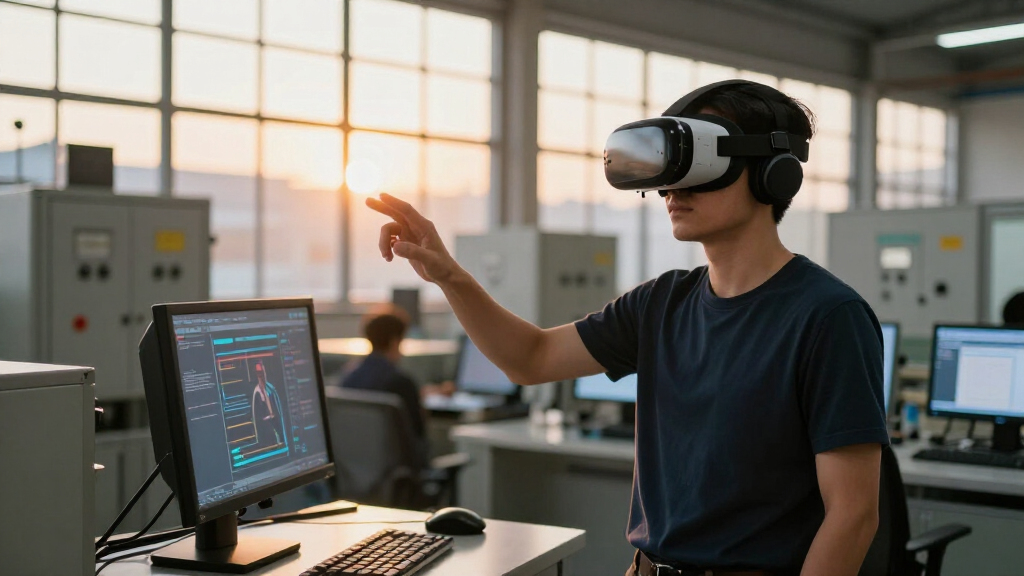
A new VR training platform is being piloted at a manufacturing plant to improve onboarding and safety compliance. The initiative targets high-risk procedures using standalone headsets and cloud tracking, with promising early results. Success could reshape industrial workforce training amidst labor shortages.
Potential Impact on Manufacturing Workforce Training
This VR training pilot could significantly reduce onboarding time and improve safety compliance, directly addressing critical labor shortages and skills gaps in manufacturing. By standardizing high-risk procedures and providing measurable performance data, companies can better ensure worker readiness and reduce incident rates. If proven effective, this approach may lead to widespread adoption across the industry, transforming traditional training paradigms and lowering costs associated with safety incidents and worker turnover.Meta Quest VR headset for industrial training
As an affiliate, we earn on qualifying purchases.
As an affiliate, we earn on qualifying purchases.
Industry Challenges Driving VR Training Development
The manufacturing sector faces a persistent labor shortage, with approximately 409,000 unfilled positions in August 2025 and a forecasted need for millions of new workers by 2033. Traditional training methods—such as classroom instruction and on-the-floor supervision—are often slow, inconsistent, and pose safety risks on live machinery. The rise of affordable, cloud-enabled XR devices like Meta Quest and Pico has opened new opportunities for immersive training deployment. The broader enterprise VR training market, valued at USD 14.55 billion in 2025, is expanding rapidly, driven by the need for scalable, effective workforce development solutions. Prior efforts have included simulation-based safety modules, but the current pilot represents a focused test of standalone VR hardware and cloud analytics for manufacturing-specific procedures.VR safety training modules for manufacturing
As an affiliate, we earn on qualifying purchases.
As an affiliate, we earn on qualifying purchases.
Unverified Outcomes and Long-Term Adoption Risks
It is not yet clear whether the VR training will deliver statistically significant improvements in hazard recognition accuracy or reduce time-to-competency compared to existing methods. The pilot’s success depends on measurable results within the 60-90 day testing window, and broader industry adoption will require demonstrating cost-effectiveness and scalability. Additionally, user acceptance and hardware durability in industrial settings remain under evaluation.standalone VR headsets for enterprise use
As an affiliate, we earn on qualifying purchases.
As an affiliate, we earn on qualifying purchases.
Next Steps for Pilot Validation and Industry Rollout
The pilot program is expected to run for 60-90 days, with initial results assessing hazard recognition scores, training duration, and supervisor feedback. If outcomes are positive, the manufacturer plans to expand the program to additional procedures and plants, potentially leading to a subscription-based deployment across multiple sites. Further research will explore long-term safety impacts, cost savings, and integration with existing training systems. Industry stakeholders will watch these results closely to determine the viability of scaling VR training solutions in manufacturing.VR training software for factory safety
As an affiliate, we earn on qualifying purchases.
As an affiliate, we earn on qualifying purchases.
Key Questions
What specific procedures are being tested with VR training?
The current pilot focuses on high-risk procedures such as lockout/tagout safety protocols, with plans to expand to other critical tasks depending on pilot success.How does the VR training compare to traditional classroom methods?
The goal is to measure whether VR reduces training time, improves hazard recognition accuracy, and increases worker readiness compared to existing classroom-based approaches.What hardware is used for the VR training?
The pilot uses standalone Meta Quest headsets, which are affordable and do not require external PCs or complex setups.How will success be measured in the pilot?
Success criteria include statistically significant improvements in hazard recognition scores, faster time-to-competency, and positive supervisor assessments, with a commitment to expand if results are favorable.Could this VR approach replace traditional safety training entirely?
While promising, it is unlikely to replace all traditional methods immediately. Instead, it is expected to complement existing training programs and serve as a scalable, standardized supplement for high-risk procedures.Source: IdeaNavigator AI
Fall Picks
fall essentials
As an affiliate, we earn on qualifying purchases.