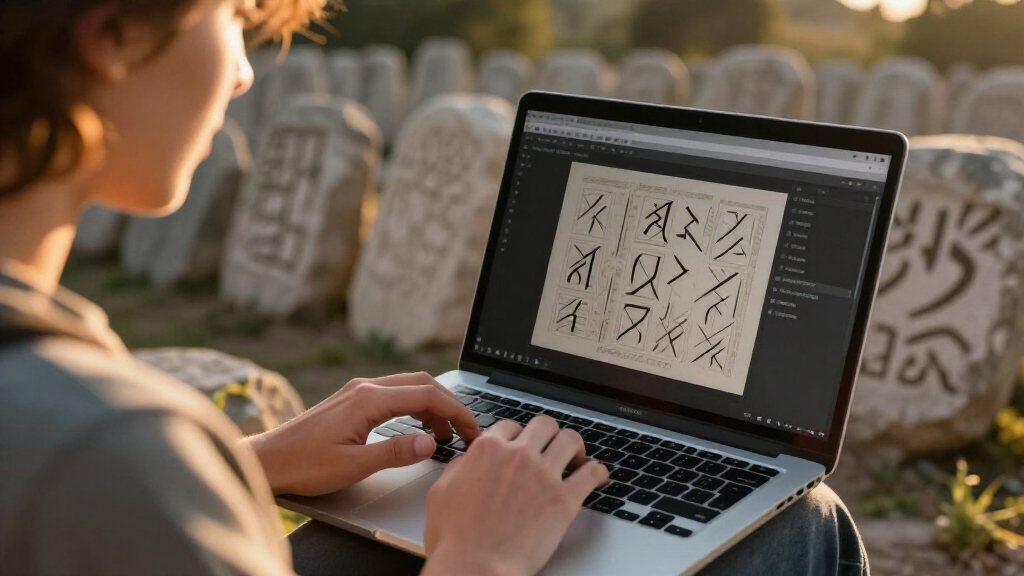

🔍 Read the full analysis: A Closer Look At AI-Driven SVG Carving: 'The Runestone Field' Uncovered on ThorstenMeyerAI.com

Get privacy and security gear delivered free with Prime
- Fast, free delivery on millions of items
- Prime Video, Amazon Music and more included
- Member-only deals all year
TL;DR
A new project demonstrates AI-driven SVG carving to animate ancient runes in ‘The Runestone Field,’ creating immersive storytelling through automation. Confirmed details reveal a blend of traditional artistry and modern technology, with ongoing development around its technical process.
Thorsten Meyer’s team has unveiled ‘The Runestone Field’, an innovative digital project that uses AI-driven SVG carving to animate ancient runes, creating an immersive storytelling experience that bridges history and modern technology. This development highlights how automation can enhance visual storytelling and artistic expression, making historical carvings come alive in a digital landscape.
The project employs precise SVG carving techniques combined with fluid animation to simulate the process of rune carving on digital stones. The animation process is powered by custom AI algorithms that automate the carving paths, allowing for detailed and dynamic visualizations of the runic inscriptions. According to Thorsten Meyer, the project was designed to explore how automation can elevate traditional craftsmanship, transforming static images into interactive narratives.
Developed as a case study, the project demonstrates the technical process behind the SVG carving animation, including the use of vector graphics and AI-guided path generation. The team reports that this approach enables detailed control over the carving process, producing visuals that resemble real stone carvings but with the flexibility of digital animation. The project’s live demonstration shows carved runes gradually emerging on digital stones, with intricate details and fluid motion that invite viewers to explore the story embedded in the carvings.
While the technical foundation appears robust, details about the specific AI models used and the full scope of automation remain undisclosed. The project aims to serve as a proof of concept for combining traditional storytelling with cutting-edge digital techniques, opening new avenues for artists and storytellers.
A Closer Look at AI-Driven SVG Carving: ‘The Runestone Field’ Uncovered
Thorsten Meyer’s team has unveiled an innovative digital project that uses AI-driven SVG carving to animate ancient runes — an immersive storytelling experience bridging history and modern technology. Custom AI algorithms automate the carving paths, letting static inscriptions emerge as living, interactive narratives.
“This project demonstrates how automation can elevate traditional craftsmanship, transforming static images into interactive narratives.”
— Thorsten MeyerWhy AI Carving Transforms Digital Storytelling
The project illustrates how AI-driven SVG carving can revolutionize digital storytelling by blending traditional craftsmanship with automation — offering a new way for artists and historians to visualize and animate ancient artifacts, making history more accessible and engaging.
Living History
Carved runes gradually emerge on digital stones with intricate detail and fluid motion, inviting viewers to explore the story embedded in the carvings.
Carving Simulation
Precise SVG carving techniques simulate the physical process of rune carving, producing visuals that resemble real stone — with the flexibility of digital animation.
Beyond the Museum
The technique could influence future digital art, education, and cultural preservation efforts, expanding visual storytelling in the digital age.
From Chisel to Code: Foundations of Runic Carving
Ancient runic carvings long served as a medium for storytelling, ritual, and record-keeping across Scandinavian and Germanic cultures. Where earlier digital efforts produced static recreations or 3D models, AI-guided SVG carving introduces a new dimension of realism and interactivity.
| Approach | Realism | Animation | Interactivity | Procedural Detail |
|---|---|---|---|---|
| Traditional Stone Carving | ✓ Authentic | ✗ None | ✗ Static | ✓ Artisan |
| 3D Modeling / Digital Archaeology | ~ Good | ~ Limited | ~ Basic | ~ Manual |
| Static Motion Graphics | ✗ Flat | ✓ Simple | ✗ Minimal | ✗ None |
| AI-Driven SVG Carving | ✓ High | ✓ Fluid | ✓ Explorable | ✓ AI-Guided |
How the AI Carving Process Works
The case study demonstrates the technical process behind SVG carving animation — from historical symbol to animated inscription.
Symbol Input
Historical runic inscriptions are selected and interpreted for digital recreation.
AI Path Generation
Custom algorithms translate symbols into precise SVG carving paths.
Vector Carving
Detailed control over the carving process simulates chisel work on digital stone.
Fluid Animation
Runes gradually emerge with motion that mirrors physical carving.
Interactive Narrative
Viewers explore the story embedded in the carvings as it unfolds.
Development Status at a Glance
The technical foundation appears robust, but transparency and scalability remain works in progress. An editorial assessment of key dimensions.
Frequently Asked, Carefully Answered
How does AI-driven SVG carving differ from traditional digital animation?
It simulates the physical process of carving into stone, producing detailed, realistic animations of inscriptions. Traditional digital animation typically relies on motion graphics or static images, lacking the procedural, carving-like appearance of AI-guided path generation.
Can this technology be used for other artifacts, or only runes?
While currently demonstrated with runic carvings, the underlying techniques can potentially be adapted for other artifacts — inscriptions, engravings, or detailed textures on various materials — depending on the AI’s ability to generate appropriate carving paths.
What are the main development challenges?
Accurately modeling the carving process, ensuring realism and detail, managing computational complexity, and building AI algorithms that can interpret complex historical symbols and translate them into precise carving paths.
Will this technology replace traditional artisans or historians?
No. The goal is to complement craftsmanship and historical research with new visualization tools — enhancing storytelling and preservation without replacing human skill and expertise.
When will it be publicly available or widely adopted?
It is currently in experimental stages. Broader availability depends on further development, testing, and validation, with technical details and applications expected in the coming months.
Open Questions & the Road Ahead
Still Unclear
- Specific AI models and algorithms remain undisclosed
- Scalability across other artifact types is unproven
- Full technical methodology and limitations under development
- Further details expected in upcoming case studies and technical reports
Next Steps
- Refine AI algorithms and increase carving complexity
- Explore interactive, user-driven customization
- Expand to other artifact types beyond runes
- Publish technical documentation and showcase at digital art and archaeology conferences
Why AI Carving Transforms Digital Storytelling
This project illustrates how AI-driven SVG carving can revolutionize digital storytelling by blending traditional craftsmanship with automation. It offers a new way for artists and historians to visualize and animate ancient artifacts, making history more accessible and engaging. The immersive experience created by this technique could influence future digital art, education, and cultural preservation efforts, expanding the possibilities of visual storytelling in the digital age.
SVG carving software for digital art
As an affiliate, we earn on qualifying purchases.
As an affiliate, we earn on qualifying purchases.
Historical and Technological Foundations of Runic Carving
Ancient runic carvings have long served as a medium for storytelling, ritual, and record-keeping across Scandinavian and Germanic cultures. Traditionally, these inscriptions were carved into stone or wood by skilled artisans, a painstaking process that preserved stories and beliefs for centuries. In recent years, digital art has sought to reinterpret these symbols, but animation remained limited to static images or simple motion graphics.
The advent of SVG (Scalable Vector Graphics) technology and AI automation has opened new possibilities for animating such artifacts. The recent project by Thorsten Meyer’s team leverages these advances to simulate the carving process digitally, creating a dynamic visual narrative that maintains the aesthetic and cultural essence of the original runes. This approach marks a significant evolution from static reproductions to interactive, animated representations that can be explored in detail.
Previous efforts in digital archaeology and art focused on 3D modeling or static recreations; however, the integration of AI-guided SVG carving introduces a new dimension of realism and interactivity, making ancient stories more vivid and engaging for modern audiences.
“This project demonstrates how automation can elevate traditional craftsmanship, transforming static images into interactive narratives.”
— Thorsten Meyer
As an affiliate, we earn on qualifying purchases.
Technical Details and Future Developments Still Unclear
Specifics about the AI models, algorithms, and automation processes used in the SVG carving remain undisclosed. It is also unclear how scalable or adaptable this technique is for other types of artifacts or storytelling formats. The full technical methodology and potential limitations are still under development, and further details are expected to be released in upcoming case studies or technical reports.
digital stone carving SVG templates
As an affiliate, we earn on qualifying purchases.
As an affiliate, we earn on qualifying purchases.
Next Steps Include Broader Testing and Public Exposure
Thorsten Meyer’s team plans to expand the project by refining the AI algorithms, increasing the complexity of carvings, and exploring interactive applications. Future developments may include integrating user-driven customization, expanding to other artifact types, and showcasing the technique at digital art and archaeology conferences. The team also intends to publish detailed technical documentation to facilitate broader adoption within the digital art community.
As an affiliate, we earn on qualifying purchases.
Key Questions
How does AI-driven SVG carving differ from traditional digital animation?
AI-driven SVG carving simulates the physical process of carving into stone, creating detailed and realistic animations of inscriptions. Traditional digital animation typically involves motion graphics or static images, lacking the procedural, carving-like appearance enabled by AI-guided path generation.
Can this technology be used for other types of artifacts or only runes?
While currently demonstrated with runic carvings, the underlying techniques can potentially be adapted for other artifacts, such as inscriptions, engravings, or detailed textures on various materials, depending on the AI’s ability to interpret and generate appropriate carving paths.
What are the main challenges in developing AI-driven SVG carving?
Challenges include accurately modeling the carving process, ensuring realism and detail, managing computational complexity, and developing AI algorithms that can interpret complex historical symbols and translate them into precise carving paths.
Will this technology replace traditional artisans or historians?
No, this technology aims to complement traditional craftsmanship and historical research by providing new visualization tools. It enhances storytelling and preservation efforts but does not replace the skill and expertise of artisans or historians.
When will this technology be publicly available or widely adopted?
It is currently in experimental stages. Broader availability depends on further development, testing, and validation. The team plans to publish technical details and showcase applications in the coming months.
Source: ThorstenMeyerAI.com
Halloween Picks
halloween
As an affiliate, we earn on qualifying purchases.