
📊 Full opportunity report: A Trust Funding Tracker For Estate Planning Professionals on IdeaNavigator AI — validation score, market gap, and execution plan.

Get privacy and security gear delivered free — and shop member deals
- Fast, free delivery on millions of items
- Access to Prime Big Deal Days deals on October 6–7
- Prime Video, Amazon Music and more included
TL;DR
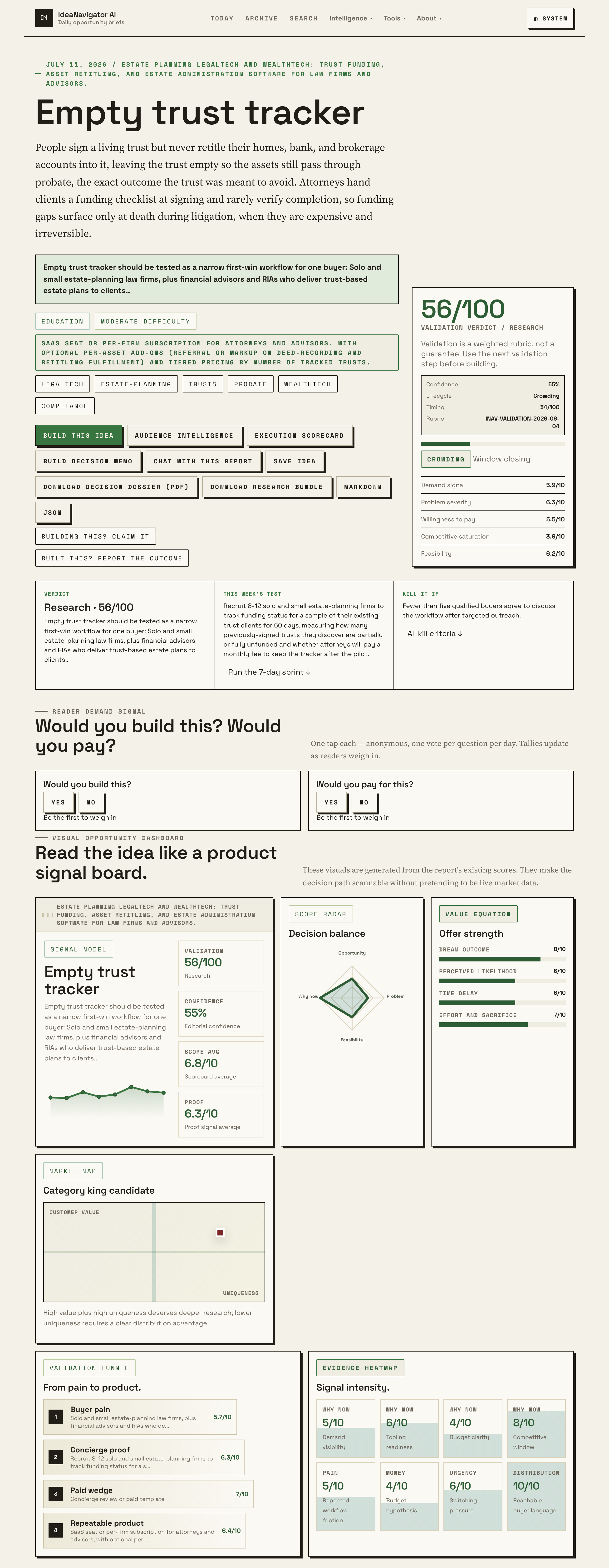
IdeaNavigator AI describes a proposed trust funding tracker for small law firms and financial advisors. The concept would record asset-by-asset progress and supporting documents, but it is a product proposal, not a launched service or validated result.
According to IdeaNavigator AI’s proposal, the tool would let a firm create a funding checklist for each trust, covering assets such as real estate, bank and brokerage accounts, business interests and beneficiary designations. Staff or clients could mark each item as pending, in progress or confirmed funded, and attach evidence such as a recorded deed or a statement showing an account was retitled.
IdeaNavigator AI says a dashboard would show the funding status of a firm’s trusts, including the share of assets confirmed funded. Automated reminders would prompt clients to complete outstanding steps. The proposal also includes subscription pricing per firm or seat, with possible add-on revenue tied to deed recording or retitling services.
IdeaNavigator AI recommends testing the concept with 8 to 12 solo and small firms over 60 days. The proposed pilot would review a sample of existing trust clients, count how many trusts appear partly or fully unfunded, and ask whether firms would pay a recurring fee. Those are suggested validation steps; the proposal identifies no participating firms, measured results or pricing commitments.
Closing the Trust Funding Gap
A signed trust may not achieve its intended purpose if assets remain titled in an individual’s name. Tracking the follow-through could give firms a way to identify unfinished funding tasks while clients can still act, rather than discovering gaps during estate administration or a dispute.
For small practices, a shared status record could make follow-up more consistent than handing over a checklist and relying on clients to report completion. For financial advisors and RIAs, the idea offers a possible administrative layer around trust-based plans. Whether firms will adopt another software subscription, and whether the tracker can reliably verify funding, remain open questions.
The Work After Signing
Trust funding generally involves changing ownership or beneficiary information so appropriate assets are connected to a trust. The proposed tracker focuses on that post-signing administrative work, which may involve separate institutions and different paperwork for each asset.
IdeaNavigator AI’s proposal says only about 11% of Americans hold a trust, but provides no survey, date range or methodology for that figure. It also points to deed-funding services priced from $250 as evidence of an existing paid market, without naming providers or specifying what those services include. These figures should be treated as claims in the proposal rather than independently documented market measurements.
Pilot Results Still Pending
IdeaNavigator AI’s description does not identify a working product, launch date, development team or pilot. It is unclear how a tracker would confirm that assets are funded across banks, brokerages, county recording systems and other institutions, or how it would handle sensitive financial documents and client permissions.
The market claims in the proposal also lack supporting methodology. The number of firms willing to pay, the time required to keep records current, and the accuracy of status reports have not been established. The suggested 60-day test would need to answer those practical questions before the business case is clear.
A Small Firm Pilot Could Test Demand
IdeaNavigator AI proposes recruiting 8 to 12 small practices and tracking a sample of existing client trusts for 60 days. The test would measure previously unrecognized funding gaps and whether participating firms would continue using the service for a monthly fee.
IdeaNavigator AI has announced no pilot start date or results. A future product assessment would need to show how firms document confirmation, protect client records and keep asset statuses updated, alongside evidence that the workflow is worth paying for.
Source: IdeaNavigator AI
Key Questions
Has the trust funding tracker launched?
No launch is reported. IdeaNavigator AI has outlined a product concept and a proposed pilot.
Who is the proposed tool for?
The concept targets solo and small estate-planning law firms, financial advisors and registered investment advisers working with trust-based plans.
What would the tracker record?
It would list assets linked to each trust, assign a pending, in-progress or confirmed-funded status, store supporting documents and send reminders.
How would the idea be tested?
The proposal calls for an eight-to-12-firm pilot lasting 60 days, measuring funding gaps found and firms’ willingness to pay for ongoing access.
Source: IdeaNavigator AI
Halloween Picks
halloween
As an affiliate, we earn on qualifying purchases.