
📊 Full opportunity report: What Can One Tiny Quest Add To OpenStreetMap? A StreetComplete Look on IdeaNavigator AI — validation score, market gap, and execution plan.

Get privacy and security gear delivered free — and shop member deals
- Fast, free delivery on millions of items
- Access to Prime Big Deal Days deals on October 6–7
- Prime Video, Amazon Music and more included
TL;DR
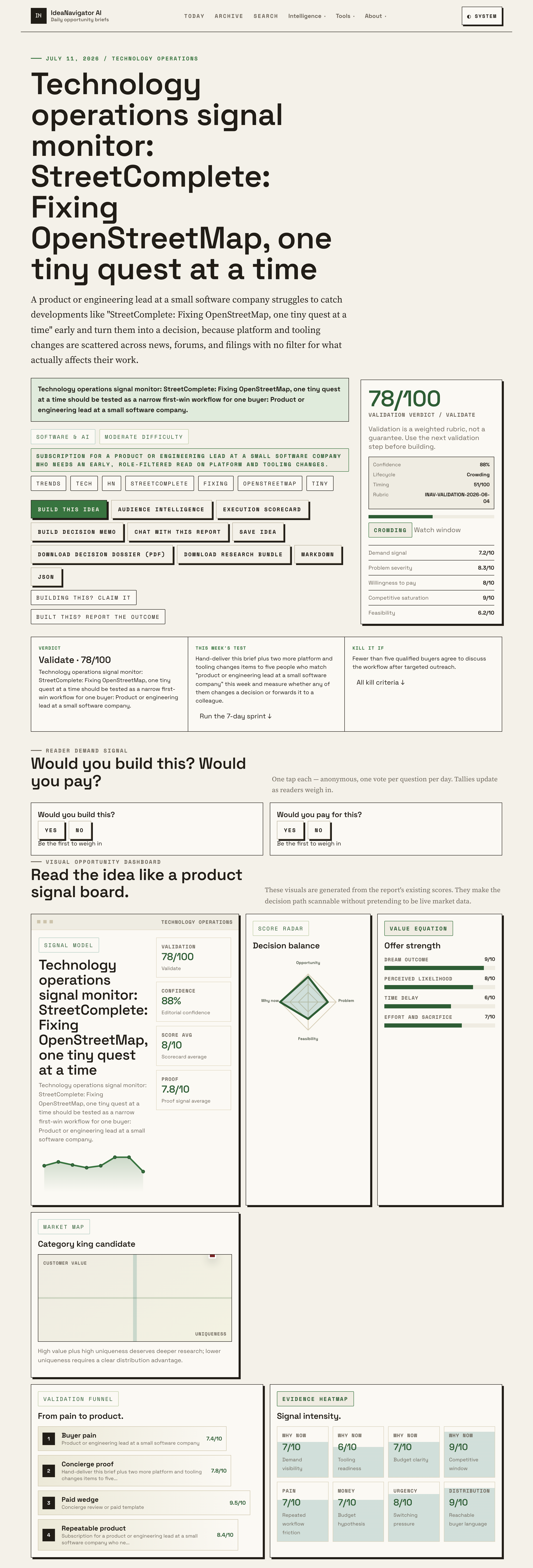
StreetComplete, a mobile app that lets volunteers answer small, targeted questions to improve OpenStreetMap, resurfaced on Hacker News with a high engagement signal. An IdeaNavigator AI brief highlights the discussion as a test case for role-filtered monitoring of platform and tooling developments.
The mobile app StreetComplete, which invites users to fix OpenStreetMap through small, single-question tasks called “quests,” resurfaced on Hacker News with an 88/100 signal score, according to a brief published by IdeaNavigator AI. The discussion highlights a contribution model — asking volunteers to answer one narrow question at a time, such as whether a shop still exists or what surface a path has — that has quietly become one of the most productive on-ramps for editing the world’s largest volunteer-built map.
StreetComplete works by scanning OpenStreetMap data around a user’s location and generating quests for missing or outdated attributes. Instead of presenting users with the full OpenStreetMap editing interface, the app asks one targeted question at a time — the opening hours of a restaurant, the type of cycle barrier on a path, or the material of a road surface. Each answered quest writes a precise, structured change back to the map database. The approach is designed to lower the barrier to contribution: no account setup complexity, no editing tools to learn, and no need to understand OpenStreetMap’s tagging system in full.
According to the IdeaNavigator AI signal monitor, the Hacker News discussion around StreetComplete registered an 88/100 signal score, placing it among higher-engagement platform and tooling items tracked by the service. The brief identifies the story’s relevance not only to the open-source mapping community but to product and engineering leads at small software companies, who face a broader problem: developments like StreetComplete’s model are scattered across news sites, forums, and filings, with no filter for what actually affects a given role.
The IdeaNavigator AI brief proposes a validation exercise: deliver this story alongside two other platform and tooling items to five people matching the target role within a week, and measure whether any of them changes a decision or forwards the brief to a colleague. That framing treats the StreetComplete discussion as a narrow first-win workflow — a single, concrete case used to test whether same-day, role-filtered reads outperform generic weekly roundups.
Why Small Tasks Move a Large Map
StreetComplete matters to readers for two reasons. First, it demonstrates that decomposing a complex contribution task into micro-tasks can dramatically widen participation in a volunteer project. OpenStreetMap traditionally required contributors to learn editing software and its tagging conventions; StreetComplete reduces that to answering questions a passerby can resolve in under a minute. Similar mechanics now appear in citizen-science projects, moderation workflows, and data-quality tooling across the software industry — a pattern directly relevant to product leads designing onboarding or contribution funnels.
Second, the story illustrates the information-overload problem the IdeaNavigator AI brief targets. Platform and tooling changes now move fast enough that a same-day, role-filtered read can beat a weekly digest, according to the brief’s reasoning. An 88/100 signal on Hacker News suggests the StreetComplete discussion reached a substantial technical audience, making it a reasonable test case for whether filtered monitoring changes real decisions.
StreetComplete’s Place in OpenStreetMap
OpenStreetMap is a collaborative project that maintains a free, editable map of the world, used by platforms including mapping services, logistics tools, and humanitarian response systems. Its data quality depends on volunteers adding and verifying attributes — surface types, access rules, opening hours — at street level. Survey-style apps like StreetComplete complement full desktop editors by handling attribute gaps rather than geometry changes. The app’s quest-based model has been discussed repeatedly in open-source and civic-technology communities, and its recurring appearance on Hacker News reflects sustained interest in low-friction contribution design rather than a single product launch.
What the Signal Score Does Not Tell Us
Several points remain unclear. The 88/100 signal score is a metric produced by IdeaNavigator AI’s monitoring system; the method for calculating it and the baseline it is measured against have not been published, so it should be read as a proprietary engagement indicator rather than an independent measure of impact. It is not clear from the available material what specifically triggered the renewed Hacker News discussion — whether a new app release, a milestone, or an organic thread. The IdeaNavigator AI brief also describes a proposed but unvalidated monitoring product; there is no confirmed evidence yet that the validation exercise with five product leads has been run, or that it changed any decisions.
Validation Runs and Community Response
According to the IdeaNavigator AI brief, the next step is a one-week validation: delivering this story and two comparable platform and tooling items to five matching product or engineering leads and measuring decision changes or forwards. On the StreetComplete side, the app continues to be developed as an open-source project, and recurring Hacker News visibility suggests continued community interest in its quest model. Readers tracking this space should watch for whether the monitoring concept moves from hand-delivered briefs to a subscription product, and whether StreetComplete’s contribution pattern is adopted more broadly in data-quality tooling.
Source: IdeaNavigator AI
Key Questions
What is StreetComplete?
StreetComplete is a mobile app that lets volunteers improve OpenStreetMap by answering small, targeted questions — called quests — about map features near them, such as a shop’s opening hours or a path’s surface. Answers are written directly back to the map database.
What is the 88/100 signal score?
It is an engagement indicator assigned by IdeaNavigator AI’s monitoring system to a Hacker News discussion of StreetComplete. The calculation method and baseline are not published, so it should be treated as a proprietary metric rather than an independent measure.
Why would a product or engineering lead care about this?
StreetComplete’s micro-task contribution model is a working example of lowering barriers to participation in a complex volunteer system — a design pattern relevant to onboarding, moderation, and data-quality workflows. The IdeaNavigator AI brief also uses the story to test role-filtered monitoring of platform and tooling changes.
Is the monitoring product described in the brief already available?
No. According to the brief, it exists as a proposed MVP with a defined validation plan — delivering briefs to five matching users and measuring decision changes — but there is no confirmed evidence the validation has been completed.
Is StreetComplete new?
No. StreetComplete is an established open-source app that has appeared repeatedly in open-source and civic-technology discussions. The current news is its resurfacing on Hacker News with a high engagement signal, not a product launch.
Source: IdeaNavigator AI
Fall Picks
fall essentials
As an affiliate, we earn on qualifying purchases.