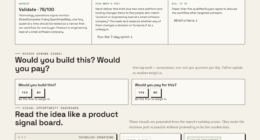
📊 Full opportunity report: What Role Does Zoning Play In Backyard Home Construction? on IdeaNavigator AI — validation score, market gap, and execution plan.

Get privacy and security gear delivered free — and shop member deals
- Fast, free delivery on millions of items
- Access to Prime Big Deal Days deals on October 6–7
- Prime Video, Amazon Music and more included
TL;DR
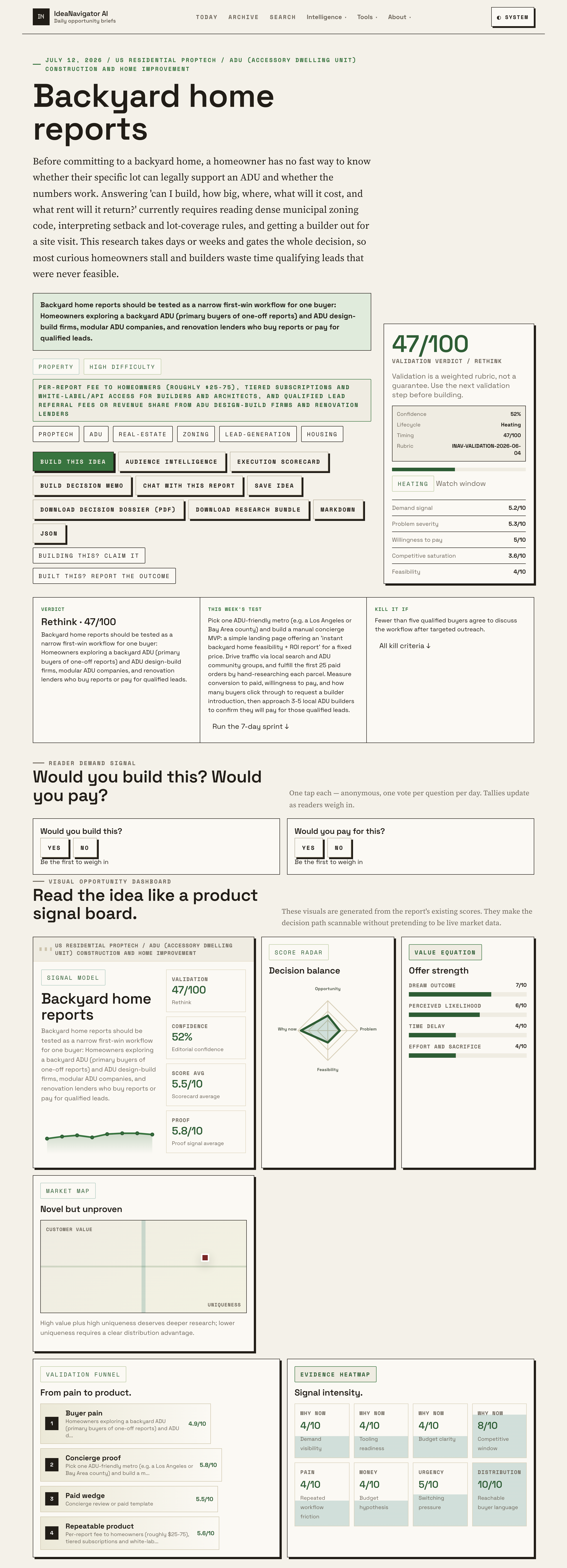
Zoning is the make-or-break factor in backyard ADU construction: setback, lot-coverage, and size rules determine whether a homeowner can legally build. A IdeaNavigator AI analysis says answering ‘can I build’ still takes days or weeks of research, stalling homeowners and wasting builder time.
Zoning rules — not financing or construction — are the first gate every homeowner hits when considering a backyard ADU (accessory dwelling unit), and answering the basic question of ‘can I build, how big, and where on my lot?’ still takes days or weeks of manual research, according to a new IdeaNavigator AI analysis. The report describes a per-address feasibility and ROI report as a narrow first-win workflow for shortening that process, targeting homeowners, ADU design-build firms, and renovation lenders.
According to the analysis, a homeowner who wants to build a backyard home currently has no fast way to determine whether their specific lot can legally support an ADU. Finding out requires reading dense municipal zoning code, interpreting setback and lot-coverage rules, and scheduling a builder site visit. Because this research gates the entire decision, the report states, most curious homeowners stall before starting, and builders spend time qualifying leads that were never feasible in the first place.
The proposed workflow is a web app where a homeowner enters a property address and pays — a band of roughly $25 to $75 per report — for a homeowner-ready PDF. The report would ingest county parcel data (lot boundaries, lot size, existing footprint) and check the lot against state ADU law plus a curated rule set for a launch market. Output would include allowed ADU types, maximum size, setback and lot-coverage constraints, a buildable-area estimate, a realistic build-cost band, and projected rental income based on local rent comps.
Additional revenue streams identified in the report include tiered subscriptions and white-label/API access for builders and architects, plus qualified lead referral fees or revenue share from ADU design-build firms and renovation lenders, via a ‘connect me with a vetted ADU builder’ option.
Why Zoning Feasibility Gates the ADU Market
The zoning bottleneck matters because the ADU market is large and growing. California legalized ADUs statewide in 2016 and has loosened rules nearly every year since, according to the analysis, and other states and cities are following. Los Angeles County alone permitted over 45,000 ADUs in 2023, and ADUs now represent roughly one in five new housing units produced in California, the report states.
Against a US housing shortage estimated in the millions of units, faster feasibility checks could convert more curious homeowners into actual builders — and keep builders from wasting effort on unworkable lots. The analysis argues that mature parcel and zoning data, combined with LLM-based code parsing, makes instant per-address feasibility reports newly practical.
How ADU Law Has Changed Since 2016
California’s statewide ADU legalization in 2016 marked the starting point of a steady loosening of rules, with amendments in nearly every subsequent legislative session, the analysis notes. That legal shift drove the surge in permitting that made ADUs a mainstream housing option rather than a niche project. Because rules now vary across thousands of municipalities — with local codes layered on top of state law — a homeowner’s answer depends heavily on their specific address, which is why the proposed report is per-parcel rather than general.
The recommended validation path, per the report, is deliberately narrow: pick one ADU-friendly metro, such as a Los Angeles or Bay Area county, hand-curate its zoning rules, and fulfill the first 25 paid orders by hand-researching each parcel before automating anything.
Unvalidated Demand and Rule-Set Limits
The feasibility-report concept is a proposal, not a proven business. Key metrics — conversion to paid, willingness to pay, and how many buyers click through to request a builder introduction — are unmeasured until the manual validation phase runs. The report itself calls for testing with a landing page and hand-fulfilled orders before any capital is committed.
It is also not yet clear whether builders will pay for the resulting leads; the analysis recommends approaching 3 to 5 local ADU builders to confirm willingness to pay, which has not occurred. Additionally, LLM-based parsing of zoning code is described as newly practical rather than proven at scale, and the accuracy of automated buildable-area and cost estimates against real permit outcomes has not been verified.
The Validation Sequence Ahead
The report outlines a concrete next step: launch a simple landing page offering an ‘instant backyard home feasibility + ROI report’ at a fixed price in one ADU-friendly metro, drive traffic through local search and ADU community groups, and fulfill the first 25 paid orders manually. After measuring conversion and lead-intent clicks, the next milestone is securing commitments from 3 to 5 local ADU builders to pay for qualified leads, then expanding the curated rule set to additional counties. Broader ADU policy loosening in states beyond California could widen the addressable market over time, though no timeline is given.
Source: IdeaNavigator AI
Key Questions
Why does zoning determine whether I can build a backyard home?
Zoning codes set the rules on ADU type, maximum size, setbacks, and lot coverage for your specific parcel. If your lot cannot satisfy those constraints, no ADU can be legally permitted regardless of budget.
How long does it take to check ADU feasibility on my own?
According to the IdeaNavigator AI analysis, researching a single lot typically takes days or weeks, because it involves reading municipal zoning code and interpreting setback and lot-coverage rules.
What would a feasibility report include?
The proposed report covers allowed ADU types, maximum size, setback and lot-coverage constraints, a buildable-area estimate, a build-cost band, and projected rental income based on local rent comps, priced at roughly $25 to $75.
Is the report service available now?
No. It is currently a proposed workflow awaiting validation; the analysis recommends fulfilling the first 25 orders manually in one launch metro before automating.
How big is the backyard ADU opportunity?
Per the analysis, Los Angeles County permitted over 45,000 ADUs in 2023, and ADUs now account for roughly one in five new housing units in California, with other states following the state’s post-2016 loosening trend.
Source: IdeaNavigator AI
Fall Picks
fall essentials
As an affiliate, we earn on qualifying purchases.