
📊 Full opportunity report: What Vendors Should Know About Consent In Youth Services on IdeaNavigator AI — validation score, market gap, and execution plan.

Get privacy and security gear delivered free — and shop member deals
- Fast, free delivery on millions of items
- Access to Prime Big Deal Days deals on October 6–7
- Prime Video, Amazon Music and more included
TL;DR
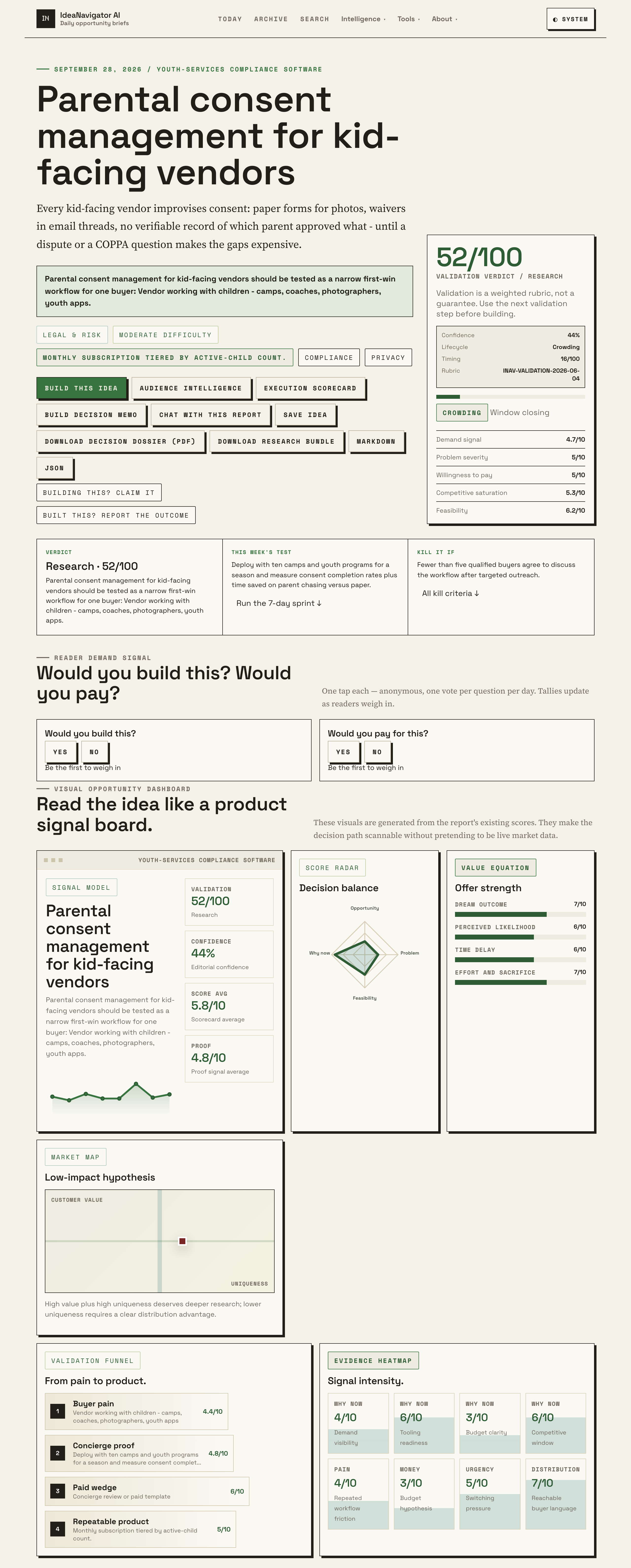
A product proposal outlines mobile parental consent records for camps, coaches, photographers and youth apps. It recommends testing the service with ten youth programs for one season; no deployment results, customer commitments or regulatory findings are provided.
A proposal for a parental consent service aimed at camps, coaches, photographers and youth apps would give parents mobile forms and vendors child-level approval records. The proposal recommends testing the workflow with ten camps and youth programs for one season, but provides no evidence that a pilot has started or that vendors have adopted the product.
The proposed service would let each vendor present branded forms on a parent’s phone. The listed permissions cover photo use, data collection, medical information and liability. The proposal does not specify form language, how vendors would tailor permissions to their activities, or how a parent could change or withdraw consent after submitting a form.
Its suggested recordkeeping features include a per-child consent ledger, expiration tracking and an audit export. Identity checks would vary according to a consent’s risk tier, though no tiers, verification methods or standards are described. Those choices would shape how much friction parents face and how confidently a vendor can establish who approved a request.
The business model proposed is a monthly subscription priced by active-child count. To assess whether the workflow solves a practical problem, the proposal calls for a seasonal pilot with ten camps or youth programs. It identifies two measures: consent completion rates and staff time spent following up with parents compared with paper forms. No pricing, pilot partners, results or customer research are included.
Records Could Ease Consent Tracking
Small organizations that work with children may collect approvals through paper forms, email and other separate channels. A single record for each child could make it easier for staff to check whether a particular permission is current before using a photo or handling information. An exportable record could also help a vendor answer questions about what a parent approved and when.
That potential depends on the quality of the records and the way permissions are presented. A digital ledger does not, by itself, show that a request was clear, that the right adult approved it, or that a vendor used information within the agreed scope. Expiry reminders may help staff identify outdated approvals, but the proposal gives no evidence yet that the suggested features reduce disputes or administrative work.
For buyers, the commercial question is whether the service fits seasonal operations and varied consent needs at a price they will pay. A camp may handle medical and liability forms, while a photographer may primarily need permissions for image use. Testing several types of youth programs could reveal whether one product can serve them well or whether each needs different forms and controls.
A Proposed Test for Youth Programs
The proposal frames the problem as an informal consent process: vendors may use paper forms, email threads or other records that make it difficult to see which parent approved which use. It says those gaps can become costly during a dispute or a question about children’s privacy. No case studies, survey findings or examples of specific disputes accompany that description, so the scale of the problem is not established here.
It also points to changes in children’s privacy rules, including updates to the U.S. Children’s Online Privacy Protection Rule, commonly called COPPA, and state laws. The proposal does not name particular laws, enforcement actions or compliance duties. Requirements can depend on the service, the information collected and the organizations involved; a consent platform would not itself establish that a vendor complies with applicable law.
The suggested first step is deliberately limited to vendors serving children, rather than a broad compliance platform for every sector. A single-season trial would let organizers compare digital completion and follow-up effort with their existing paper process. The proposal does not identify a launch date, software provider, participating programs or a method for independently checking the pilot’s measurements.
Adoption and Safeguards Remain Unknown
No product launch or pilot results are reported. It is not clear whether any camps or youth programs have agreed to participate, how the service would verify a parent’s identity, or what evidence it would retain. The proposal also does not explain where records would be stored, who could access them, how long they would be kept, or how vendors and families could correct mistakes.
The meaning of “risk tier” is also unspecified. Without criteria, it is not possible to judge whether identity checks would be proportionate to the permission requested or consistent across vendors. The proposal does not set out how consent would work for separated guardians, disputed authority, emergencies or families with limited access to smartphones.
Claims about expanding enforcement and rising parent challenges are not supported with dates, figures or cited examples in the proposal. The relevant legal requirements and the demand for a paid service would need separate validation. It remains unknown whether vendors would pay by active-child count, what the subscription would cost, or whether the service would save more staff time than it takes to set up and maintain.
Pilot Measures Will Test Demand
The next proposed step is to recruit ten camps and youth programs for a season-long test. The pilot would track how many families complete consent and how much time staff spend chasing approvals compared with paper-based workflows. To make those results useful, organizers would need to define the measurement period, establish a paper-process baseline and account for differences in program size and permission type.
Further product decisions would include setting verification levels, writing permission and withdrawal flows, establishing retention and access rules, and determining subscription prices. The proposal does not provide a schedule for those decisions or say when results might be released. Until a pilot is conducted and its methods and findings are reported, the service’s effect on completion, staff workload and vendor demand remains untested.
Source: IdeaNavigator AI
Key Questions
Has a consent platform for youth vendors launched?
The proposal describes a possible service, but it does not report a launch, named provider or participating customers.
What would the proposed service manage?
It would collect mobile parental approvals for photo use, data collection, medical information and liability, then keep child-level records with expiry tracking and audit exports.
How would the proposal be tested?
It recommends a one-season pilot with ten camps and youth programs, measuring consent completion and staff time spent following up with parents compared with paper forms.
Would using the service establish legal compliance?
No such conclusion is provided. The proposal does not analyze specific legal requirements, and a recordkeeping tool alone would not establish that a vendor meets obligations that apply to its activities.
Source: IdeaNavigator AI
Fall Picks
fall essentials
As an affiliate, we earn on qualifying purchases.