
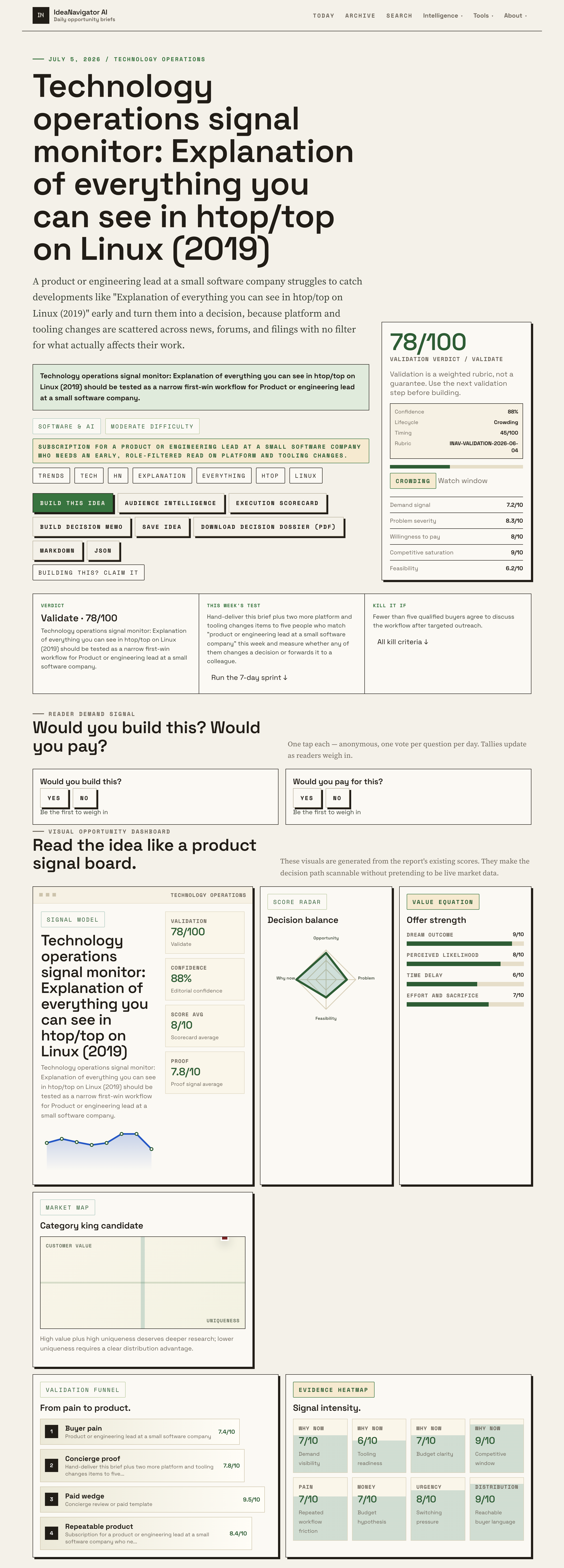
📊 Full opportunity report: Technology Operations Signal Monitor: Explanation Of Everything You Can See In Htop/top On Linux (2019) on IdeaNavigator AI — validation score, market gap, and execution plan.

Get privacy and security gear delivered free with Prime
- Fast, free delivery on millions of items
- Prime Video, Amazon Music and more included
- Member-only deals all year
TL;DR
This article explains what the ‘h’ key does in Linux monitoring tools such as htop and top. It clarifies the confirmed functions, their relevance, and what remains uncertain for users.
The ‘h’ key in Linux system monitoring tools like htop and top is confirmed to open help menus or toggle display options, aiding users in navigating system metrics. This functionality is essential for product and engineering leads to quickly access relevant information during system diagnostics and performance monitoring. Monitoring supply chain operations can also be crucial, as highlighted in recent trade and supply-chain alerts.
Linux system monitors such as htop and top are widely used by developers and system administrators to observe real-time system metrics. You can learn more about PeerTube as a decentralized platform for hosting and sharing videos. When pressing the ‘h’ key, users typically invoke a help menu or toggle specific display options, depending on the tool version. According to official documentation and user reports, in htop, ‘h’ generally opens the help screen that explains available commands and shortcuts, whereas in top, ‘h’ often toggles the help display or configuration options.
This functionality allows users to quickly access guidance without leaving the terminal, streamlining troubleshooting and system analysis workflows. The behavior of ‘h’ can vary slightly between versions and configurations, but its core purpose remains consistent: providing immediate access to help or display options to improve user efficiency.
Why the ‘h’ Key Functionality Is Critical for System Monitoring
Understanding what the ‘h’ key does in Linux monitoring tools is vital for product and engineering leads who rely on these tools for system diagnostics. Quick access to help menus or display toggles enhances operational efficiency, especially during critical performance issues or system failures. Clarifying this function reduces user confusion and ensures consistent usage across different environments, contributing to faster troubleshooting and more reliable system management.
Linux system monitoring tools htop
As an affiliate, we earn on qualifying purchases.
As an affiliate, we earn on qualifying purchases.
Role of Keyboard Shortcuts in Linux Monitoring Tools
Tools like htop and top have become standard for real-time system monitoring in Linux environments. These tools support keyboard shortcuts to improve usability, allowing users to access menus, toggle views, or configure displays rapidly. The ‘h’ key is among the most common shortcuts, historically used to invoke help or toggle help screens. Variations in behavior across versions reflect ongoing updates to these tools, but the core purpose remains consistent: facilitating quick user guidance during system monitoring tasks.
“Pressing ‘h’ in htop always brings up the help menu, which is essential when you’re trying to remember all the shortcuts on the fly.”
— an experienced Linux user
As an affiliate, we earn on qualifying purchases.
Variations and Limitations of the ‘h’ Key Functionality
While it is confirmed that ‘h’ generally opens help menus or toggles display options, the exact behavior can vary between htop versions and configurations. It is not yet clear how recent updates or custom setups might alter this function, and some users report differences between Linux distributions. Additionally, the behavior of ‘h’ in other monitoring tools remains less documented, creating uncertainty about its universal applicability.
As an affiliate, we earn on qualifying purchases.
Monitoring Tool Updates and User Guidance Improvements
Future updates to Linux monitoring tools like htop and top are expected to clarify and standardize the behavior of keyboard shortcuts such as ‘h’. Developers may also enhance help menus or integrate more contextual guidance within the tools. For users, staying informed about version-specific behaviors and official documentation will be crucial for effective system monitoring.
As an affiliate, we earn on qualifying purchases.
Key Questions
What exactly does pressing ‘h’ do in htop?
In htop, pressing ‘h’ typically opens the help menu that explains available shortcuts and commands, aiding users in navigating the tool efficiently.
Does the ‘h’ key have the same function in all Linux monitoring tools?
No, the behavior of ‘h’ varies between tools like htop and top, and may differ across versions or configurations.
Can the ‘h’ key be customized in these tools?
Some tools allow customization of keyboard shortcuts through configuration files, but default behaviors for ‘h’ are generally fixed and documented.
Why is understanding the ‘h’ key important for system administrators?
Knowing what the ‘h’ key does helps administrators access help menus quickly, reducing troubleshooting time and improving operational efficiency.
Are there risks in relying on the ‘h’ key for help in these tools?
There are no inherent risks; however, variations in behavior across versions mean users should consult official documentation for their specific environment.
Source: IdeaNavigator AI
Columbus Day / Indigenous Peoples' Day Picks
long weekend sales
As an affiliate, we earn on qualifying purchases.