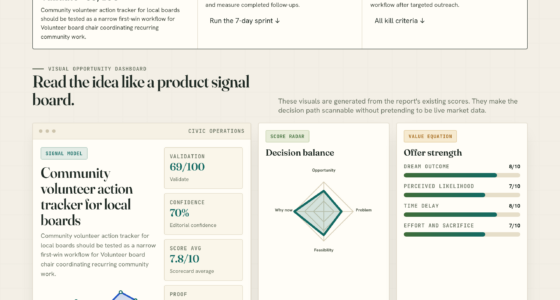

📊 Full opportunity report: The Power Of Strategic Logistics Spaces In Civic Engagement Efforts on IdeaNavigator AI — validation score, market gap, and execution plan.

Get privacy and security gear delivered free — and shop member deals
- Fast, free delivery on millions of items
- Access to Prime Big Deal Days deals on October 6–7
- Prime Video, Amazon Music and more included
TL;DR
A nonprofit is testing a dedicated logistics workspace to improve planning and execution of citizens’ assemblies. This could address current manual challenges and enable scaling civic engagement efforts.
A civic-dialogue nonprofit is testing a new logistics workspace designed specifically for organizing citizens’ assemblies, aiming to streamline participant recruitment, scheduling, and reporting. This development addresses a critical bottleneck faced by small organizations and could significantly improve the scalability of deliberative democracy initiatives.
The nonprofit is developing a guided event-operations platform that takes a participant roster from recruitment through demographic balancing, session scheduling, and attendance tracking, culminating in a final report. This prototype is being validated by recruiting five coordinators planning upcoming forums, who will run their workflows within the platform to assess usability and willingness to pay. Currently, coordinators manage these tasks manually using spreadsheets and email, which limits their capacity to scale as demand increases.
The initiative is motivated by the rising demand from funders and local governments for citizens’ assemblies, which often overwhelm small nonprofits with logistical challenges. The platform’s revenue model involves a per-program subscription billed to organizing nonprofits, aiming to provide a sustainable, scalable solution for civic engagement efforts.
Impact of Logistics Tools on Civic Engagement Scalability
This development could transform how civic organizations manage deliberative forums, reducing administrative burdens and enabling organizations to handle more events simultaneously. Improved logistics workflows may lead to broader participation, better demographic representation, and more consistent reporting, strengthening the legitimacy and impact of citizens’ assemblies. As civic engagement scales, these tools could foster more inclusive and effective democratic processes.
As an affiliate, we earn on qualifying purchases.
Growing Demand for Citizens’ Assemblies and Logistical Challenges
Recent years have seen increased funding and political interest in deliberative democracy, with local governments and funders commissioning citizens’ assemblies to address complex issues. However, the small nonprofits responsible for organizing these forums face persistent logistical hurdles, including participant recruitment, demographic balancing, facilitator scheduling, and post-event reporting. Currently, these tasks are managed manually, limiting scalability. The proposed logistics workspace aims to address these inefficiencies and meet the rising demand for participatory governance.
“The manual handling of logistics significantly constrains the capacity of small civic organizations to scale their deliberative efforts.”
— an anonymous researcher
citizens' assembly logistics software
As an affiliate, we earn on qualifying purchases.
As an affiliate, we earn on qualifying purchases.
Unresolved Questions About Platform Effectiveness and Adoption
It is not yet clear how well the prototype will perform in real-world settings or whether coordinators will adopt it widely. The pilot phase will reveal usability, willingness to pay, and actual impact on workflow efficiency, but results are still pending. Long-term scalability and integration with existing civic engagement infrastructure remain to be evaluated.
participant recruitment and scheduling tool
As an affiliate, we earn on qualifying purchases.
As an affiliate, we earn on qualifying purchases.
Next Steps Include Broader Testing and Evaluation
The nonprofit plans to complete pilot testing with the five recruited coordinators, gather feedback, and refine the platform. If successful, the next phase will involve wider deployment, additional feature development, and exploring partnerships with other civic organizations. Monitoring adoption rates and measuring improvements in logistical efficiency will be key indicators of success.
event reporting and attendee tracking software
As an affiliate, we earn on qualifying purchases.
As an affiliate, we earn on qualifying purchases.
Key Questions
How will this logistics workspace improve civic engagement?
The platform aims to streamline organizing citizens’ assemblies, reducing manual work and enabling organizations to handle more events efficiently, potentially increasing participation and representation.
Who will pay for this platform?
The model involves a per-program subscription billed to the nonprofit organizations that organize the civic forums.
What are the main challenges in scaling this solution?
Key challenges include ensuring the platform’s usability in diverse settings, securing widespread adoption, and integrating it with existing civic infrastructure.
When will the platform be available for broader use?
The current pilot is ongoing; if successful, wider deployment could follow within the next year, depending on feedback and refinement.
Source: IdeaNavigator AI
Halloween Picks
halloween
As an affiliate, we earn on qualifying purchases.