
📊 Full opportunity report: Micro-agency Proposal Scope Checker on IdeaNavigator AI — validation score, market gap, and execution plan.

Get privacy and security gear delivered free with Prime
- Fast, free delivery on millions of items
- Prime Video, Amazon Music and more included
- Member-only deals all year
TL;DR
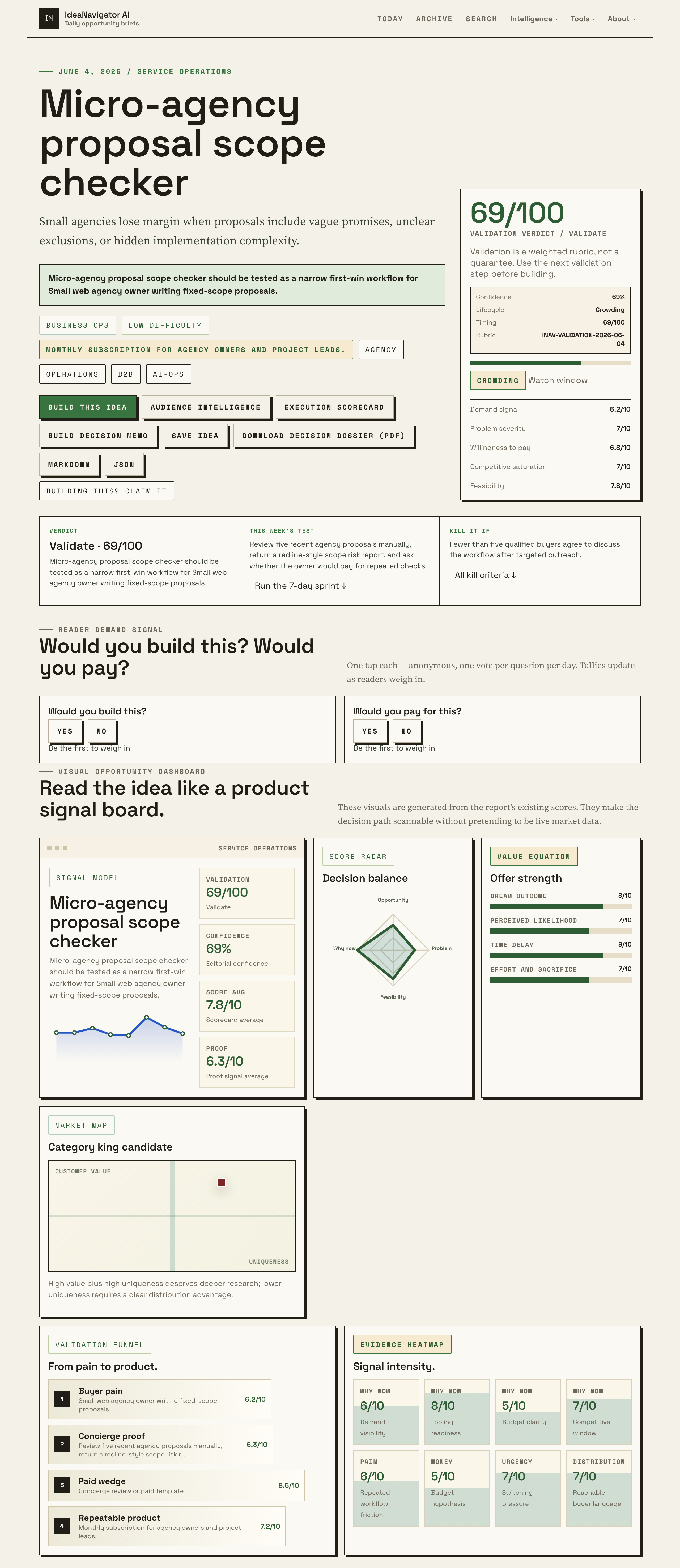
A prototype AI tool designed for small web agencies is being tested to identify scope risks in proposals. It aims to reduce margin loss caused by vague promises and hidden complexities. The project is in early validation stages.
IdeaNavigator AI has begun testing a prototype scope checker tool aimed at small web agencies. The tool reviews draft proposals to flag vague deliverables, missing assumptions, and risky integrations before client review. This development could help agencies protect margins and improve proposal clarity, addressing common issues with scope creep and hidden complexities.
The proposed tool, called the Micro-agency proposal scope checker, is designed specifically for small web agencies that often struggle with unclear scope definitions in fixed-price proposals. It uses AI to compare draft proposals against reusable delivery checklists, highlighting scope risks such as vague promises, missing assumptions, and risky integrations. The initial MVP involves a proposal upload interface that generates a redline-style report of potential issues.
According to an anonymous researcher involved in the project, the goal is to validate whether agency owners find value in repeated scope checks by reviewing five recent proposals manually and testing the tool’s ability to flag risks. Revenue would be generated through a monthly subscription model targeted at agency owners and project leads. The market focus is service operations within small web agencies, where margins are often squeezed by scope ambiguities.
The project is currently in early validation, with no public launch announced. The team plans to refine the tool based on user feedback before expanding its capabilities or commercial availability.
Why Small Agencies Need Better Scope Management
This development matters because small web agencies often lose margins due to scope creep, unclear deliverables, and hidden complexities in proposals. An AI-based scope checker could serve as a critical quality control step, reducing risk and increasing profitability. It also offers a scalable way for agencies to standardize proposal reviews, potentially transforming how they manage project scope and client expectations.
As an affiliate, we earn on qualifying purchases.
Background on Scope Risks in Small Web Agencies
Many small web agencies rely on fixed-scope proposals to secure projects but face challenges with scope creep and unanticipated complexities during delivery. Traditionally, scope risks are identified through manual review, which can be time-consuming and inconsistent. Recent advances in AI have enabled tools that can automate parts of this process, offering the potential for more reliable and efficient scope management. The idea of an AI-driven scope review is gaining interest as agencies seek to protect margins and improve proposal clarity.
The concept of automated scope checking is emerging amid broader trends toward AI-assisted project management and proposal automation in the service industry. The initial testing phase by IdeaNavigator AI marks a step toward validating whether such tools can deliver measurable value in real-world agency workflows.
“The goal is to help small agencies identify scope risks early, before proposals are sent to clients, reducing misunderstandings and margin loss.”
— an anonymous researcher
AI scope risk checker for agencies
As an affiliate, we earn on qualifying purchases.
As an affiliate, we earn on qualifying purchases.
Unclear Aspects of the Scope Checker’s Effectiveness
It is not yet confirmed how accurately the AI tool will identify scope risks across diverse proposal formats or how much it will improve margins in practice. The effectiveness of the redline reports and user acceptance are still being evaluated in the early testing phase. Additionally, the long-term commercial viability and integration into existing agency workflows remain uncertain.
As an affiliate, we earn on qualifying purchases.
Next Steps for Validation and Deployment
The team plans to complete initial testing by reviewing five recent proposals and gathering feedback from agency owners. Based on these insights, they will refine the tool’s algorithms and user interface. If validation proves successful, a pilot launch could follow within the next few months, with broader availability contingent on further development and market interest.
As an affiliate, we earn on qualifying purchases.
Key Questions
How will the scope checker improve proposal accuracy?
The tool analyzes draft proposals against predefined checklists to flag vague promises, missing assumptions, and risky integrations, helping agencies refine their scope before client review.
Who is the target user for this tool?
Small web agency owners and project leads who prepare fixed-scope proposals and want to reduce scope-related risks and margin losses.
Is this tool available for use now?
No, it is currently in early testing and validation. A public or commercial launch has not yet been announced.
What is the pricing model for the scope checker?
The plan is to offer a monthly subscription for agency owners and project leads, but pricing details are still being finalized.
Will the tool integrate with existing proposal software?
Integration plans are still under development, but the MVP focuses on proposal uploads for initial testing. Future versions may include direct integration with common proposal platforms.
Source: IdeaNavigator AI
Columbus Day / Indigenous Peoples' Day Picks
long weekend sales
As an affiliate, we earn on qualifying purchases.